Author: Zex PRwire

  • Global Tech Leaders Unite to Shape the Future of Blockchain and Web3 Innovation

    Wyoming, US, 23rd February 2026, ZEX PR WIRE, Following the successful event at Abu Dhabi, Riyadh is also going to become the “Mecca of Blockchain” as the Global Blockchain Show is making its comeback there. The global event shall take place on the 29-30th of June 2026 in Riyadh and will commemorate the attendance of industry stalwarts and thought leaders across the Web3 industry. It will provide an innovative platform where cutting-edge technologies will collide with the worlds of business and finance.

    Organized by VAP Group in collaboration with the Times of Blockchain, the Global Blockchain Show is anticipated to gather over 10,000 delegates, in addition to more than 250 speakers, 200 exhibitors, and 300+ media representatives. The event will provide a platform to its delegates through keynote lectures, panels, and workshops, which provide an opportunity to have direct exposure to the latest tools and platforms available in the blockchain world.

    Speakers who have previously spoken at the event include a prestigious list of international leaders and blockchain innovators. H.E. Justin Sun, Ambassador and former Permanent Representative of Grenada to the WTO, Founder of TRON, HTX, and Liberland, and Yat Siu, Co-Founder and Executive Chairman of Animoca Brands, have all taken to the podium. Then there is Ahmed Bin Sulayem, who is the Executive Chairman and CEO of the Dubai Multi Commodities Centre (DMCC), and also John Lilic, who is the CEO of Hilbert Group.

    Speakers included Dr. Marwan Alzarouni, CEO of Dubai Blockchain Center & CEO of AI at Dubai Economy & Tourism, and Jason Allegrante, Chief Legal & Compliance Officer at Fireblocks. Rachel Conlan, CMO at Binance; Sunny Lu, CEO of VeChain; Abdulla Al Dhaheri, CEO at Abu Dhabi Blockchain Center; and investor Murad Mahmudov have also contributed to this successful event.

    The event agenda presents two power-packed days of forward-thinking discussions, expert-led sessions, and networking opportunities designed to explore the evolving landscape of blockchain, Web3, and emerging technologies. Attendees will engage with thought leaders, innovators, and pioneers shaping the next generation of the digital economy.

    Key highlights include:

    • In-depth Panels & Keynotes: Covering topics such as blockchain innovation, scalability, security, and real-world adoption across industries.
    • Technology Insights: Exploring intersections with artificial intelligence, quantum computing, and the metaverse to understand the next wave of digital transformation.
    • Ecosystem Development: Examining collaborative strategies that drive global Web3 growth, infrastructure advancement, and sustainable innovation.
    • Networking Opportunities: Facilitating meaningful connections among policymakers, entrepreneurs, investors, and technology enthusiasts.

    Across both days, the agenda delivers a comprehensive look at how decentralization, creativity, and technological progress are redefining the future of digital economies worldwide.

    As Riyadh transforms itself into a hub for tech advancement, the Global Blockchain Show reinforces the city’s commitment to supporting emerging technologies and fostering global collaboration. The mix of expertise, innovation, and opportunity makes the Global Blockchain Show an unmissable event on the tech calendar.


    Inquiries: 

    contact: Media@globalblockchainshow.com
  • AgriFi Launches Real Yield DeFi Platform Backed by Agricultural Productivity

    Estonia, 21st February 2026, ZEX PR WIRE, AgriFi, the blockchain-based agricultural finance ecosystem built on the Polygon network, has introduced its structured DeFi staking framework designed to align blockchain rewards with measurable agricultural productivity.

    Unlike conventional yield farming systems that rely primarily on token emissions, AgriFi’s staking architecture operates under what it defines as a Fair Yield Economy, where participation rewards are linked to ecosystem performance rooted in real farming activity.

    This milestone reflects AgriFi’s 2026 objective of building a transparent Agricultural DeFi infrastructure where digital finance mechanisms are anchored to productive land, verified farm data, and operational revenue.

    Redefining DeFi Staking Around Real Economic Output

    Most staking systems in decentralized finance are structured around supply expansion or liquidity mining incentives. While these models can drive participation, they are often disconnected from real-world productivity.

    AgriFi’s architecture introduces a structurally different framework.

    The AGF token, an ERC 20 asset operating on Polygon with a fully circulating supply of 7.2 billion tokens, functions within a broader agricultural finance ecosystem. Staking is not positioned as speculative yield farming. Instead, it operates as a structured participation layer linked to ecosystem performance.

    The underlying principle is straightforward:

    Blockchain rewards should reflect measurable economic activity.

    Within AgriFi’s model, that activity originates from agricultural production, farmland participation structures, and ecosystem-level revenue logic.

    How AgriFi’s Blockchain Staking & Profit Model Works 

    Staking Module

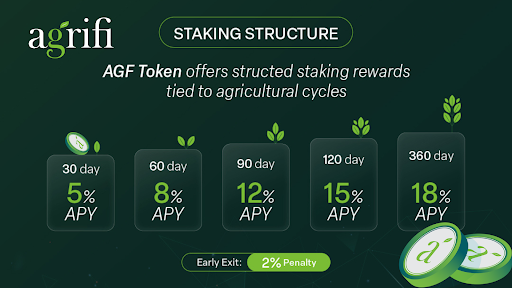
    Token holders can lock their AGF tokens for periods ranging from 30 to 360 days, earning competitive yields of 5%–18% APY.
    Smart contracts automatically calculate rewards based on staking duration and redistribute them directly to users’ wallets.
    An early exit penalty of 2% ensures long-term ecosystem stability and consistent capital flow.

    Profit Distribution Module

    Beyond staking, AgriFi’s Profit Distribution Module converts farm revenues, such as crop sales and lease income, into stablecoins (e.g., USDC) and allocates them proportionally to AGF holders.
    This creates a dual-income structure where investors benefit from both DeFi yield and real-world agricultural profits.

    This establishes a dual participation structure where AGF holders may engage in both staking mechanics and agricultural performance participation, subject to ecosystem conditions.

    All distribution logic is governed by smart contracts and remains on-chain and verifiable.

    1. Transparency Through Smart Contracts: All staking data, farm yields, and revenue flows are verifiable on the Polygon blockchain, ensuring full traceability from the field to the token holder.
    2. Farmer Capital Access: By enabling fractional investment through tokenized farmland, AgriFi allows farmers to raise funds transparently while sharing returns with global stakeholders.

    From Field Performance to On-Chain Reward Logic

    The defining strength of AgriFi’s staking model lies in its economic linkage between agriculture and blockchain.

    The ecosystem architecture operates across three primary layers:

    Blockchain Layer
    Records token ownership, staking participation, governance logic, and smart contract execution.

    Business Logic Layer
    Manages farmland tokenization structures, allocation formulas, and reward calculations.

    Off-Chain Operational Layer
    Integrates agricultural activity, farm management systems, and IoT data inputs.

    Revenue generated through agricultural activities and ecosystem participation influences the broader performance logic of the platform. That performance logic informs the sustainability and allocation of staking rewards.

    In simplified structural terms:

    Farm productivity influences ecosystem revenue
    Ecosystem revenue influences distribution capacity
    Distribution capacity influences staking sustainability

    This framework establishes a direct pathway between real agricultural output and decentralized finance participation.

    Importantly, staking returns are performance-linked and ecosystem dependent. They are not fixed-income guarantees. This distinction preserves structural integrity and regulatory clarity.

    Agricultural DeFi Within the Real World Asset Movement

    The tokenization of real world assets has become one of the defining themes in decentralized finance. Treasury instruments, real estate, and private credit have gained attention. Agriculture, despite being foundational to global economic stability, has remained structurally underrepresented.

    AgriFi’s staking framework introduces a clear model for integrating agricultural productivity into DeFi reward mechanics.

    Rather than treating farmland as a static digital token, the ecosystem embeds agricultural output into staking participation, governance structures, and ecosystem incentives.

    This approach positions agricultural finance as a distinct and credible category within the broader real world asset evolution.

    Infrastructure Built for Accessibility

    Operating on Polygon enables low transaction costs and high throughput. Wallet compatibility includes MetaMask and WalletConnect, allowing participants to engage directly with staking contracts.

    All staking logic remains on chain and independently verifiable, reinforcing transparency and trust.

    About Agrifi

    Agrifi is driving an agricultural revolution, harnessing blockchain technology to transform the agricultural supply chain. Our mission is to enhance transparency, efficiency, and sustainability in agriculture while empowering farmers and supporting small-scale agricultural practices.

    Join us on this exciting journey to explore the future of agriculture while potentially enhancing the value of your AGF tokens. We’re not just redefining agricultural finance; we’re revolutionizing the future of farming and food production.

    Ready to start staking your AGF tokens? Visit our website at https://agrifi.tech/for detailed steps on how to stake your tokens. Stay connected with us on Telegram, Twitter, Facebook and Instagram for the latest updates and community discussions.

    Follow Us on:

  • Bernardo Arsuaga Cardenas on Emerging Trends That Matter to Everyday People

    Bernardo Arsuaga Cardenas of Monterrey, Mexico breaks down key trends shaping how we work, create, and tell stories in a changing world.

    Monterrey, Mexico, 21st February 2026, ZEX PR WIRE, Award-winning filmmaker and storyteller Bernardo Arsuaga Cardenas is highlighting several recent trends that are affecting individuals across industries, careers, and communities. Drawing from his own experience moving from law to documentary filmmaking, Bernardo offers insight into what these trends mean for everyday people and how they can respond with practical action.

    Bernardo Arsuaga Cardenas

    Trend 1: Creative Work Is Becoming More Accessible — and More Competitive

    More people than ever are creating videos, podcasts, short films, and digital content. Easy online tools and platforms mean anyone can publish, but that also means more noise and more competition for attention.

    • More than 90% of internet users watch video content weekly.

    • Independent creators now number in the tens of millions worldwide.

    In Bernardo’s words, “A good story opens doors, but only if someone takes the time to tell it right.”

    Trend 2: Storytelling Is More Valuable Than Ever in Work and Life

    Across fields, the ability to communicate clearly has shifted from a “nice-to-have” to a core skill. Whether pitching an idea, presenting a project, or sharing a life experience, strong storytelling builds connection.

    “My goal in filmmaking is to make people sit down, forget about themselves, and enjoy a story,” Bernardo says. Simple, relatable narratives resonate.

    Trend 3: People Are Seeking Depth Over Distraction

    There’s a growing desire for meaningful content that helps people reflect, learn, or feel something real. Short, surface-level content still grows fast, but deeper work earns lasting engagement.

    Bernardo believes this reflects a need for substance: “Ideas die when they stay abstract. Plans keep them alive.”

    Trend 4: Collaboration Across Fields Fuels Opportunity

    People who work with others outside their comfort zone — different industries, backgrounds, or skill sets — open unexpected doors. Bernardo’s collaborations with musicians, chefs, and athletes demonstrate how cross-disciplinary work expands audience reach.

    What This Means for You — in Plain Language

    These trends show that while tools are easy to access, real influence comes from clarity of idea and consistency of effort. Bernardo puts it simply: “Finish what you start, even if it’s imperfect.” When you invest time into a clear story, idea, or skill — and share it with others — you build value that lasts beyond trends.

    Your Next 7 Days — Actions You Can Take This Week

    1. Write a short narrative (about your week, a project, or a goal) and share it with someone.

    2. Watch one long-form documentary instead of scrolling social media.

    3. Pick one idea you’ve put off and write a first step.

    4. Talk to a neighbor or colleague about something they’re passionate about.

    5. Record a short video sharing something you learned recently.

    6. Organize your notes or sketches into one simple outline.

    7. Attend a local event — even online — that focuses on creativity or craft.

    Your Next 90 Days — Longer Actions for Growth

    1. Start a storytelling project (journal, mini documentary, blog, or podcast).

    2. Build a small network of collaborators — aim for three people in different fields.

    3. Learn one new tool (editing software, audio recorder, design app) and use it weekly.

    4. Host or co-host a community screening or talk about a local issue.

    5. Set a weekly reflection habit — review what worked, what didn’t, and your next step.Call to Action

    Start now. Pick one action — big or small — and take the first step today. Whether you write a paragraph, record a voice memo, or have a meaningful conversation, momentum begins with action.

    About Bernardo Arsuaga Cardenas

    Bernardo Arsuaga Cardenas is a Monterrey-based documentarian, producer, and partner in a post-production studio. A former lawyer, he has directed internationally recognized documentaries including The Weekend Sailor and The Michoacan File. His work merges storytelling, curiosity, and real human experience, with a focus on turning meaningful ideas into projects that connect with audiences around the world.

  • Tennessee-born Marketing Strategist, John Gordon Nutley, on Budget Constraints and Digital Challenges Facing SMEs

    Michigan, US, 21st February 2026, ZEX PR WIRE, As small and mid-sized enterprises face tightening budgets and fragmented media environments, marketing strategist John Gordon Nutley is urging leaders to rethink how they allocate limited resources. According to Nutley, many companies are investing in tactics that no longer produce reliable returns. He believes digital platforms have grown more complex while performance has become less predictable.

    Nutley, a New Jersey-based strategist with roots in Tennessee, says the problem is not only reduced spending power. It is also a misaligned strategy. “Budget and resource constraints are real,” Nutley explains. “But it is risky to keep investing in familiar tactics like social media ads and pay-per-click campaigns without questioning whether they still match audience behavior.”

    Across NJ, Tennessee, and beyond, SMEs report higher costs per click and reduced organic reach. Many also see diminishing returns from platforms that once delivered steady results. According to John Gordon Nutley, algorithmic changes have altered the economics of digital visibility. “Platforms prioritize paid placements and keep users inside their ecosystems,” Nutley says. “That forces smaller businesses to spend more just to maintain the same exposure.”

    Consumer behavior has also shifted. Nutley explains that audiences are overwhelmed by repetitive and interruptive messaging. “Customers scroll past sponsored posts instinctively,” Nutley says. “When acquisition costs rise and attention shrinks, shallow marketing becomes expensive.”

    In highly competitive and low-margin sectors, the margin for error is slim. He notes that many SMEs lack the in-house expertise to evaluate performance beyond surface-level metrics. “Vanity metrics create a false sense of progress,” Nutley says. “True return on investment connects directly to revenue, retention, and customer lifetime value.”

    Media fragmentation adds another layer of complexity. Nutley explains that audiences are now spread across multiple platforms, streaming services, private communities, and niche forums. “Businesses try to be present everywhere,” He says. “That approach stretches budgets thin and weakens overall impact.”

    Instead of chasing every new channel, Nutley advises strategic restraint. He encourages SMEs in New Jersey and across the country to start with clear positioning. “If your brand voice is not distinct, paid amplification will not solve the problem,” Nutley says. “Strong positioning makes your message memorable and reduces dependence on constant ad spend.”

    John Gordon Nutley also notes that pay-per-click models have become less efficient. “PPC once rewarded precision,” Nutley explains. “Now competition drives up bids. Smaller businesses in NJ or Tennessee cannot outspend national brands.” He recommends investing in owned assets such as content platforms, email communities, and strategic partnerships. These assets build value over time and are not subject to sudden algorithm changes.

    He adds that authenticity has become a measurable advantage. “Trust is a multiplier,” Nutley says. “When resources are limited, clarity and consistency matter more than volume.” He believes customers respond to brands that communicate with purpose rather than chase trends.

    John Gordon Nutley’s approach emphasizes discipline. He often draws lessons from motorsports, where precision determines success. “Marketing requires careful targeting and careful measurement,” Nutley says. “Speed without direction wastes fuel.”

    For SMEs operating in NJ and Tennessee’s competitive landscape, John Gordon Nutley recommends conducting a rigorous audit of marketing spend. He advises leaders to identify which channels contribute directly to revenue. “Eliminate activity that only creates motion,” Nutley says. He also encourages reallocating funds toward brand development, customer experience, and retention strategies. These areas often receive less attention when budgets tighten, yet they drive long-term profitability.

    Looking ahead, John Gordon Nutley expects digital complexity to increase. Privacy regulations continue to evolve. Platforms continue to adjust algorithms. Consumer expectations continue to shift. “The period of easy returns from digital ads has passed,” he says. “Businesses must focus on strategic clarity.”

    Despite the challenges, John Gordon Nutley remains optimistic. He believes constraints can sharpen thinking. “Limited budgets force better decisions,” Nutley says. “When spending is intentional, brands become stronger.”

    For SMEs in New Jersey, Tennessee, and nationwide, Nutley’s message is direct. Sustainable return on investment does not come from reacting to every platform update. It comes from defining purpose, sharpening voice, and aligning resources with long-term value. “Marketing should build equity,” Nutley concludes. “If your strategy requires constant increases in ad spend just to stay visible, the foundation needs attention.”

    To learn more visit: https://johngordonnj.com/

  • Los Angeles Marketing Strategist Sedrick Sparks Says Sustainability and Ethical Marketing Now Define Brand Survival

    Michigan, US, 21st February 2026, ZEX PR WIRE, Los Angeles–based marketing strategist Sedrick Sparks believes the era of optional sustainability has officially ended. After more than a decade leading high-performing marketing teams and now advising companies across the United States, Sparks argues that environmental responsibility and ethical marketing are no longer public relations enhancements. They are strategic imperatives.

    According to Sedrick Sparks, today’s consumers evaluate companies with a level of scrutiny that did not exist a decade ago. “Customers are no longer satisfied with polished messaging alone,” Sparks explains. “They want proof. They want transparency. And they want brands to demonstrate measurable responsibility.”

    Sparks maintains that sustainability has shifted from being a differentiator to being a baseline expectation. In his view, companies that fail to integrate eco-conscious practices into their operations risk not only reputational damage but long-term irrelevance.

    Sustainability as an Operational Commitment

    According to Sedrick Sparks, the most successful organizations treat sustainability as an operational discipline rather than a marketing slogan. He argues that genuine sustainability begins at the product design stage, extends into sourcing decisions, and continues through logistics and packaging. “Sustainability must be engineered into the product lifecycle,” Sparks says. “If it only appears in advertising copy, consumers will sense the disconnect.”

    He emphasizes that marketers must collaborate closely with supply chain leaders and product developers. Sparks believes that when sustainability metrics are integrated into procurement standards, vendor selection, and manufacturing protocols, marketing teams can communicate impact with confidence.

    According to Sedrick Sparks, consumers increasingly expect reduced waste, responsible sourcing, energy-efficient production, and ethical labor standards. “Transparency is no longer a bonus,” Sparks adds. “It is a requirement.”

    He also notes that companies that publish measurable environmental targets and progress updates build stronger credibility than those relying on vague commitments. In Sparks’ assessment, data-backed storytelling is replacing aspirational messaging.

    Ethical Marketing in an Age of Accountability

    Sparks argues that ethical marketing extends beyond environmental responsibility. It includes honest representation, responsible data practices, and clarity in claims. “Overstatement and exaggeration are more dangerous than ever,” Sparks explains. “Digital platforms allow consumers to fact-check in real time. If a claim cannot withstand scrutiny, trust evaporates.”

    According to Sedrick Sparks, brands must avoid broad, undefined language and instead provide specific, verifiable details about sustainability initiatives. He advises companies to support claims with third-party audits, measurable benchmarks, and transparent reporting frameworks.

    Sparks also believes ethical marketing includes fair pricing practices, clear return policies, and responsible communication strategies. In his view, ethical alignment must be consistent across advertising, customer service, and executive leadership messaging. “Integrity cannot be compartmentalized,” Sparks says. “It must be systemic.”

    Supply Chains as Strategic Assets

    One of Sparks’ strongest convictions is that supply chains are no longer back-office functions. They are brand assets. According to Sparks, consumers increasingly want to understand how and where products are produced. “Your sourcing decisions reflect your values,” Sparks notes. “And those values are now part of your brand equity.”

    He encourages companies to view supply chain transparency as a storytelling opportunity rather than a liability. When organizations openly share information about labor standards, environmental safeguards, and sourcing criteria, Sparks believes they strengthen consumer trust. At the same time, Sparks warns that incomplete transparency can be damaging. “Selective disclosure raises suspicion,” he explains. “Full visibility builds confidence.”

    Sedrick Sparks also sees emerging technologies playing a role in strengthening ethical marketing. He believes digital tracking systems and verifiable data platforms will enable consumers to trace product origins and environmental impact with greater precision. According to Sparks, this level of traceability will soon become an industry norm rather than an innovation.

    Building Long-Term Loyalty Through Shared Values

    For Sparks, the ultimate objective of sustainability and ethical marketing is long-term loyalty. He argues that value alignment creates stronger emotional bonds than price promotions ever could. “When consumers believe a brand reflects their values, loyalty deepens,” Sparks explains. “And that loyalty is far more resilient than discount-driven engagement.”

    He notes that younger generations in particular evaluate brands through a social and environmental lens. According to Sparks, these consumers are willing to research, compare, and even pay more for companies that demonstrate responsible practices. “Sustainability is not a feature,” Sparks says. “It is a filter.”

    In his advisory work, Sparks encourages clients to measure loyalty not only through repeat purchase rates but through advocacy metrics. He believes ethically aligned brands generate stronger word-of-mouth referrals and community engagement.

    Discipline, Measurement, and Accountability

    Despite his strong advocacy, Sparks cautions that sustainability requires discipline. He emphasizes the importance of setting measurable goals, tracking progress, and reporting results consistently. “Good intentions are not enough,” Sparks concludes. “Accountability transforms intention into impact.” Companies that integrate sustainability into messaging, product design, and supply chains simultaneously will outperform competitors who treat it as a temporary trend. Transparency builds trust. Trust builds loyalty. And loyalty drives sustainable growth. 

    To learn more visit: https://sedricksparks.com/

  • Nakuja Expeditions Offers All-Encompassing African Journeys Across Five Iconic Safari Destinations

    Luxury Safari Company Expands Customized Travel Experiences Across Tanzania, Kenya, Rwanda, Uganda, and South Africa

    Houston, TX, 20th February 2026, ZEX PR WIRE, Nakuja Expeditions, a Tanzania-based luxury safari specialist, is proud to offer fully customized, all-encompassing African journeys across five of the continent’s most iconic safari destinations: Tanzania, Kenya, Rwanda, Uganda, and South Africa. With a focus on private travel, high-end accommodations, and immersive wildlife experiences, the company continues to position itself as a trusted provider of tailor-made African adventures for international travelers.

    Headquartered in Arusha, Tanzania, with a U.S. office in Houston, Texas, Nakuja Expeditions designs seamless multi-country itineraries that combine world-renowned wildlife encounters with cultural exploration and luxury comfort. From witnessing the Great Wildebeest Migration in Tanzania and Kenya to trekking mountain gorillas in Rwanda and Uganda, each safari is carefully curated to match the traveler’s preferences, timeline, and budget.

    “Our goal is to provide more than just a safari,” said a spokesperson for Nakuja Expeditions. “We create personalized African journeys that connect travelers to wildlife, landscapes, and local communities in a meaningful and unforgettable way.”

    Nakuja Expeditions offers a diverse portfolio of experiences, including luxury Tanzania safaris in Serengeti and Ngorongoro, private family safaris, honeymoon journeys, Kilimanjaro climbing expeditions, and Zanzibar beach extensions. The company partners with carefully selected luxury lodges, boutique camps, and premium hotels to ensure comfort and exclusivity throughout every trip.

    Unlike standardized group tours, Nakuja Expeditions specializes in private departures led by experienced local guides who provide in-depth knowledge of wildlife behavior, conservation efforts, and regional culture. This personalized approach allows travelers to explore East and Southern Africa at their own pace while enjoying elevated service standards.

    “We believe luxury travel should be both transformative and responsible,” the spokesperson added. “As a locally based company, we are deeply committed to supporting community initiatives and ensuring tourism creates a positive, lasting impact.”

    Beyond delivering exceptional safari experiences, Nakuja Expeditions actively supports community-driven projects connected to education and social development in Tanzania. By integrating responsible tourism principles into its operations, the company ensures that travel contributes to local empowerment and sustainable growth.

    With growing demand from North American and European markets, Nakuja Expeditions continues to expand its offerings across the region, providing clients with seamless cross-border travel planning, expert guidance, and curated accommodations that reflect the highest standards of African hospitality.

    Travelers seeking authentic yet refined African experiences can work directly with Nakuja’s safari specialists to design bespoke itineraries that bring together wildlife, adventure, relaxation, and cultural immersion into one comprehensive journey.

    About Nakuja Expeditions

    Nakuja Expeditions is a Tanzania-based luxury safari company offering tailor-made travel experiences across Tanzania, Kenya, Rwanda, Uganda, and South Africa. Specializing in private safaris, Kilimanjaro climbs, gorilla trekking adventures, beach holidays, and multi-country African journeys, the company is committed to personalized service, premium accommodations, and responsible tourism initiatives that benefit local communities.

  • Charles Howenstine DDS on Arresting Gum Inflammation Before It Leads to Surgery

    Michigan, US, 20th February 2026, ZEX PR WIRE, Many patients first notice gum disease in small, easy‑to‑ignore ways. A little bleeding while brushing. Tenderness that comes and goes. Mild swelling that does not hurt enough to feel urgent. Charles Howenstine DDS often explains that these early signs matter more than people realize, because they usually reflect inflammation, not permanent damage.

    Gum disease does not begin with bone loss. It starts with bacteria collecting along the gumline and triggering an inflammatory response. In the early stages, the bone and connective tissue that support the teeth remain intact. The disease is present, but it has not crossed the point where damage becomes irreversible.

    This window matters. When inflammation is identified early and addressed consistently, the disease process often stops. Dentists describe this as arrested gum disease. Progression halts. Tissue stabilizes. Surgery stays off the table.

    Charles Howenstine DDS emphasizes that arresting gum inflammation is not complicated, but it does require follow through. Daily brushing and flossing reduce bacterial buildup. Professional cleanings remove hardened deposits that home care cannot reach. When the bacterial load drops, the gums respond. Bleeding decreases. Swelling subsides. The tissue becomes firmer and healthier.

    What surprises many patients is how much control they have at this stage. Gum inflammation does not progress on its own. It progresses when the conditions that caused it stay in place. When those conditions change, the disease slows or stops.

    Consistency is the deciding factor. One cleaning does not arrest gum disease permanently. Improvement depends on maintaining habits over time. Arrested inflammation means the disease is under control, not cured. Without routine care, inflammation returns.

    Surgery enters the conversation only when disease advances far enough to affect bone. At that point, treatment shifts from prevention to repair. Charles Howenstine DDS works to keep patients well clear of that threshold by identifying inflammation early and responding before damage escalates.

    There is also a persistent misconception that gum disease is inevitable with age. Charles Howenstine DDS pushes back on this idea. Age does not determine outcome. Daily habits, professional maintenance, and follow through do. Many patients maintain stable gum health for decades when inflammation is addressed early and kept arrested.

    Monitoring plays a central role. Arrested gum disease requires regular evaluation. Dentists assess tissue response, bleeding patterns, and pocket measurements over time. Stability confirms success. Changes signal renewed activity and prompt early correction.

    Clear communication supports long‑term results. Patients are more likely to maintain habits when they understand what is happening and why it matters. When people see how small actions affect inflammation, care becomes intentional rather than reactive.

    Arresting gum disease reflects partnership. Dentists provide diagnosis, guidance, and professional care. Patients bring consistency at home. Together, they prevent progression and protect the structures that keep teeth stable.

    About Charles Howenstine DDS

    Charles Howenstine DDS is a dentist and practice owner in Stevensville, Michigan. His clinical focus includes prevention, early intervention, and maintaining arrested gum conditions through clear communication, routine care, and disciplined follow through.

  • McLaren Charlotte Launches a Personal Pledge for Informed Performance Culture

    California, US, 20th February 2026, ZEX PR WIRE, McLaren Charlotte has announced the launch of a personal pledge aimed at raising awareness around the importance of informed performance culture, as interest in high-performance vehicles continues to rise while understanding of the systems behind them lags.

    The pledge reflects McLaren Charlotte’s long-standing belief that performance is not defined by speed alone, but by structure, consistency, and respect for engineering and process.

    “We’ve always believed that how you build matters as much as what you build,” the team shared.
    “You can’t lead customers if you don’t understand the machine,” they added.
    “Our job doesn’t end when the keys are handed over. That’s actually when the relationship starts.”
    “In this industry, consistency is the real differentiator.”

    These principles form the foundation of the new pledge.

    Why This Issue Matters Right Now

    As performance vehicles and advanced systems become more accessible, the need for understanding has grown more urgent.

    • 70% of luxury vehicle buyers now complete most of their research before first contact, increasing the risk of misinformation and surface-level knowledge.

    • Over 60% of premium automotive customers say education and clarity matter more than incentives, according to industry surveys.

    • Modern high-performance vehicles rely on increasingly complex systems adapted from motorsport.

    • Research from Harvard Business Review shows that process-driven organisations reduce repeat errors by over 30%.

    “Performance doesn’t happen by accident,” McLaren Charlotte notes. “Whether it’s a car or a business, results come from systems working together.”

    The McLaren Charlotte Personal Pledge

    McLaren Charlotte is committing to the following seven behaviours as part of this pledge:

    1. Prioritise education over assumptions in every interaction.

    2. Treat ownership as a long-term relationship, not a single event.

    3. Explain how systems work, not just what they do.

    4. Maintain consistency across every touchpoint.

    5. Apply racing discipline to everyday decision-making.

    6. Encourage thoughtful questions and informed curiosity.

    7. Build processes designed to last, not just move fast.

    Do It Yourself: Informed Performance Toolkit

    McLaren Charlotte is sharing a free toolkit for individuals who want to apply these principles on their own:

    1. Learn how the systems behind your tools or vehicles work.

    2. Read the engineering or design story, not just headlines.

    3. Ask “why” before asking “how fast.”

    4. Keep a simple learning journal.

    5. Review instructions or manuals after initial use.

    6. Follow credible technical sources.

    7. Reflect on how parts work together.

    8. Track questions you still have.

    9. Compare expectations with real-world experience.

    10. Share what you learn with others.

    30-Day Progress Tracker

    • Week 1: Learn one system or concept you didn’t understand before.

    • Week 2: Ask three informed questions.

    • Week 3: Review how your expectations have changed.

    • Week 4: Write down one insight that reshaped your thinking.

    Call to Action

    McLaren Charlotte invites readers to take the pledge personally, apply the toolkit in their own lives, and share it with others who value thoughtful performance and long-term thinking.

    To read the full interview, visit the website here.

    About Informed Performance Culture

    Informed performance culture is an approach that values education, discipline, and system-level understanding. It encourages individuals to respect how performance is built, sustained, and experienced over time, rather than focusing solely on speed or outcomes.

  • Armik Aghakhani Raises Awareness Around Community Giving and Responsibility

    California, US, 20th February 2026, ZEX PR WIRE, Armik Aghakhani, CPA, Managing Partner of Chartered International LLP, is raising awareness around the role individuals and professionals can play in strengthening communities through consistent, values-driven charitable support.

    Drawing on years of community involvement alongside his professional career, Aghakhani is encouraging people to think more intentionally about how their time, resources, and attention can support causes that create long-term impact.

    “Giving back shouldn’t feel separate from your life or your work,” Aghakhani says. “It’s part of being responsible.”

    Why Community Support Still Matters

    Across the United States, nonprofits continue to face growing demand with limited resources. According to recent nonprofit sector data, more than 70% of charities report increased need over the past three years, while nearly half report funding shortfalls that affect programs for children, families, and local communities.

    Aghakhani notes that many of the most effective organizations are deeply rooted in local communities and rely on steady, quiet support rather than large, one-time donations.

    “Most real impact doesn’t happen overnight,” he says. “It happens when people stay involved.”

    Focus on Children, Youth, and Families

    Aghakhani’s charitable involvement includes support for Focus on Children Now (FCN), an organization dedicated to improving the lives of underserved children and families through education, health initiatives, and outreach.

    “Helping children is long-term work,” he says. “You may not see the result right away, but it compounds.”

    He has also supported ACOP Youth programs and the ACOP Motor Sports Ministry’s ‘Race for a Cause’, which combines fundraising with youth responsibility and education. The initiative provides a controlled environment that emphasizes discipline, safety, and confidence.

    “When young people are given structure, they rise to it,” Aghakhani explains.

    Supporting Autism and Inclusive Education

    One of the most personal areas of Aghakhani’s giving has been autism support. He contributed to the creation of a sensory classroom for children with autism at a local Armenian school, helping provide an inclusive learning environment for families who previously lacked access to specialized resources.

    “When you see how much that space matters to kids and parents, it changes how you think about impact,” he says.

    According to the CDC, 1 in 36 children in the U.S. is diagnosed with autism, increasing the need for inclusive educational spaces and community-based support.

    Faith, Service, and Stability

    Aghakhani also supports faith-based organizations, including the First Church of the Nazarene and the Armenian Christian Outreach of PazNaz (ACOP). These organizations serve as anchors for spiritual support, youth engagement, and community outreach.

    “Faith-based groups often step in quietly when people need help most,” he says. “That stability matters.”

    Creating Opportunity Through Aviation and Service

    Another cause Aghakhani supports is Women in Aviation International, an organization focused on advancing women through education, scholarships, and career access in aviation and aerospace. The cause holds personal meaning, as his wife is a pilot.

    “Opportunity changes lives,” Aghakhani says. “Sometimes support is what opens the door.”

    Women currently make up less than 10% of pilots worldwide, highlighting the importance of access, mentorship, and early encouragement.

    He has also contributed to animal shelters, supporting organizations that care for vulnerable animals and promote responsible stewardship.

    What Individuals Can Do Today

    Rather than calling for large donations or formal commitments, Aghakhani encourages simple, practical steps people can take on their own:

    • Learn about one local organization and what it actually needs

    • Support causes consistently, even in small ways

    • Volunteer time or skills when possible

    • Talk with family about giving and service

    • Stay involved beyond a single event

    “You don’t have to do everything,” he says. “You just have to do something, and keep doing it.”

    A Call to Action

    Aghakhani believes community strength depends on everyday choices made by individuals who care.

    “People remember who showed up,” he says. “That’s how trust is built in communities.”

    By supporting organizations that focus on children, faith, opportunity, and inclusion, he believes individuals can help create stability that lasts.

    “At the end of the day,” Aghakhani says, “what you support says a lot about what you value.”

    To read the full interview, visit the website here.

    About Armik Aghakhani

    Armik Aghakhani, CPA, MST, is the Managing Partner and Founder of Chartered International LLP, a Beverly Hills–based accounting and advisory firm. Alongside his professional work, he is actively involved in charitable initiatives supporting children and families, autism inclusion, youth development, faith-based organizations, women in aviation, and animal welfare. His approach to giving emphasizes long-term commitment, responsibility, and community impact.

  • Dr. Gina Potter Shares 4 Trends Shaping How People Learn and Lead

    California, US, 20th February 2026, ZEX PR WIRE, Dr. Gina Acosta Potter, Superintendent and a longtime California education leader, is sharing key trends she sees shaping how individuals learn, work, and lead today. Drawing from more than 30 years of experience across classrooms, district leadership, and statewide advisory roles, Potter offers a practical view of what matters now—and what people can do next.

    “These trends aren’t abstract,” Potter said. “They show up in how people feel at work, how students learn, and how communities function.”

    Trend 1: Simplicity Is Replacing Complexity

    Across education and leadership, fewer initiatives are producing better results. Studies widely cited in leadership and organizational research show that teams focusing on fewer priorities outperform those juggling many goals.

    • Leaders who focus on 3–5 priorities are more likely to follow through

    • Overloaded systems see higher burnout and lower engagement

    “When everything is urgent, nothing is effective,” Potter said. “Clarity creates calm, and calm improves outcomes.”

    What it means: Doing less results in higher overall success.

    Trend 2: Relationships Drive Performance

    Research consistently shows that trust and connection improve learning and productivity. Schools and organizations with strong relationships report higher retention and better outcomes.

    • Strong relationships increase engagement and follow-through

    • Feeling seen and heard improves motivation

    “People don’t commit to systems,” Potter said. “They commit to people. Compassionate systems build united teams.”

    What it means: Progress moves faster when relationships come first.

    Trend 3: Reflection Improves Decision-Making

    Daily reflection is gaining attention as a productivity and leadership habit. Leaders who reflect regularly make more consistent decisions and adapt faster to change.

    • Reflection improves focus and reduces reactive decision-making

    • Short daily reflection builds long-term clarity

    “I don’t reflect to dwell,” Potter said. “I reflect to decide better tomorrow.”

    What it means: Small pauses provide time for more thoughtful decisions which lead to better outcomes.

    Trend 4: Communities Are Becoming the Classroom

    Schools are increasingly acting as hubs for food access, wellness, and family support. During the pandemic, districts that partnered with local agencies responded faster and more effectively.

    • Community-based support improves student stability

    • Integrated services reduce stress on families

    “Learning improves when basic needs are met,” Potter said.

    What it means: Support systems matter as much as instruction.

    Short Term Goals

    1. Write down your top three priorities.

    2. Remove one task that doesn’t support them.

    3. Listen fully in one conversation each day.

    4. Spend five minutes reflecting at the end of the day.

    5. Thank someone whose work often goes unnoticed.

    6. Simplify one decision by asking what matters most.

    7. Take a short walk without distractions to reset your focus.

    Long Term Goals

    1. Build a weekly reflection habit and protect it.

    2. Strengthen one key relationship through regular check-ins.

    3. Reduce competing commitments that drain energy.

    4. Create a simple system to track what’s working.

    5. Partner with others instead of solving everything alone.

    Call to Action

    Pick one step. Start today. Small actions, done consistently, shape stronger systems and better outcomes.

    To read the full interview, visit the website here.

    About Dr. Gina Potter

    Dr. Gina Acosta Potter is an educational leader with more than 30 years of experience serving diverse communities across California. She has served as a Superintendent since 2018 and is recognized statewide for her work in equity, school finance, governance, and community-centered leadership. She is the first female Filipina, biracial Superintendent in California and a longtime advocate for compassionate systems that support student success and community well-being.