Author: Zex PRwire

  • Building Fulbright Success by Treating Every Student Like a First-Generation Scholar

    • David Shein, independent educational consultant in Red Hook, New York, helped hundreds of students apply for  competitive awards by applying lessons from his own first-generation college experience.

    When No One Shows You the Map

    Red Hook, N.Y, Jun 09, 2026, ZEX PR WIRE — Imagine a student sitting in their dorm room staring at a Fulbright application. Imagine it’s a first-generation college student from a working-class family who had never heard of the scholarship until her advisor mentioned it. The instructions felt like a foreign language. They almost closes the tab.

    Instead, the student visits an office designed to help students who, like her, are navigating college without a roadmap. Over the next six months, the students gets help decoding the unwritten rules of competitive scholarships. They won a Fulbright to study abroad.  They’ve never before left the US.

    David Shein knows what it feels like to navigate college without a map. He was a first-generation college student before the term existed. That experience became the foundation of his 25-year career at Bard College and informed his work as a Fulbright Program Adviser.  It ow shapes his work as an independent educational consultant.

    Frameworks That Level the Playing Field

    “I was a first-generation college student before we knew what that meant,” Shein says. “While I didn’t yet have the label, the experience of navigating college without a roadmap was integral to my experience as a student and has been the foundation of my professional practice.”

    At Bard, Shein founded the Academic Resources Center and Disability Support Services. He co-founded the Center for Student Life & Advising. He helped to launch the Clemente Course in the Humanities, which delivers free college-level humanities instruction to adults in under-resourced neighborhoods, in two nearby cities. He helped secure accreditation for more than a dozen programs and advised scores of students through competitive post-graduate awards.

    “At the core of this work is a commitment to making the full college experience accessible to students, to empowering those students to participate in meaningful ways in what can often feel like an alien environment, and to helping them connect with their college experiences in ways that impact their lives outside of and beyond their time in university,” Shein explains.

    His approach helped to turn Bard into a Fulbright powerhouse: it was named a top producer of Fulbright U.S. Scholars three years in a row and he was invited by the Institute for International Education to lead training workshops for Fulbright advisers from across the nation.  ..  

    Making the Invisible Visible

    Shein’s framework rests on a simple truth. The students who need guidance most often don’t know what questions to ask. They don’t see the invisible infrastructure that supports traditional students.

    The Clemente Course demonstrates this philosophy at scale. Shein helped launch the program in multiple locations, providing 110 hours of instruction in humanities disciplines to adults who otherwise would never access college-level courses.

    “It delivers a college-level introduction to humanities  neighborhoods which tend to be under-resourced,” Shein says. “It’s intended for people who otherwise wouldn’t have access to this level of engagement and discourse. It’s for people who wish they’d taken this kind of course in college, or wish they’d gone to college.”

    The program covers tuition, books, and childcare. It removes barriers rather than asking students to overcome them.

    Five Steps to Create Access

    Shein’s approach to student success follows five clear steps that anyone can adapt to their own educational setting.

    Phase 1: Make the Invisible Curriculum Visible Map out the unwritten rules, unspoken expectations, and invisible networks that traditional students navigate automatically. Write them down. Make them visible. Create a checklist of what students need to know but might never think to ask.  (Hidden Curriculum)

    Phase 2: Build Infrastructure Before Crisis Don’t wait for students to struggle and then react. Establish support systems, advising frameworks, and resource centers before students need them. Proactive infrastructure prevents problems rather than managing damage. (Intrusive Advising)

    Phase 3: Design for Those Who Need It Most Build programs that serve students who face the highest barriers. If your system works for first-generation students, students with disabilities, and students from under-resourced communities, it will work for everyone. (Universal Design)

    Phase 4: Remove Barriers, Don’t Just Offer Support Don’t ask students to overcome obstacles. Eliminate the obstacles. Provide books, childcare, transportation, and funding. Treat access as a structural issue, not an individual challenge. (Structural Equity)

    Phase 5: Connect Education to Life Beyond Campus Help students see how their academic work connects to their lives outside the classroom and after graduation. Make the full college experience accessible, not just the courses. Show how intellectual engagement shapes their futures. (Engaged Education)

    Quick Wins 

    Start small with these concrete actions you can take immediately.

    • Write down three unwritten rules in your educational environment and share them explicitly with students who might not know them.

    • Create a one-page guide to a competitive opportunity, scholarship, or program that first-generation students rarely access.

    • Identify one structural barrier students face (cost, transportation, childcare) and research solutions to remove it.

    • Reach out to one student who might not know what questions to ask and offer specific guidance without waiting for them to seek help.

    • Document the invisible network connections that traditional students use and create a visible pathway for all students.

    About David Shein

    David Shein is an independent educational consultant based in Red Hook, New York. He spent over 25 years at Bard College in roles including Vice President for Student Success and Network Integration, Associate Vice President for Academic Affairs, Dean of Studies, and William Lensing Senior Lecturer in the Humanities. At Bard, he founded the Academic Resources Center and Disability Support Services and co-founded the Center for Student Life & Advising. He launched the Clemente Course in the Humanities in multiple locations and advised hundreds of students through competitive post-graduate awards. He holds a PhD in Philosophy from the Graduate School and University Center of the City University of New York.

  • Alexia Poe Releases Free Clarity Check to Stop Miscommunication Before It Starts

    • Alexia Poe, a strategic communications expert with 30 years of experience across journalism, government, and consulting, has released a free 15-minute guide designed to help people catch confusion early and communicate with confidence.

    Nashville, TN, Jun 09, 2026, ZEX PR WIRE — Most communication breakdowns happen before anyone speaks. Meetings end with nodding heads, then five teams walk out chasing five different goals. Emails get sent with unclear next steps. Leaders believe everyone is aligned, only to find out weeks later that nobody moved in the same direction.

    Alexia Poe has spent three decades watching this pattern repeat in newsrooms, governor’s offices, boardrooms, and crisis situations. Now, she has released a free resource called the 15-Minute Clarity Check. The tool is designed to help people test whether their message will land before they send it.

    “I’ve been in rooms where everyone nodded yes. Then a week later, five teams were working toward five different goals,” Poe said. “Clarity creates momentum. When people understand what is happening, they can move forward with confidence. Without that clarity, even strong plans can stall.”

    A Career Built on Making the Complex Simple

    Poe started her career as a television anchor and reporter before becoming the youngest person and only the second woman to serve as Press Secretary to a Tennessee Governor. She went on to serve as Deputy Press Secretary to First Lady Laura Bush, Communications Director for U.S. Senator Lamar Alexander, and Director of Communications for Tennessee Governor Bill Haslam. She also led the public campaign for the Music City Center, a $600 million convention center project, working for Mayor Karl Dean as Director of Economic Development for Nashville/Davidson County.

    In 2015, she founded Poe Consulting, a certified woman-owned strategic consulting firm based in Nashville, Tennessee. The firm helps organizations navigate complex challenges, strengthen leadership communication, and turn ideas into action.

    “In government, every word matters. You are speaking not just for yourself, but for the people you serve,” Poe said. “That time taught me to listen first. You cannot tell a story well if you don’t fully understand it.”

    Why the Clarity Check Exists

    The guide grew out of a simple observation. Poe noticed that most communication problems could be prevented if people paused to ask a few questions before hitting send, stepping into a meeting, or rolling out a decision.

    The Clarity Check asks users to test their message against four filters. Can you explain the core idea in one sentence? Do you know exactly what you want people to do next? Can you name what might confuse your audience? Have you stated why it matters to them?

    “Simple wins. If you can’t explain it clearly, it’s probably not ready yet,” Poe said.

    The tool is built for speed. It takes 15 minutes or less to complete. It works for emails, presentations, announcements, project kickoffs, and even difficult conversations. Users can apply it solo or as a team exercise before launching a new initiative.

    Use This in 15 Minutes

    The Clarity Check is a one-page guide that can be completed in a single sitting. Start by writing down the message or idea you want to communicate. Then answer four questions.

    First, state your core message in one sentence. If you cannot do this, the message is not ready yet. Second, write down the single action you want your audience to take. If there are multiple actions, decide which one matters most. Third, list anything that could confuse your audience. This might include jargon, unclear timelines, or missing context. Fourth, explain why your message matters to the person receiving it.

    Once you finish, review your answers. If any feel vague, revise before you communicate. The guide is designed to be used repeatedly. Teams can run through it before every major announcement or campaign launch.

    Common Mistakes People Make

    One of the biggest mistakes is assuming everyone starts with the same information. Leaders often communicate from their own level of knowledge and forget that their audience does not have the same context. The result is confusion, even when the speaker believes they were clear.

    Another mistake is skipping the why. People are told what to do and how to do it, but they are not told why it matters. Without that understanding, they struggle to prioritize or execute.

    A third mistake is trying to say too much at once. Messages get packed with detail, timelines, and exceptions. By the time the speaker finishes, the audience has lost the main point. Clarity requires focus. One idea, one action, one reason.

    Finally, many people never test their message. They assume it will make sense. They send the email, make the announcement, or launch the project without checking whether the core idea is clear. The Clarity Check solves this by forcing a pause.

    A Simple Fix for a Costly Problem

    Miscommunication costs time, money, and trust. Projects stall. Teams duplicate work. Leaders lose credibility. In some cases, poor communication creates crises that could have been avoided.

    Poe has seen the consequences firsthand. She has helped organizations recover from miscommunication during high-stakes moments. She has also helped prevent problems by building clarity into the process from the start.

    “Clear communication builds trust. And trust is what moves everything forward,” Poe said.

    The 15-Minute Clarity Check is designed to give people a tool they can use before the problem starts. It is free, fast, and easy to apply. It works in any industry and at any level of experience.

    How to Use the Resource Today

    The 15-Minute Clarity Check is available now at no cost. Readers can download the guide and start using it immediately. The tool works for individuals, teams, and entire organizations. It can be printed, shared, and adapted to fit specific needs.

    To access the guide, visit Poe Consulting online or contact Alexia Poe directly. The resource is part of a broader effort to help people communicate with greater clarity, especially in high-pressure situations.

    Poe encourages anyone who sends emails, leads meetings, or manages teams to try the Clarity Check before their next communication moment. The goal is simple: stop confusion before it starts, and help people move forward with confidence.

    About Alexia Poe

    Alexia Poe is Principal of Poe Consulting, LLC, a certified woman-owned strategic consulting firm based in Nashville, Tennessee. With more than 30 years of experience across journalism, government, higher education, and business, she has worked as a morning television anchor and reporter and held senior communications roles for two Tennessee Governors, a United States Senator, in the East Wing of the White House, and for a Nashville Mayor. She graduated magna cum laude from the University of Tennessee and serves on the University of Tennessee Knoxville Chancellor’s Advisory Board, the Tennessee Performing Arts Center Board of Directors and Executive Committee, and the Friends of Warner Parks Board of Directors and Executive Committee.

  • Miles Alexander III Launches Initiative to Encourage Young People to Dream Bigger

    • Florida entrepreneur and real estate developer Miles Alexander III is using his personal journey to inspire the next generation through Mr. Miles World of Dreams, a platform focused on youth development, purpose, and possibility.

    FORT LAUDERDALE, Fla., Jun 09, 2026, ZEX PR WIRE — Miles Alexander III, founder and managing partner of Alexander Goshen, is raising awareness about the importance of helping young people develop confidence, vision, and a belief in their future through his growing initiative, Mr. Miles World of Dreams.

    Drawing on his own life experiences, Alexander encourages parents, educators, mentors, and community leaders to help children recognize that their circumstances do not have to define their future.

    “Growing up, I faced a lot of internal battles—figuring out who I was while knowing I was meant for more,” said Alexander. “There were times I felt out of place, like my environment didn’t match my vision. What changed my life was learning to define who I was instead of letting my circumstances define me.”

    Research continues to show the importance of positive role models and future-oriented thinking among young people. Studies have found that children who develop a sense of purpose, goal-setting skills, and supportive mentorship are more likely to experience academic success, stronger self-confidence, and improved long-term outcomes.

    For Alexander, the mission is personal.

    Having spent much of his childhood moving through foster care and later serving in the U.S. Army before becoming a successful real estate developer, he understands the impact that encouragement and belief can have on a young person’s life.

    “My biggest motivation has always been the vision of what’s possible,” Alexander said. “I want young people to understand that where they start does not determine where they can go.”

    Through Mr. Miles World of Dreams, Alexander hopes to encourage conversations about resilience, discipline, personal growth, and purpose. He believes success begins with helping children see opportunities beyond their current circumstances.

    “Vision is what allows you to see beyond your current situation and build toward something greater,” he said. “Self-belief is what carries you through doubt, setbacks, and slow progress.”

    Alexander also emphasizes the role of daily habits and personal responsibility in achieving goals.

    “Discipline is what keeps you consistent when you don’t feel motivated,” he said. “Success isn’t just about skill—it’s about who you become in the process.”

    As a father, Alexander says creating resources and opportunities for young people has become increasingly important to him.

    “My daughter gives my work deeper meaning,” he said. “Everything I’m building is about creating a better future—not just for her, but for other young people who need encouragement, guidance, and belief in themselves.”

    What Individuals Can Do

    Alexander encourages families and communities to take simple but meaningful actions to support the next generation:

    • Encourage children to set goals and dream beyond their current circumstances.
    • Make time for conversations about purpose, leadership, and personal growth.
    • Support reading, learning, and creative exploration.
    • Become a mentor or positive role model in a young person’s life.
    • Help children develop confidence through consistent encouragement and accountability.

    “Sometimes the biggest difference you can make is helping a young person believe they are capable of more,” Alexander said. “When that belief takes root, it can change the direction of an entire life.”

    About Mr. Miles World of Dreams

    Mr. Miles World of Dreams is an initiative founded by Miles Alexander III that encourages young people to dream bigger, believe in their potential, and pursue purposeful lives through personal development, mentorship, education, and positive inspiration. The initiative reflects Alexander’s commitment to helping the next generation develop the confidence, resilience, and vision needed to create brighter futures. Through storytelling, educational resources, and youth-focused programming, Mr. Miles World of Dreams seeks to empower children to recognize their potential and pursue their goals with purpose and determination. Learn more at https://www.mrmilesworldofdreams.com

    About Miles Alexander III

    Miles Alexander III is a Florida-based real estate developer and the founder and managing partner of Alexander Goshen. A U.S. Army veteran, he has built a career focused on workforce and affordable housing development, community impact, and entrepreneurship. Through his business ventures and youth-focused initiatives, Alexander is committed to creating opportunities that help individuals and communities thrive.

  • Anthony Anderson Interview Launches the “Show Up Ready” Pledge

    California, USA, Jun 09, 2026, ZEX PR WIRE — Anthony Anderson Interview has announced the launch of the “Show Up Ready” Pledge, a public commitment designed to encourage individuals to build stronger daily habits around preparation, consistency, and accountability.

    The pledge is inspired by the same principles that have shaped Anderson’s career across acting, executive producing, hosting, entrepreneurship, and advocacy work.

    Throughout recent interviews and public appearances, Anderson has repeatedly emphasized the importance of structure and consistency over short-term intensity.

    “I never wanted to just show up and leave. I wanted to understand how everything worked.”
    “You don’t panic. You adjust and keep moving.”
    “If it wouldn’t pass the family test, it didn’t go out.”
    “I focused on building skills that last.”
    “Preparation creates opportunity, but you have to keep building.”

    These ideas became the foundation for the new pledge.

    Why This Matters Right Now

    The launch comes at a time when many people are struggling with consistency, burnout, and lack of structure in work and personal routines.

    Recent studies show:

    • Nearly 70% of adults report difficulty maintaining daily routines consistently

    • Workplace stress contributes to productivity loss estimated at billions of hours annually

    • Research shows people who follow structured habits are significantly more likely to achieve long-term goals

    • Over 60% of individuals abandon personal improvement goals within the first month

    • Studies also show that routine-based behavior can reduce stress and improve focus over time

    The pledge focuses on practical behavior rather than motivation alone.

    The “Show Up Ready” Pledge: 7 Personal Commitments

    Participants are encouraged to commit to the following behaviors for 30 days:

    1. Start Each Day With One Clear Priority

    Write down the single most important task before beginning the day.

    2. Prepare Before Every Major Task

    Spend at least 10 minutes reviewing materials, notes, or expectations before starting.

    3. Keep Standards Consistent Across Environments

    Apply the same level of focus whether the task is large or small.

    4. Finish One Task Before Starting Another

    Reduce unnecessary switching between responsibilities.

    5. Review Progress Daily

    Take five minutes each evening to identify what worked and what needs adjustment.

    6. Replace Excuses With Adjustments

    When plans fail, reset quickly instead of stopping completely.

    7. Protect Long-Term Habits Over Short-Term Intensity

    Focus on repeatable effort instead of burnout-driven bursts of activity.

    “Do It Yourself” Toolkit

    The pledge includes a free self-guided toolkit with simple actions anyone can take immediately without paying for services or downloading special software.

    10 Simple Actions to Start Today

    1. Write tomorrow’s top priority tonight

    2. Wake up 15 minutes earlier for preparation time

    3. Turn off notifications during focused work

    4. Use a notebook instead of switching between apps constantly

    5. Schedule one uninterrupted work block daily

    6. Walk for 15 minutes without distractions

    7. Review one unfinished task instead of avoiding it

    8. Keep a visible checklist near your workspace

    9. End each day by identifying one improvement for tomorrow

    10. Commit to consistency even on low-energy days

    Call to Action

    Anthony Anderson Interview is inviting individuals to take the “Show Up Ready” Pledge and begin using the free toolkit immediately.

    Participants are encouraged to:

    • Share the toolkit with friends, coworkers, or family members

    • Track progress for 30 days

    • Focus on consistency instead of perfection

    • Build systems that support long-term growth

    The pledge starts with one simple step: showing up prepared today.

    About Anthony Anderson Interview

    Anthony Anderson Interview is an Emmy and Golden Globe-nominated actor, producer, host, and entrepreneur based in Los Angeles. Known for his work on Black-ish, live television hosting, AC Barbeque, and community advocacy efforts, he has built a multi-dimensional career focused on structure, adaptability, and long-term growth.

  • Monica Goyal Launches “Responsible AI in Law” Personal Pledge

    Ontario, Canada, Jun 09, 2026, ZEX PR WIRE — Monica Goyal, Vice President of Legal Innovation at Briefly Legal, has announced the launch of a new personal initiative called the “Responsible AI in Law Pledge,” a public commitment focused on ethical AI adoption, accessibility, education, and balanced technology use within the legal profession and beyond.

    The pledge comes at a time when artificial intelligence is rapidly transforming workplaces, education, and professional services. According to Goldman Sachs, AI could impact up to 300 million full-time jobs globally, while a 2025 Thomson Reuters report found that 77% of legal professionals believe AI will have a high or transformational impact on the legal industry within the next five years.

    At the same time, access-to-justice challenges continue to grow. The World Justice Project estimates that 5.1 billion people globally lack meaningful access to justice, while studies in Canada and the United States continue to show that many individuals cannot afford traditional legal support.

    Goyal says the conversation around AI should focus not only on productivity, but also on responsibility and long-term impact.

    “I really felt legal tech could help bridge the gap for people who cannot afford legal services currently,” Goyal said.

    The pledge is rooted in lessons from her own career working at the intersection of engineering, law, and legal innovation.

    “In the area that I work in, to be successful, you need to understand both the law and the business of law, along with technology,” she said.

    Goyal also emphasized the importance of steady progress over quick wins.

    “Little steps over a year can have a huge impact,” she said. “That’s how I approach long-term goals.”

    She says the initiative is intentionally practical and designed for everyday professionals, students, and individuals trying to navigate a rapidly changing digital environment.

    “People need to understand how technology is changing the profession,” Goyal said. “The future requires both technical awareness and human judgment.”

    She also believes personal well-being must remain part of the conversation.

    “You can really work too much,” she said. “It’s important to have balance in life.”

    Monica Goyal’s 7 Personal Commitments

    As part of the pledge, Goyal outlined seven ongoing personal commitments:

    1. I will continue learning about AI responsibly instead of blindly adopting trends.

    2. I will prioritize human judgment alongside technology in professional decisions.

    3. I will dedicate time each month to mentoring or educating others about legal innovation and AI awareness.

    4. I will advocate for technology that improves access and inclusion, not just efficiency.

    5. I will remain transparent about the limits and risks of AI systems.

    6. I will protect time for mental wellness, meditation, and balance outside of work.

    7. I will focus on long-term impact rather than short-term hype.

    Why This Issue Matters Right Now

    • 77% of legal professionals believe AI will significantly reshape the legal field within five years

    • 5.1 billion people worldwide lack meaningful access to justice

    • Over 50% of legal needs in North America go unmet due to cost or complexity

    • AI adoption in professional services has accelerated dramatically since 2023, especially in law, healthcare, and finance

    “Do It Yourself” Responsible AI Toolkit

    Goyal is encouraging people to start with simple actions that require no paid services or specialized background.

    7 Actions Anyone Can Take

    1. Read one article each week about AI ethics or digital literacy

    2. Learn the basics of how generative AI tools work

    3. Fact-check AI-generated information before sharing it

    4. Set boundaries around screen time and notifications

    5. Spend 15 minutes daily learning a new professional skill

    6. Schedule regular breaks away from devices

    7. Reflect monthly on whether technology is improving or distracting from your goals

    30-Day Progress Tracker

    Week 1

    • Learn one new fact about AI or digital ethics

    • Reduce unnecessary screen time by 15 minutes daily

    Week 2

    • Share one educational resource with another person

    • Practice one hour of uninterrupted focused work

    Week 3

    • Take one full evening away from devices

    • Write down one long-term personal or career goal

    Week 4

    • Reflect on how technology affects productivity and stress

    • Commit to one long-term healthy digital habit

    Goyal hopes the pledge encourages more thoughtful conversations around technology, responsibility, and balance.

    “Success is about impact,” she said. “It’s about what changes because of the work you do.”

    Readers are encouraged to take the pledge personally, adapt the toolkit to their own routines, and share the framework with colleagues, students, and communities.

    About Monica Goyal

    Monica Goyal is a Toronto-based legal innovator, engineer, and lawyer serving as Vice President of Legal Innovation at Briefly Legal. She holds degrees from the University of Waterloo, Stanford University, and the University of Toronto Faculty of Law. Goyal is the founder of My Legal Briefcase and Aluvion Law and has spent more than a decade working in legal AI, innovation, workflow automation, and access-to-justice initiatives. She has been recognized as one of the ABA’s Ten Women to Watch in Legal Tech and a Fastcase 50 recipient.

  • Spirit of Service Builds Charitable Giving Into Estate Administration

    • Founder Jacob Schmalzle says estate administration can preserve family legacy while continuing support for churches and charitable causes.

    Florida, USA, Jun 09, 2026, ZEX PR WIRE — Spirit of Service (SOS), the faith-based estate executor and trustee organization founded by Jacob Schmalzle, is bringing charitable giving into the estate administration process through a model that donates a portion of executor fees back to churches and nonprofit organizations selected by clients.

    The organization, founded in 2025, provides estate executor and trustee services for families navigating probate and trust administration. Under its operating model, Spirit of Service charges no more than the state minimum executor fee of three percent and donates ten percent of collected statutory fees to the client’s church or preferred charity.

    According to Schmalzle, the idea came from recognizing that many families already think about stewardship and charitable giving when creating estate plans, but very few consider how probate administration itself fits into that legacy.

    “Families spend a lot of time thinking about who receives assets,” Schmalzle said. “Very few think about how the administration process itself could continue supporting the people and causes they care about.”

    The model reflects Schmalzle’s personal background and the mission behind Spirit of Service.

    Raised in a missionary family, Schmalzle says he grew up around the idea that service and stewardship should work together. Years later, after losing both his father and grandmother within a short period of time, he found himself navigating probate firsthand while grieving.

    That experience shaped how he viewed estate administration.

    “I realized probate is not just paperwork,” he said. “Families are dealing with grief, legal responsibilities, property issues, financial accounts, and major decisions all at once. The process can feel overwhelming very quickly.”

    The experience eventually led him to create Spirit of Service after helping members of his church community with probate planning and executor responsibilities.

    Today, the organization works with families, churches, and communities nationwide.

    Schmalzle says the charitable component of the business was designed intentionally from the beginning.

    “Many churches encourage legacy giving through wills or estate planning programs,” he said. “But once probate starts, families often leave that environment and enter a completely different system. We wanted to create something that kept stewardship connected throughout the administration process.”

    According to Giving USA, Americans donated an estimated $557 billion to charitable causes in 2023, including significant contributions through planned giving and estate gifts. Faith-based organizations remain among the largest recipients of charitable donations nationwide.

    At the same time, probate administration costs can reduce the overall value passed to heirs and charitable organizations if estates become delayed or inefficiently managed.

    Spirit of Service says its structure is intended to help preserve more estate value while also supporting charitable causes selected by clients.

    “To us, stewardship includes how efficiently the estate is administered,” Schmalzle said. “The longer things drag out, the more stress and expense families often experience.”

    The organization works as a professional fiduciary resource for estates requiring third-party executor or trustee support. Responsibilities may include probate coordination, asset management oversight, communication with beneficiaries, and trust administration.

    Schmalzle believes the model also changes how some families think about executor services.

    “In traditional probate situations, families often feel like money is simply disappearing into administrative costs,” he said. “We wanted to create a structure where part of that process could continue benefiting churches, ministries, or charitable organizations that mattered to the client.”

    Spirit of Service continues expanding through church referral relationships and community partnerships nationwide.

    Schmalzle says churches are increasingly looking for practical ways to support members beyond funeral services and emotional care.

    “Many families need operational help after a loss,” he said. “Somebody still has to manage deadlines, paperwork, court filings, and distributions. That responsibility doesn’t disappear because people are grieving.”

    For Schmalzle, the broader goal is to encourage families to think about estate administration as part of their overall legacy planning process.

    “A will is important,” he said. “But stewardship does not end once the document is signed. Somebody still has to carry out the process responsibly.”

    Families and organizations interested in learning more about Spirit of Service and its estate administration model can visit the organization online.

    About Jacob Schmalzle

    Jacob Schmalzle is the founder of Spirit of Service (SOS), a faith-based estate executor and trustee organization that helps families navigate probate and trust administration. Inspired by his personal experience managing family estates after the loss of his father and grandmother, Schmalzle founded SOS in 2025 to provide compassionate, service-oriented fiduciary support for families and church communities. Spirit of Service works nationwide with churches and families seeking trusted estate administration guidance and executor support.

    About Spirit of Service

    Spirit of Service (SOS) is a Christian Fiduciary Estate Management organization founded in 2025 by Jacob Schmalzle. The organization provides estate executor services, trustee support, probate coordination, and estate administration guidance for families navigating loss and transition. Spirit of Service was established to bridge the gap between churches and estate administration while promoting stewardship, compassionate service, and charitable giving. The organization donates a portion of its earned fees to churches and charitable organizations selected by clients. Learn more at www.mySOS.care.

  • Spray Foam Insulation USA Sees Rising Demand From Contractors and Developers Across the Tri-State Area

    • Long Island-Based Company Reports Increased Interest in Energy-Efficient Insulation and Soundproofing Systems for Residential and Commercial Construction

    OCEANSIDE, NY, Jun 09, 2026, ZEXPRWIRE — Spray Foam Insulation USA says demand from contractors, developers, and commercial builders has continued to grow as construction projects place greater focus on energy efficiency, building performance, and long-term operating costs.

    The Oceanside-based company, founded in 2015 by construction veteran Jake Herman, has steadily expanded over the past decade from a one-trailer operation to a four-truck business serving residential, commercial, marine, and industrial projects across the Tri-State area.

    Company leaders say the increase in contractor partnerships reflects broader shifts happening throughout the construction industry.

    “Builders are paying closer attention to insulation now than they did years ago,” Herman said. “It’s no longer just something that gets thrown in at the end of the project. Developers understand it affects comfort, energy costs, moisture control, and the overall performance of the building.”

    Spray Foam Insulation USA specializes in open-cell and closed-cell spray foam insulation, soundproofing systems, Monoglass applications, and Rockwool installations. The company works with homeowners as well as general contractors, developers, and commercial property owners.

    According to the U.S. Department of Energy, heating and cooling account for a major share of energy use in most buildings. Poor insulation and uncontrolled air leakage can increase operating costs and reduce HVAC efficiency.

    Herman says more contractors are seeking insulation systems that improve air sealing while helping projects meet modern energy-efficiency standards.

    “We’re seeing more builders ask detailed questions about thermal performance and long-term energy savings,” Herman said. “Ten years ago, those conversations were not nearly as common.”

    The company reports growing demand for insulation and soundproofing systems in multifamily housing developments, mixed-use buildings, warehouses, and high-end residential projects throughout New York and surrounding areas.

    Sound control has become a major priority in many new developments, especially in dense suburban and urban markets.

    “Developers want buildings to feel quieter and more comfortable,” Herman said. “We’ve worked on projects where soundproofing became one of the biggest concerns because tenants notice noise immediately.”

    Spray Foam Insulation USA says contractors also value scheduling reliability and communication during active construction projects.

    “Construction is unpredictable,” Herman said. “Schedules change constantly. Materials get delayed. Weather becomes a problem. The biggest thing is staying responsive and adapting quickly so projects keep moving.”

    The company’s growth has largely come through repeat partnerships and referrals within the construction industry. Herman says strong relationships with contractors helped the business expand steadily throughout the region.

    “You build trust over time,” he said. “Contractors want to know you’re going to show up, stay on schedule, and handle problems when they come up.”

    The company currently services projects ranging from single-family homes to large-scale commercial and industrial properties. Its work spans insulation installation, energy-efficiency upgrades, air sealing, and acoustic control systems.

    Herman believes demand for modern insulation systems will continue growing as property owners look for ways to improve efficiency and reduce long-term operating costs.

    “People are thinking more about how buildings perform over time,” he said. “Comfort matters. Energy efficiency matters. Operating costs matter. Those conversations are becoming part of almost every project now.”

    Despite the company’s expansion, Herman says the business still operates with the same approach it had when it first launched in 2015.

    “We started with one trailer and equipment,” he said. “Everything we built came from hard work, consistency, and relationships.”

    As construction activity continues throughout the Tri-State region, Spray Foam Insulation USA says it plans to continue expanding its contractor and developer partnerships while maintaining a focus on customer service and project quality.

    About Spray Foam Insulation USA

    Founded in 2015, Spray Foam Insulation USA is a Long Island-based insulation company serving the Tri-State area. The company specializes in open-cell and closed-cell spray foam insulation, soundproofing systems, Monoglass, and Rockwool installations for residential, commercial, marine, and industrial projects.

  • ZenithBlox Demonstrates Governed Paperless Trade Infrastructure for Cross-Border eBL and Trade Finance Workflows

    A TradeTrust-aligned workflow shows how document issuance, verification, title transfer, settlement-triggering actions, and audit evidence can operate under pre-execution policy controls.

    Toronto, Canada, June 2026 — ZenithBlox today announced a controlled demonstration of its governed paperless trade infrastructure, showing how electronic Bills of Lading and related trade finance workflows can be governed through a single policy-controlled architecture.

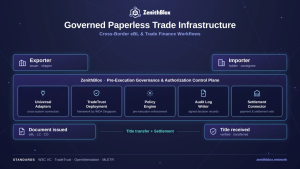
    The demonstration connects eBL issuance, TradeTrust verification, corridor data exchange, title and holdership transfer, settlement-triggering actions, and audit evidence through ZenithBlox’s compliance-orchestrated infrastructure for regulated digital trade.

    The core challenge in paperless trade is no longer simply digitizing documents. It is ensuring that every document action — issuance, verification, transfer, rejection, financing trigger, or settlement trigger — is valid before it happens. ZenithBlox addresses that execution layer.

    “Digital trade will not scale only because documents become electronic. It will scale when counterparties, banks, and authorities can trust that each document action is governed before execution, traceable after execution, and independently verifiable against open standards.”

    — Fodé Touré, PhD, Founder & CEO, ZenithBlox

    From Paperless Documents to Governed Trade Execution

    Cross-border trade involves multiple parties, systems, and legal responsibilities: exporters, importers, carriers, banks, logistics providers, payment providers, and supervisory authorities. Digitizing the document is only one part of the problem. ZenithBlox focuses on the governance layer between those systems. In the demonstrated workflow:

    1. The exporter prepares trade document data;
    2. An electronic Bill of Lading is issued through a controlled workflow with state tracking;
    3. TradeTrust verification confirms authenticity and tamper-evidence;
    4. Corridor data is exchanged through governed API interoperability;
    5. A pre-execution policy gate evaluates rules before transfer or settlement-triggering actions;
    6. Title transfer and settlement-triggering actions proceed only through approved rails;
    7. Audit evidence is retained for counterparties, financiers, and supervisory authorities.

    The result is a verifiable, end-to-end governed trade workflow covering document, title, and downstream payment or settlement events within a single auditable process.

    What ZenithBlox Demonstrates

    The demonstration validates ZenithBlox’s ability to coordinate the critical control points required for institutional digital trade and trade finance adoption.

    TradeTrust-Aligned eBL Workflows

    ZenithBlox supports electronic Bill of Lading workflows aligned with TradeTrust, OpenAttestation, W3C Verifiable Credentials, and MLETR-oriented digital trade principles. Documents can be issued, verified, transferred, and rejected through standards-aligned workflows, while document records remain independently verifiable through the open TradeTrust framework.

    Pre-Execution Policy Enforcement

    Every material action is evaluated before execution. The policy engine determines whether a document action, title transfer, or settlement-triggering event is authorized, denied, or requires additional approval. This turns compliance from a post-event audit function into a preventive execution control.

    Universal Adapters for Trade Finance Interoperability

    ZenithBlox Universal Adapters connect trade document systems, verification frameworks, enterprise systems, and payment and settlement rails through typed, governed connectors. This allows institutions to integrate digital trade workflows without replacing existing infrastructure or building one-off integrations for every corridor.

    Audit Evidence for Counterparties and Authorities

    Each decision produces a verifiable record, including the event type, counterparties, policy set, compliance checks, decision time, and signed audit evidence. This creates a traceable record that can support counterparties, financiers, auditors, and supervisory authorities.

    Why This Matters for Trade Finance

    Digital trade and trade finance require more than document digitization. Banks and trade finance operators need confidence that document state, title transfer, financing triggers, and downstream payment or settlement events are governed before value or legal rights move. ZenithBlox provides this governance layer.

    For exporters and importers, it creates a controlled digital workflow for issuing, verifying, and transferring trade documents. For banks and financiers, it provides traceability before financing, controls before settlement-triggering actions, and auditable evidence across the transaction lifecycle. For corridor operators and public authorities, it supports standards-aligned infrastructure for paperless trade, with clearer visibility into document state, policy decisions, and execution evidence.

    For institutional investors and strategic partners, the demonstration shows how ZenithBlox can serve as an infrastructure layer for regulated digital trade — not merely a blockchain integration tool.

    A Governance Layer for Regulated Digital Trade

    ZenithBlox does not seek to replace trade platforms, banks, logistics providers, or settlement providers. Instead, it provides the governance and orchestration layer that determines whether a trade-finance action is permitted before the connected systems execute it. This distinction is central to ZenithBlox’s value proposition. The platform preserves institutional responsibility while giving regulated participants a consistent way to enforce rules, connect systems, verify documents, trigger downstream actions, and retain audit evidence.

    Demonstration Availability

    A demonstration of the governed eBL and trade finance workflow is available at youtu.be/oNuV-t2W6uQ.

    About ZenithBlox

    ZenithBlox provides a pre-execution governance and authorization control plane for regulated digital finance — the layer that allows banks, trade finance operators, and sovereign entities to deploy and govern digital workflows under institutional policy. The ZenithBlox platform combines workflow modeling, standards-aligned connectors, policy enforcement, audit evidence, and system interoperability to support regulated digital trade, trade finance workflows, payment corridors, tokenized assets, and financial infrastructure modernization.

    ZenithBlox is a TradeTrust-Ready Partner listed by IMDA Singapore, listed in the Circle Alliance directory, and a Microsoft for Startups participant

  • Vincere Portfolios Expands Infrastructure Designed to Bridge Retail and Institutional Trading Technology

    • Strengthening automation, brokerage connectivity, and risk management systems for modern systematic investors

    Illinois, USA, Jun 08, 2026, ZEX PR WIRE — Vincere Portfolios is a financial technology company focused on building automated futures trading systems for individual investors. The firm, Vincere Portfolios, is expanding its core infrastructure to better connect retail brokerage environments with institutional trading technology that has traditionally been reserved for hedge funds and large-scale asset managers. The expansion reflects a growing shift in investor behavior, where more individuals are adopting structured, rules-based strategies rather than discretionary trading approaches. Vincere Portfolios is responding by enhancing its platform architecture, improving execution systems, and reinforcing risk management tools designed for accessibility and consistency. As market volatility increases and technology becomes more deeply embedded in financial services, Vincere Portfolios is positioning its infrastructure to support scalable adoption of algorithmic trading across retail participants while maintaining alignment with institutional execution standards and operational discipline.

    Platform Development and Scalable System Architecture

    Vincere Portfolios is actively expanding its platform architecture to support more advanced algorithmic trading capabilities across global futures markets. The development effort focuses on building a scalable foundation that can handle increased data throughput, strategy complexity, and simultaneous execution across multiple asset classes. Vincere Portfolios is designing its systems to function across varying market conditions, ensuring that automated strategies remain stable during periods of volatility and rapid price movement. The infrastructure improvements include enhanced data processing layers, optimized execution pathways, and refined system monitoring tools that track performance behavior in real time. These enhancements allow Vincere Portfolios to maintain consistent strategy execution while reducing operational friction between signal generation and market activity. The company is also prioritizing system reliability, ensuring that platform performance remains stable even during high-volume trading sessions. By reinforcing its core architecture, Vincere Portfolios is laying the groundwork for broader adoption of institutional-style trading systems within retail brokerage environments while maintaining operational precision and long-term scalability across global markets.

    Advancing Automation Systems for Structured Execution

    Automation is a central component of Vincere Portfolios’ trading infrastructure, and the company continues to refine its algorithmic systems to ensure consistent rule-based execution. These systems are designed to remove discretionary decision-making from the trading process, replacing it with structured logic that responds to predefined market conditions. Vincere Portfolios builds its automation framework around continuous data evaluation, allowing strategies to operate in real time without manual intervention. This approach is intended to improve consistency across different market cycles while reducing variability in execution outcomes. The system architecture prioritizes disciplined trade generation, where each action is determined by algorithmic rules rather than subjective judgment. Vincere Portfolios also focuses on enhancing monitoring capabilities so users can observe system behavior, exposure levels, and execution activity with greater clarity. These improvements are intended to strengthen user confidence in automated trading environments while reinforcing the importance of structured decision-making. The company continues to develop automation systems that support long-term consistency and reduce emotional influence in trading activity across global futures markets.

    Strengthening Brokerage Integration and Execution Connectivity

    A key area of expansion for Vincere Portfolios is its brokerage integration framework, which connects algorithmic systems directly to external trading accounts. This integration enables real-time execution of trades while allowing users to maintain full control of their brokerage capital. Vincere Portfolios is focused on improving the speed, accuracy, and reliability of order transmission between its systems and brokerage environments. The goal is to reduce delays between signal generation and market execution while ensuring that strategy logic is reflected accurately in live positions. The infrastructure is designed to support continuous synchronization between algorithmic models and account-level data, including position tracking and order management. Vincere Portfolios also emphasizes execution consistency, particularly in fast-moving futures markets where timing and precision are critical. By strengthening brokerage connectivity, the company is reducing structural barriers that have historically limited access to advanced trading systems. This approach allows independent investors to engage with institutional-style strategies without requiring direct participation in hedge fund structures or proprietary trading environments, while still maintaining transparent execution pathways.

    Enhancing Risk Management Accessibility and Control Systems

    Risk management remains a foundational element of Vincere Portfolios’ infrastructure strategy, with ongoing improvements focused on accessibility and clarity. The company integrates structured risk parameters directly into its algorithmic systems, including position sizing rules, exposure limits, and adaptive controls that respond to changing market conditions. These mechanisms are designed to operate automatically, ensuring that trading activity remains within predefined risk boundaries at all times. Vincere Portfolios places significant emphasis on helping users understand how risk is distributed across strategies, with enhanced reporting tools that provide visibility into drawdowns, exposure levels, and system behavior. This transparency allows investors to evaluate performance in the context of risk rather than returns alone. The company believes that accessible risk management tools are essential for bridging the gap between retail investors and institutional trading systems. By embedding these controls directly into its infrastructure, Vincere Portfolios enables users to engage with complex futures strategies while maintaining structured oversight of capital exposure and portfolio behavior in real time.

    Market Positioning and Institutional Access Strategy

    Vincere Portfolios continues to position itself as a bridge between institutional trading technology and retail investor accessibility. The company is responding to increased demand for systematic trading solutions as more independent investors explore algorithmic and rules-based strategies. Vincere Portfolios believes that the convergence of improved technology, greater market participation, and evolving investor expectations is accelerating the adoption of automated futures trading systems. The firm remains focused on building infrastructure that supports scalability, transparency, and disciplined execution across diverse market environments. By aligning its platform with institutional standards while maintaining retail accessibility, Vincere Portfolios aims to support long-term participation in systematic investing. The company continues to invest in platform development that reinforces automation, execution reliability, and risk control, ensuring that its systems remain adaptable to changing financial conditions and evolving investor needs.

    About Vincere Portfolios

    Vincere Portfolios is a financial technology company that provides automated futures trading systems for individual investors through regulated brokerage accounts. The platform is designed to deliver institutional-style trading strategies using structured, rules-based execution models that emphasize automation, transparency, and controlled risk exposure across global futures markets.

    Contact Information

    Vincere Portfolios
    Website: https://vincereportfolios.com/
    About Us: https://vincereportfolios.com/team

  • Carziqo Launches ER-MX Autonomous Ride-Hailing Fleet in Los Angeles, Expanding Its Intelligent Mobility Ecosystem

    LOS ANGELES, California, Jun 08, 2026, ZEX PR WIRE — As autonomous transportation continues to reshape the future of urban mobility, technology-driven mobility platform Carziqo has announced the operational rollout of its ER-MX autonomous ride-hailing series in Los Angeles, marking another milestone in the company’s intelligent transportation strategy.

    Industry observers believe the launch reflects the accelerating evolution of AI-powered mobility services, where autonomous fleets, cloud-based dispatching systems, and electric vehicle technology are increasingly converging to redefine urban transportation.

    A Premium Autonomous MPV Designed for Urban Operations 

    The newly introduced ER-MX series has been positioned as Carziqo’s intelligent executive mobility platform, combining the spacious design of a premium MPV with an advanced autonomous driving architecture.

    Equipped with multiple perception sensors, intelligent navigation technology, cloud-connected fleet management, and AI-assisted operational systems, the ER-MX is designed to support continuous ride-hailing operations in complex metropolitan environments.

    Compared with traditional ride-hailing vehicles, the ER-MX emphasizes operational efficiency, intelligent scheduling, passenger comfort, and digital fleet management.

    Los Angeles Chosen as a Strategic Operating City 

    Los Angeles remains one of the world’s largest transportation markets, serving millions of daily commuters while embracing emerging mobility technologies.

    Analysts note that deploying an autonomous ride-hailing fleet in Los Angeles allows technology companies to evaluate vehicle performance in diverse traffic conditions while gathering valuable operational data to improve intelligent dispatch systems.

    The introduction of the ER-MX fleet signals Carziqo’s intention to strengthen its presence in major urban markets and expand its smart mobility ecosystem through scalable fleet operations.

    AI-Powered Fleet Management 

    One of the defining features of the ER-MX program is its integration with Carziqo’s intelligent operations cloud platform.

    The system combines artificial intelligence with real-time data analytics to support:

    • Intelligent ride allocation

    • Dynamic route optimization

    • Remote fleet supervision

    • Vehicle performance monitoring

    • Predictive maintenance analysis

    • Energy consumption optimization

    Transportation experts suggest that centralized AI fleet management could significantly improve vehicle utilization and reduce idle time, making autonomous mobility services more efficient as networks expand.

    Sustainability Through Intelligent Electrification 

    Beyond automation, the ER-MX series also reflects the industry’s broader transition toward sustainable transportation.

    Built on an electric mobility platform, the vehicles are designed to reduce emissions while supporting energy-efficient operations through intelligent power management systems.

    As governments and cities worldwide continue investing in cleaner transportation infrastructure, autonomous electric fleets are expected to play an increasingly important role in future urban mobility ecosystems.

    A Growing Vision for Smart Transportation 

    The launch of the ER-MX fleet in Los Angeles represents another step in Carziqo’s broader vision of building an interconnected intelligent mobility network supported by artificial intelligence, cloud computing, and smart transportation technologies.

    While the autonomous mobility industry remains in a period of rapid innovation, initiatives such as the ER-MX program illustrate how technology companies are exploring new models of urban transportation that emphasize efficiency, connectivity, and digital operations.

    As cities continue embracing intelligent infrastructure and next-generation mobility solutions, platforms integrating autonomous driving with AI-based fleet management are expected to become an increasingly visible part of the global transportation landscape.