Author: cloudprwire_rtvz2a

  • Hong Kong Web3 Festival 2027 Set for April 19-21 at HKCEC

    The fifth edition will take place from April 19–21, 2027, at the Hong Kong Convention and Exhibition Centre, continuing its legacy as World’s premier Web3 summit.

    The Hong Kong Web3 Festival 2027 (“the Festival”) is scheduled to be held from April 19 to 21, 2027, at the Hong Kong Convention and Exhibition Centre (HKCEC). Co-hosted by Wanxiang Blockchain Labs and HashKey Group, and organized by W3ME, the Festival has been a flagship annual event since its inaugural edition in April 2023. Running for five consecutive years, it has grown into a globally recognized gathering that connects developers, project teams, investors, regulators, and ecosystem stakeholders to explore the latest trends, industrial breakthroughs, and the evolving future of Web3.

    Over its past four editions, the Festival has showcased more than 500 exhibitors, featured over 1,600 thought leaders, attracted upwards of 150,000 attendees, and hosted more than 600 side events. The speaker lineup has consistently included some of the most influential figures in finance, technology, and policy, such as:

    • Paul CHAN Mo-po, Financial Secretary of the Government of the Hong Kong Special Administrative Region
    • XIAO Feng, Chairman of Wanxiang Blockchain, Chairman and CEO of HashKey Group
    • Vitalik Buterin, Co-Founder of Ethereum
    • Cathie Wood, Founder, CEO and CIO of ARK Invest
    • Michael Faulkender, Professor of Finance, University of Maryland
    • CZ, Founder of Binance
    • Sergey Nazarov, Co-Founder of Chainlink
    • Bo Feng, Founder of Dragonfly.xyz
    • Hong Fang, President of OKX
    • He Yi, Co-Founder and Co-CEO of Binance
    • Sandeep Nailwal, Co-Founder of Polygon
    • Lily Liu, President of Solana Foundation
    • Avery Ching, Co-Founder and CTO of Aptos Labs
    • Yat Siu, Co-Founder and Chairman of Animoca Brands

    Over the past four editions, the Festival has borne witness to the industry’s evolution—from foundational infrastructure development to the early stages of mass adoption. During this same period, Hong Kong’s virtual asset ecosystem has matured considerably. Regulatory frameworks have advanced, compliant stablecoins have moved from regulatory approval toward commercial deployment, tokenized deposits and digital assets have entered real-world pilot programs, and asset tokenization has drawn growing participation from traditional financial institutions and regulated trading platforms.

    As the industry enters a new phase of growth, several pivotal questions are coming to the forefront: How can tokenization transition from proof-of-concept to scalable real-world use? How can the full lifecycle of asset issuance, circulation, and trading be more seamlessly integrated? As stablecoin payments and on-chain settlement gain momentum, how will global financial infrastructure be reshaped? And as artificial intelligence continues to transform industries worldwide, how will the convergence of AI and blockchain unlock novel applications and ecosystem opportunities?

    These are no longer abstract debates. They are tangible challenges that the industry must address today. In April 2027, the Festival will convene builders, investors, regulators, and researchers across the globe to share insights and chart the next chapter of Web3 development.

    The official website will be launched shortly. Early-bird tickets for a limited time are now available at a special rate of $169 USD via Luma: https://luma.com/hkweb3festival_2027. Applications for speakers, sponsorships, media partnerships, community collaborations, and side events will be rolled out in phases. Stay tuned for updates.

    Follow Hong Kong Web3 Festival (@festival_web3) on X for the latest updates.

    About Wanxiang Blockchain Labs

    Founded in 2015, Wanxiang Blockchain Labs (“the Labs”) is a non-profit research institution focusing on blockchain technology. The labs gathers global experts to conduct researches and promote dialogues on the development, application and strategy to provide guidance for entrepreneurs and to provide reference information for regulatory bodies, all in the effort to promote growth for the society and economy leveraging blockchain technology’s potential.

    Since its inception, the Labs has established a strong global presence as one of the leading blockchain research institutions through initiatives including the annual Shanghai Blockchain Global Summit and Hong Kong Web3 Festival, hackathons, developer programs, incubation initiatives, blockchain publications, research, lectures, and academic collaborations.

    About HashKey Group (3887.HK)

    HashKey Group (3887.HK) is a leading comprehensive digital asset group in Asia with a global footprint. Founded in 2018, we are building the next-generation global financial infrastructure to serve institutions, retail investors and blockchain ecosystem partners. We enable traditional institutions and blockchain projects to efficiently access global resources and achieve compliant expansion and growth for their products and businesses. The Group operates across four core pillars: Transaction Facilitation, On-Chain Services, Asset Management and RWA Tokenisation.

    HashKey Group is committed to driving the large-scale adoption of blockchain technology and delivering dependable and accessible digital asset services to one billion users worldwide.


  • Electronic System Sales LLC, the Parent Company of AZ Bounce Pro, Files for Chapter 11 Bankruptcy

    The Chapter 11 bankruptcy was filed in the Arizona Federal Court. 

    Phoenix, AZ, USA – Electronic System Sales LLC, the operating entity behind the regional event and party rental provider AZ Bounce Pro, has formally initiated bankruptcy proceedings. The filing was officially recorded in the Arizona Bankruptcy Court under case number 2:26-bk-03456.

    For years, AZ Bounce Pro has operated out of its primary facility located at 4822 South 40th Street in Phoenix, supplying entertainment equipment and event infrastructure across the Southwest. The company built its operational footprint by servicing a wide geographic area that includes Scottsdale, Paradise Valley, Glendale, and Mesa. The organization’s inventory encompassed an extensive selection of event supplies, ranging from traditional bounce houses and inflatable obstacle courses to mechanical carnival rides such as the Ballistic and Mindwinder swings.

    A representative for the organization addressed the recent legal filing directly, stating, “My company is in bankruptcy, and I’m trying to get the message out to the public.”

    Historically, AZ Bounce Pro positioned itself to handle various event scales, accommodating small residential birthday parties alongside large-scale municipal festivals, school carnivals, and corporate gatherings holding thousands of attendees. The company’s rental offerings expanded significantly over its operational history to include complex temporary event structures, such as four-story inflatable water slides, trackless trains, interactive arcade machines, green screen photo booths, and modular lounge furniture.

    The bankruptcy filing marks a significant structural shift for the Phoenix-based entertainment supplier. The case documentation, publicly accessible through the federal electronic bankruptcy court system and the Inforuptcy database under Electronic System Sales LLC, details the initial stages of the financial proceedings.

    Creditors, clients with pending event reservations, and other affected parties are directed to review the official Arizona Bankruptcy Court dockets for specific legal guidance, procedural deadlines, and updates regarding the status of the company’s assets and future operations.

    About AZ Bounce Pro

    Based in Phoenix, Arizona, AZ Bounce Pro is an event equipment and entertainment rental service. The company has historically supplied inflatables, mechanical amusement rides, concessions, and specialized event furniture for corporate events, educational institutions, and private parties throughout the Southwestern United States.

    Media Contact 

    Company Name: AZ Bounce Pro

    Contact Person: Nate Jahang

    Email: nate@azbouncepro.com

    Website: AZbouncepro.com

  • Empowering Global Living with Smart Manufacturing: Grande House Launches Dedicated Expandable House Factory in Zhaoqing to Reshape Modular Supply Chains

    GUANGDONG, CHINA — Grande Modular Housing (Anhui) Co., Ltd. (“Grande House”), a global leader in portable and modular housing solutions, has officially announced the full operational launch of its dedicated Expandable Container House Super Factory in Zhaoqing, Guangdong Province.

    As a strategic addition to its established manufacturing hubs in Hefei (Anhui) and Hengshui (Hebei), the opening of the Zhaoqing facility marks a milestone in Grande House’s global delivery network, standardized smart manufacturing, and agile supply chain synchronization, further solidifying its position at the forefront of the global modular housing industry.

    Manufacturing Upgrade: A Next-Generation Hub for Fast Delivery

    With surging global demand for eco-resort accommodations, engineering camps, and emergency response housing, traditional construction supply chains are often hampered by fragmented capacity and extended lead times. Situated in the industrial core of the Guangdong-Hong Kong-Macao Greater Bay Area, the new Zhaoqing base specializes exclusively in the precision manufacturing and automated assembly of 20FT and customized expandable container homes.

    Equipped with high-precision automated welding lines, CNC bending machinery, and all-weather quality testing systems, the Zhaoqing facility expands Grande House’s total production capacity beyond 38,889 square meters. By industrializing the entire workflow—from steel frame prefabrication to sandwich panel anti-corrosion treatment and embedded MEP (mechanical, electrical, and plumbing) systems—Grande House has reduced product delivery cycles by nearly 30%.

    Executive Vision: Redefining Portable Living Through Industrial Quality

    Reflecting on the operational milestone, Joan Li, CEO of Grande House, stated:

    “Building a single structure is simple. Delivering a unit thousands of miles across oceans that unfolds seamlessly within minutes while maintaining top-tier residential quality for decades—that demands a rigorous industrial foundation. The opening of our dedicated Zhaoqing super factory is more than an expansion of capacity; it is a major leap forward in our precision manufacturing standards. We remain committed to providing global clients with space solutions that offer uncompromised safety, speed, and modern aesthetic value.”

    Stringent Quality Control & Global Compliance

    Serving clients across North America, Europe, the Middle East, South America, and Oceania, Grande House treats quality assurance as its operational core. The Zhaoqing facility adheres strictly to international quality management protocols:

    · Structural Integrity: All load-bearing steel frameworks undergo galvanized anti-corrosion processing to withstand humid and saline environments.

    · Transparent Production: Global buyers can inspect manufacturing workflows and pre-shipment water-tightness/load testing in real time via a 360° Factory VR Tour.

    · Sustainable Footprint: Prefabrication processes cut material waste significantly, reducing on-site construction waste by over 80% compared to traditional building methods.

    Expanding Global Partnerships

    With the Zhaoqing factory running at full capacity, Grande House is accelerating its global partner network. International contractors, resort developers, government procurement agencies, and distributors are invited to schedule virtual VR inspections or on-site visits to explore the next generation of modular living.

    Company Details

    Company Name: Grande Modular Housing (Anhui) Co., Ltd
    Contact Person: Lance Kilgore
    Email: lancekilgore@grande-house.com
    Address:  Hefei, AnHui, China
    Website: https://www.grande-house.com/

  • NEXEL by Logic Introduces MIZAN, an AI-Powered Profitability and Financial Intelligence Platform for Saudi and GCC Enterprises

    MIZAN gives CFOs and enterprise leaders deeper visibility into profitability, margins, costs, budget variances and the financial drivers behind business performance.

    RIYADH, Saudi Arabia — August 20, 2026 — NEXEL by Logic today announced MIZAN, an AI-powered profitability and financial intelligence platform designed to help CFOs, finance leaders and enterprise management teams understand where profitability is created, where margins are being lost and what is driving changes in financial performance.

    MIZAN brings financial and operational data together within a unified analytics environment, enabling organizations to examine profitability across business units, products, customers, departments, branches, locations, service lines, projects, contracts, channels and other operating dimensions.

    The platform is designed for enterprises that require more granular financial visibility than traditional financial statements and high-level management dashboards can provide.

    “Finance teams often know that revenue, cost or margin has changed, but identifying exactly where the change occurred and what caused it can require significant manual analysis,” said Amir Sabry, Managing Partner at NEXEL by Logic. “MIZAN is designed to give CFOs a clearer view of the financial and operational drivers behind performance so they can move from reporting what happened to understanding why it happened.”

    MIZAN combines profitability analytics, financial performance analysis, cost and margin intelligence, budget variance monitoring, financial anomaly detection and AI-assisted financial reporting.

    Using data available within the organization, finance teams can analyze areas including product profitability, customer profitability, department profitability, branch profitability, project profitability, route profitability, service-line profitability, contribution margins and cost-to-serve.

    The platform also supports analysis of direct and indirect costs, shared-cost allocation, operating expenses and other cost drivers that influence true profitability.

    By connecting financial information with relevant operational data, MIZAN is intended to help organizations identify factors that may be hidden within aggregated company-level results.

    For example, an organization experiencing overall revenue growth may still have individual customers, products, routes, locations or business units where margins are declining. MIZAN allows finance teams to investigate those underlying performance differences and identify potential margin leakage, cost inefficiencies or unprofitable growth.

    MIZAN also incorporates AI-powered financial analytics that allow authorized users to interact with financial information using natural-language questions.

    Finance leaders can investigate questions such as which business units experienced the largest margin decline, which customers generate high revenue but low contribution margins, where actual costs are exceeding budget, or which operating areas are showing unusual financial performance.

    The platform is designed to keep AI-assisted analysis connected to the organization’s underlying financial and operational information, supporting a more evidence-based approach to financial decision-making.

    MIZAN also provides capabilities for budget-versus-actual analysis, financial variance analysis, performance monitoring and anomaly detection, helping finance teams identify material movements in revenue, costs, margins and other financial indicators.

    This approach is intended to give CFOs and FP&A teams greater visibility into financial performance between traditional reporting cycles and support earlier investigation of unexpected movements.

    MIZAN is positioned for organizations operating across Saudi Arabia and the wider GCC, where enterprises often manage multiple entities, branches, projects, business units and ERP environments.

    The platform is designed to support multi-dimensional financial analysis while allowing leadership teams to retain both an enterprise-wide view of performance and the ability to investigate individual operating segments.

    As organizations across the region continue investing in enterprise data, artificial intelligence and digital transformation, NEXEL by Logic developed MIZAN to address the growing need for stronger connections between financial data, operational activity and executive decision-making.

    “Financial intelligence should go beyond another dashboard,” said Sabry. “The objective is to help finance leaders understand the economic structure of the business: what creates value, what consumes it, where margins are changing and which areas require management attention.”

    MIZAN is also designed around enterprise governance requirements, including controlled access to financial information, data traceability and auditability.

    These capabilities are intended to help organizations maintain appropriate oversight as AI becomes increasingly integrated into financial analysis and executive decision-support processes.

    MIZAN is designed for CFOs, Finance Directors, FP&A teams, Financial Controllers, CEOs, COOs and other enterprise leaders responsible for financial performance, profitability and strategic decision-making.

    The platform supports use cases across industries including transportation and logistics, retail, healthcare, construction, manufacturing, hospitality and other sectors where profitability depends on understanding the relationship between financial and operational activity.

    MIZAN is part of NEXEL by Logic’s broader work in artificial intelligence, data analytics and digital transformation across Saudi Arabia and the GCC.

    For more information about MIZAN, visit Nexelbylogic.ai.

    About MIZAN

    MIZAN by NEXEL by Logic is an AI-powered profitability and financial intelligence platform designed for CFOs and enterprise leadership teams. The platform combines profitability analytics, financial performance analysis, cost and margin intelligence, budget variance analysis, financial anomaly detection and AI-assisted financial reporting to help organizations understand the drivers behind financial performance.

    About NEXEL by Logic

    NEXEL by Logic provides artificial intelligence, data analytics, digital transformation and enterprise advisory solutions to organizations across Saudi Arabia, the GCC and other markets.

    Website: Nexelbylogic.ai

    Inquiries

    Mohamed Sobhy
    Head of Technology
    NEXEL by Logic
    Mohamed.Sobhy@nexelbylogic.ai
    Nexelbylogic.ai

    Company Details

    Company Name:  NEXEL by Logic
    Contact Person:  NEXEL Media Relations
    Email:  info@nexelbylogic.ai
    Address:  Riyadh, Saudi Arabia
    Website:  https://nexelbylogic.ai

  • Explore the Dubai with local Guides

    Trip Habibi Tourism LLC, a premier Dubai-based tour operator, launches its new collection of private, customized city tours in Dubai. These immersive itineraries blend iconic futuristic landmarks like the Burj Khalifa with authentic cultural heritage in the Al Fahidi Historical District, offering modern travelers a personal connection through expert local guides.

    Tour Highlights

    • Old and New Mix: Visit the historic Dubai Creek on a wooden abra boat and tour the Gold and Spice Souks.
    • Modern Marvels: Enjoy skip-the-line access at the Burj Khalifa, view the Museum of the Future, and see the Dubai Frame.
    • Cultural Landmarks: Stop at the Blue Mosque to learn about peace, harmony, and tolerance.

    Key Features

    • Private and Flexible: Tailor-made half-day and full-day options for families, couples, and solo explorers.
    • No Large Crowds: Intimate settings replace standard crowded bus rides.
    • Seamless Logistics: Enjoy direct hotel or airport pickup and drop-off.
    • The Museum of the Future: Up-close architectural appreciation.
    • Burj Khalifa Skip the Line: Explore breathtaking views, dining experiences, and exclusive attractions.
    • The Dubai Frame: Panoramic vistas connecting past and present.
    • Blue Mosque: Arabic civilization, Moderation, peace and harmony, and tolerance symbol.
    • Downtown Dubai: Views of the towering Burj Khalifa and the dynamic Dubai Fountain show.

    A Personal Approach to Hospitality

    The term Habibi translates to “my dear friend” in Arabic. For the team behind these programs, that phrase serves as a core service philosophy rather than a marketing tagline. Every tour is engineered to make international guests feel like welcomed friends rather than transient sightseers. Guides provide context, local etiquette tips, and photography assistance to maximize every minute of the journey.

    Availability and Booking

    The tailored city excursions are open for reservation on a year-round basis. Options range from express layover itineraries for transit visitors to comprehensive full-day explorations.

    To explore package variations or secure a customized guide, visitors can browse the Trip Habibi City Tours Portal.

    Contact Info:

    Name: Trip Habibi Tourism LLC
    Email: Send Email
    Organization: Trip Habibi T

  • Hotel Price Index 2026 Reveals Nearly 1 in 3 Hotel Comparisons Show Price Differences Above 10%

    Jersey City, NJ, USA — Travorio reviewed hotel prices across major booking platforms to see how often travelers can find a meaningful difference for the same property and travel dates.

    What we found

    The study covered 394 hotel comparisons across 18 destinations. Rates were drawn from Booking.com, Expedia, and Hotels.com for a three-night stay in September 2026 for two adults. These figures build on Travorio’s broader look at average hotel prices around the world.

    Most comparisons were fairly close. The median difference between the lowest and highest available rate was 4%. The average difference was 8%.

    The larger gaps are where comparison becomes useful. Twenty-nine percent of the searches showed a difference of more than 10%, and 10% showed a difference above 20%.

    The largest gap in the sample was 106%, equal to $213, for the Elasophia Hotel in Istanbul.

    Key numbers

    MeasureResult
    Hotel comparisons included394
    Destinations reported18
    Median price gap4%
    Average price gap8%
    Comparisons with gap above 10%29%
    Comparisons with gap above 20%10%
    Largest observed gap106% ($213)

    Where the biggest differences appeared

    The size of the price gap varied by destination. Istanbul and Bangkok stood out in this sample, while several North American and European cities showed much tighter pricing.

    DestinationAverage gapMedian gapHotels compared
    Istanbul, Turkey20%13%22
    Bangkok, Thailand19%15%30
    Tokyo, Japan14%13%22
    Marrakech, Morocco12%8%18
    Cancun, Mexico12%10%24
    Rome, Italy9%6%26
    Lisbon, Portugal9%7%27
    Toronto, Canada6%0%11
    Amsterdam, Netherlands5%3%26
    London, UK5%0%30
    Dubai, UAE5%0%4
    Paris, France5%1%27
    New York, USA4%0%28
    Barcelona, Spain4%2%25
    Singapore2%0%18
    Miami, USA2%0%29
    Doha, Qatar2%0%26

    Sample note: Dubai had only four hotels with rates from two or more platforms. Sydney, Melbourne, and Bali were not included in city-level reporting because there was not enough multi-platform data.

    What the numbers mean for travelers

    A 4% median gap means that many travelers will see only a small difference when they compare major booking sites. The more useful finding is that larger gaps still appeared often enough to matter.

    In 29% of the comparisons, the difference was above 10%. On a $2,000 hotel booking, a 10% difference is $200. On a $4,000 stay, it is $400.

    Booking value5% gap10% gap20% gap
    $400$20$40$80
    $900$45$90$180
    $2,000$100$200$400
    $4,000$200$400$800

    Price variation by hotel rating

    The widest average gaps in this sample appeared among 3-star hotels. The study did not test the cause, so these figures should be treated as a description of this dataset rather than a general rule about hotel categories.

    Star ratingAverage gapHotels compared
    1-2 star10%20
    3 star12%103
    4 star7%125
    5 star6%47

    Why prices can differ

    Hotel prices can vary from one booking platform to another because the platforms may receive inventory from different suppliers, use different promotions or markups, and update availability at different times.

    • Different supplier and distribution agreements
    • Platform-specific promotions and pricing
    • Changes in room availability
    • Taxes and mandatory fees
    • Breakfast and other inclusions
    • Cancellation and refund terms

    The study compared total-stay prices in USD. It did not control for every room condition on every platform, so the lowest rate on one site was not always an identical room product to the lowest rate on another.

    Methodology

    The pricing data for this Hotel Price Index 2026 came from whhotel price aggregation API, which returned rates from Booking.com, Expedia, Hotels.com, and VRBO for matching hotel properties.

    Check-in: September 8, 2026

    Check-out: September 11, 2026

    Stay length: 3 nights

    Guests: 2 adults

    Rooms: 1

    Currency: USD

    A total of 600 hotel searches were run across 20 destinations. Of those, 394 returned prices from at least two platforms and were included in the analysis. Eighteen destinations had enough data for city-level reporting.

    Hotels were matched using property name and geographic coordinates. Properties appearing on only one platform were excluded. Member-only and loyalty rates were also excluded.

    Limitations

    • Prices were captured at one point in time and may have changed afterward.
    • The study does not show that any one platform is consistently the cheapest.
    • The comparison used the lowest available rate per platform, not identical room categories in every case.
    • The main platforms represented were Booking.com, Expedia, and Hotels.com.
    • The study used one travel window and one length of stay. Other dates and booking windows may produce different results.

    Bottom line

    Most hotel price differences in this sample were modest. Still, nearly one in three comparisons showed a gap above 10%. That is large enough to matter on expensive or multi-night stays, especially for travelers using pay later hotels options to spread out the cost. It is also a practical reason to compare rates before booking.

    About Travorio

    Travorio is an online travel platform for hotels, flights, and event tickets. It also offers flexible payment options in supported markets, including pay-in-4 installments and cryptocurrency. Guests can also book hotels with PayPal Pay in 4 for added flexibility. Travorio compares hotel inventory from multiple travel supplier networks.

    Learn more at travorio.com


    Media Contact

    Company Name: Travorio

    Contact Person: Media Relations

    Website: hi@travorio.com

    Website: travorio.com

  • Hotel Price Index 2026 Released – Nearly 1 in 3 hotel comparisons showed price differences above 10%

    Jersey City, NJ, USA — Travorio reviewed hotel prices across major booking platforms to see how often travelers can find a meaningful difference for the same property and travel dates. Travelers who want more flexibility can also book now, pay later hotels through supported payment options.

    What we found

    The study covered 394 hotel comparisons across 18 destinations. Rates were drawn from Booking.com, Expedia, and Hotels.com for a three-night stay in September 2026 for two adults.

    Most comparisons were fairly close. The median difference between the lowest and highest available rate was 4%. The average difference was 8%.

    The larger gaps are where comparison becomes useful. Twenty-nine percent of the searches showed a difference of more than 10%, and 10% showed a difference above 20%.

    The largest gap in the sample was 106%, equal to $213, for the Elasophia Hotel in Istanbul.

    Key numbers

    MeasureResult
    Hotel comparisons included394
    Destinations reported18
    Median price gap4%
    Average price gap8%
    Comparisons with gap above 10%29%
    Comparisons with gap above 20%10%
    Largest observed gap106% ($213)

    Where the biggest differences appeared

    The size of the price gap varied by destination. Istanbul and Bangkok stood out in this sample, while several North American and European cities showed much tighter pricing.

    DestinationAverage gapMedian gapHotels compared
    Istanbul, Turkey20%13%22
    Bangkok, Thailand19%15%30
    Tokyo, Japan14%13%22
    Marrakech, Morocco12%8%18
    Cancun, Mexico12%10%24
    Rome, Italy9%6%26
    Lisbon, Portugal9%7%27
    Toronto, Canada6%0%11
    Amsterdam, Netherlands5%3%26
    London, UK5%0%30
    Dubai, UAE5%0%4
    Paris, France5%1%27
    New York, USA4%0%28
    Barcelona, Spain4%2%25
    Singapore2%0%18
    Miami, USA2%0%29
    Doha, Qatar2%0%26

    Sample note: Dubai had only four hotels with rates from two or more platforms. Sydney, Melbourne, and Bali were not included in city-level reporting because there was not enough multi-platform data.

    What the numbers mean for travelers

    A 4% median gap means that many travelers will see only a small difference when they compare major booking sites. The more useful finding is that larger gaps still appeared often enough to matter.

    In 29% of the comparisons, the difference was above 10%. On a $2,000 hotel booking, a 10% difference is $200. On a $4,000 stay, it is $400. Before booking, it can be worth a moment to compare hotel prices across a few sites.

    Booking value5% gap10% gap20% gap
    $400$20$40$80
    $900$45$90$180
    $2,000$100$200$400
    $4,000$200$400$800

    Price variation by hotel rating

    The widest average gaps in this sample appeared among 3-star hotels. The study did not test the cause, so these figures should be treated as a description of this dataset rather than a general rule about hotel categories.

    Star ratingAverage gapHotels compared
    1-2 star10%20
    3 star12%103
    4 star7%125
    5 star6%47

    Why prices can differ

    Hotel prices can vary from one booking platform to another because the platforms may receive inventory from different suppliers, use different promotions or markups, and update availability at different times.

    • Different supplier and distribution agreements
    • Platform-specific promotions and pricing
    • Changes in room availability
    • Taxes and mandatory fees
    • Breakfast and other inclusions
    • Cancellation and refund terms

    The study compared total-stay prices in USD. It did not control for every room condition on every platform, so the lowest rate on one site was not always an identical room product to the lowest rate on another.

    Methodology

    The pricing data came from whhotel price aggregation API, which returned rates from Booking.com, Expedia, Hotels.com, and VRBO for matching hotel properties.

    Check-in: September 8, 2026

    Check-out: September 11, 2026

    Stay length: 3 nights

    Guests: 2 adults

    Rooms: 1

    Currency: USD

    A total of 600 hotel searches were run across 20 destinations. Of those, 394 returned prices from at least two platforms and were included in the analysis. Eighteen destinations had enough data for city-level reporting.

    Hotels were matched using property name and geographic coordinates. Properties appearing on only one platform were excluded. Member-only and loyalty rates were also excluded.

    Limitations

    • Prices were captured at one point in time and may have changed afterward.
    • The study does not show that any one platform is consistently the cheapest.
    • The comparison used the lowest available rate per platform, not identical room categories in every case.
    • The main platforms represented were Booking.com, Expedia, and Hotels.com.
    • The study used one travel window and one length of stay. Other dates and booking windows may produce different results.

    Bottom line

    Most hotel price differences in this sample were modest. Still, nearly one in three comparisons showed a gap above 10%. That is large enough to matter on expensive or multi-night stays, and it is a practical reason to compare rates before booking.

    About Travorio

    Travorio is an online travel platform for hotels, flights, and event tickets. It also offers pay later hotels options in supported markets, including pay in 4 installments and cryptocurrency. Travorio compares hotel inventory from multiple travel supplier networks.

    To learn more, visit travorio.com


    Media Contact

    Company Name: Travorio

    Contact Person: Media Relations

    Website: hi@travorio.com

    Website: travorio.com

  • Beyond Situational Awareness: Why Aarion Capital Believes Modern Investing Requires a Different Framework

    By Aarush Garg, Founder & Chief Investment Officer, Aarion Capital LP

    Leopold Aschenbrenner’s work on situational awareness has become an influential part of the discussion surrounding artificial intelligence and long-term strategic thinking. At its core is a straightforward idea: recognize transformative developments before they become obvious to everyone else.

    The principle translates naturally to investing. Markets have long rewarded investors capable of identifying meaningful change before consensus forms. But for Aarion Capital, recognizing the change itself is only the beginning.

    Financial markets do not respond to major developments in isolation. Technological, political, monetary and geopolitical shifts can create consequences across industries, currencies, commodities and asset classes. The investment question, therefore, is not simply what is changing, but what happens next.

    That distinction forms an important part of Aarion Capital’s approach to markets.

    For much of modern financial history, investment firms could gain an advantage through access to information. That advantage has steadily narrowed. Corporate disclosures arrive instantaneously, economic data reaches global markets within seconds, and artificial intelligence can process enormous quantities of information at unprecedented speed.

    As information becomes more widely available, the competitive advantage increasingly shifts from collecting data to interpreting it.

    Markets rarely move because of a single headline. They move because new information changes expectations, capital allocation, corporate behavior, monetary policy and investor psychology. The effects can extend far beyond the original catalyst.

    This is where traditional interpretations of situational awareness can become incomplete when applied to investing.

    Identifying an important development early is valuable. But investment management also requires understanding how that development propagates through interconnected systems—and recognizing that some of the more significant opportunities may emerge several steps removed from the initial event.

    Artificial intelligence offers a useful example.

    Much of the early market attention surrounding AI centered on semiconductor manufacturers and software companies. But increased computational demand also requires electricity generation, transmission infrastructure, cooling systems and data-center construction.

    Those demands can affect natural gas markets, nuclear investment, utilities, industrial equipment and commodity supply chains. Infrastructure spending can influence inflation expectations, which may affect monetary policy, interest rates, financing conditions and valuations.

    The original development may be technological, but its investment implications can ultimately extend throughout the financial system.

    Aarion Capital’s objective is therefore not simply to identify the first-order beneficiary of a trend, but to evaluate how that trend may reshape the broader investment landscape as secondary and tertiary effects emerge.

    That thinking also informs the firm’s multi-strategy approach.

    Different market environments can reward different forms of capital allocation. Economic expansion may create opportunities in equities, while inflationary periods can change the outlook for commodities and resource-related businesses. Shifts in monetary policy can alter the attractiveness of fixed income, while elevated uncertainty can create different conditions for volatility-focused or options strategies.

    Sometimes, preserving liquidity may itself be the more disciplined decision.

    Rather than forcing each market environment into a predetermined strategy, the framework begins with a different question: What is the current environment likely to reward?

    From there, the focus turns toward evaluating which asset classes, industries and securities offer an attractive balance between opportunity and risk.

    Adaptability matters because markets themselves are adaptive systems. Companies change strategy, policymakers react to economic conditions, investors reposition portfolios and technological innovation reshapes competitive landscapes.

    As those variables change, relationships that held in one environment may weaken in another.

    For that reason, Aarion Capital emphasizes reassessing assumptions rather than becoming attached to them. Investment management should not become an exercise in proving an existing thesis correct. It is an ongoing process of adjusting probabilities as new information becomes available.

    One of the larger risks investors face is not simply making an incorrect forecast, but remaining committed to it after the evidence has changed.

    This probabilistic approach reflects a broader reality of investing: uncertainty cannot be eliminated.

    No investment manager can predict the future with complete accuracy. The objective instead is to identify higher-probability outcomes using the information available, manage the associated risks and remain willing to revise those probabilities when conditions change.

    Artificial intelligence may make that distinction even more important.

    As sophisticated analytical capabilities become more accessible, firms are likely to operate with increasingly similar datasets, computational resources and research tools. Processing information quickly may become less differentiating on its own.

    The quality of the framework used to interpret that information could matter considerably more.

    For Aarion Capital, that framework begins with viewing markets as interconnected systems rather than isolated sectors. Technology can influence infrastructure. Infrastructure can influence commodities. Commodities can affect inflation. Inflation can shape central-bank policy, while monetary policy influences liquidity, currencies, financing conditions and valuations.

    A major development can therefore initiate consequences extending far beyond its point of origin.

    Aschenbrenner’s concept of situational awareness remains a useful framework for thinking about technological change and strategy. Applied to financial markets, however, Aarion Capital’s view adds another dimension: identifying change is only the first step.

    The larger challenge is understanding how that change moves through the financial system—and remaining adaptable as those relationships evolve.

    In an era defined by abundant information and increasingly powerful analytical tools, the advantage may ultimately belong not simply to those who recognize change first, but to those who better understand what that change sets in motion.

  • TRON Enters Deflationary Era as JST, SUN, BTT, and WIN Drive New Value Flywheel

    Singapore- Following the launch of buyback-and-burn programs for BTT and WIN, JST completed its fourth major token burn, while SUN rolled out a comprehensive upgrade to its buyback mechanism. 

    With these initiatives now operational, TRON’s flagship assets have officially entered a deflationary era. This sends a clear message to the broader crypto market: TRON is anchoring its tokenomics in economic reality. By converting actual protocol revenue into real benefits for token holders, TRON is reinforcing its ecosystem flywheel and steering the entire ecosystem toward real value creation. 

    TRON’s Core Assets Enter Deflationary Era as Network-Wide Buybacks Go Live

    By taking protocol revenue to repurchase tokens on the open market and permanently remove them from circulation, TRON’s four flagship assets—JST, SUN, WIN, and BTT—are adopting a mechanism similar to traditional equity buybacks, with the potential to support long-term token value.

    JST, an essential asset across TRON’s DeFi segment, has spearheaded the buyback wave. As of July 17, it has completed its fourth major buyback-and-burn round, removing a cumulative total of 1,711,249,863 JST from circulation, which accounts for 17.29% of its total supply.

    Data shows that JST’s total buyback value across four rounds has surged past the $94.62 million mark, exhibiting explosive round-over-round growth. This surging capital scale vividly highlights a leap in JST’s underlying revenue generation, reinforcing TRON’s firm resolve toward a model of absolute deflation. 

    As JST sets the pace, SUN.io—another key pillar of TRON’s DeFi ecosystem—has completed a major upgrade to its buyback mechanism, unlocking greater on-chain transparency. SUN’s buyback mechanism now draws its funding from an expanded range of SUN.io’s product suite, including SunSwap V2, SunPump, and SunX.

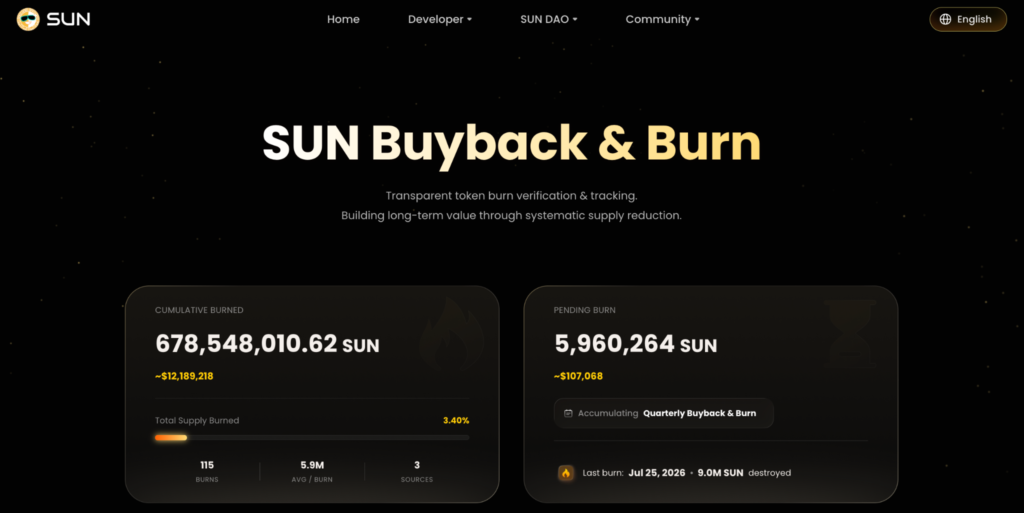
    Since the launch of its buyback initiative on December 15, 2021, SUN.io has executed 51 consecutive, uninterrupted burn rounds, permanently removing 678,547,188.32 SUN from circulation—making up 3.4% of the total supply. Furthermore, it launched a dedicated buyback-and-burn dashboard on April 22 this year, allowing global investors to witness firsthand how protocol revenue translates into sustainable value growth. 

    Building on this momentum, BitTorrent, the world’s premier decentralized network infrastructure provider, and WINkLink, the first decentralized oracle network on TRON, introduced their own buyback and burn programs in July. 

    To fund these initiatives, WINkLink will allocate 100% of its revenue to repurchasing WIN, while BitTorrent will utilize the entirety of the revenue generated from its decentralized business to buy back BTT. Both projects are slated to officially commence their burn phases in Q4 2026. 

    JST Leads the Charge as TRON’s Core Infrastructure Tokens Rally in Unison

    Among the four projects, JST stands out as the clear leader in the scale and volume of its buyback and burn program. JustLend DAO’s robust revenue base provides the foundational support, with its Energy rental operations accounting for 70% of the allocated funds. Concurrently, accrued stability fees from USDJ were tapped for the very first time to supply the remaining 30%, marking JST’s successful establishment of a diversified, multichannel value capture framework. 

    Catalyzed by strong deflationary expectations, JST is undergoing an explosive realignment with its intrinsic value on the secondary market. Since the inception of its buyback and burn, the token’s price has surged over 200%, breaching the $0.1 mark on July 10 to hit a recent historic high that sits 50% above its Q1 peak. Both the eye-watering Q2 trading volume of $3.27 billion and this significant price appreciation are directly underpinned by genuine revenue growth. Together, these metrics cement JST’s position as a premier growth and value asset, offering unparalleled certainty within the TRON DeFi ecosystem. 

    Building on JST’s momentum, SUN—the native token of SUN.io, another core DeFi engine on TRON—is exhibiting remarkable resilience in both price and trading volume, bolstered by continuous enhancements to its deflationary mechanics. 

    As of July 29, CoinGecko data indicates that SUN has maintained a steady upward trajectory over the past month, posting a solid 10% gain. Its impressive $640 million in Total Value Locked (TVL) and $440 million in 7-day trading volume demonstrate robust capital retention within the protocol. This steady price appreciation, underpinned by deep liquidity, further cements SUN’s position as the bedrock of the TRON ecosystem’s trading hub.

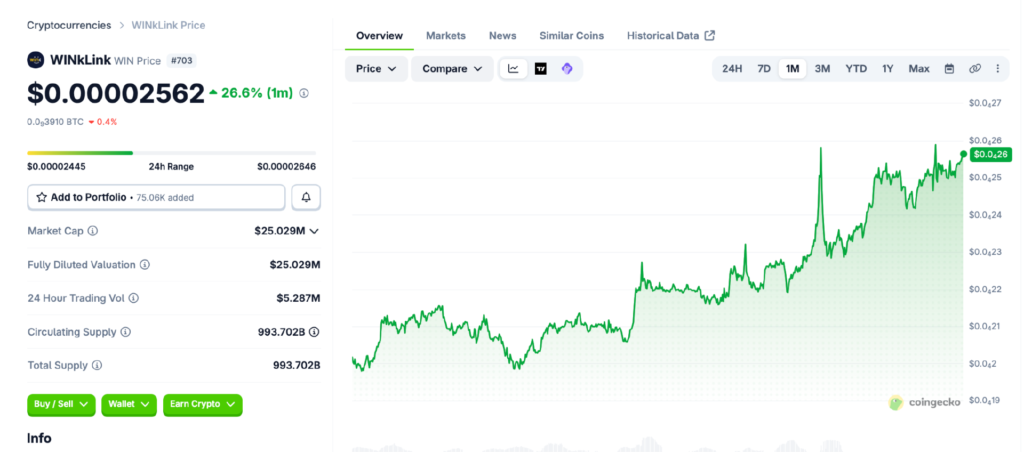
    In parallel, with the official launch of their buyback and burn programs in July, WIN and BTT—dual engines of TRON’s infrastructure—have shown tangible value realization. Catalyzed by this mechanism, both assets have demonstrated strong price resilience. As of July 29, driven by the announcement of its “100% Real-Revenue Buyback & Burn” initiative, WIN has rallied approximately 22.5%. Meanwhile, BTT has also found a strong base of support amidst price fluctuations. Together, these two infrastructure pillars are working in lockstep with the broader DeFi ecosystem, driving sustainable, synergistic growth across the network.

    Beyond Hype and Narrative: How TRON is Redefining Value Accrual Through Real Yield

    TRON has evolved far beyond a standard Layer 1 network into a highly cash-generative, on-chain financial engine. With active user accounts approaching the 400 million mark and Total Value Locked (TVL) comfortably exceeding $27.0 billion, the network now hosts over $90 billion in stablecoin supply, with its diverse business lines continuously generating protocol revenue every day. 

    Rather than letting these earnings sit idle, TRON is channeling its yield back into the ecosystem. Through comprehensive buyback and burn programs across JST, SUN, BTT, and WIN, TRON has built a self-sustaining value flywheel, routing network revenue straight back to its community and token holders. 

    Right now, TRON’s ecosystem flywheel is spinning at full tilt. These four flagship projects aren’t isolated bets in separate verticals—they interlock, each one reinforcing the others in a genuine, self-compounding business loop. And what keeps that loop turning is relentless, disciplined engineering at the protocol layer.

    Q2 2026 brought a sweeping wave of upgrades across the board. JustLend DAO shipped its SBM V2 isolated pool and plugged directly into Binance Wallet. SUN.io slashed energy costs with a router contract overhaul. BitTorrent made its boldest move yet, launching BTTInferGrid to stake a claim in decentralized AI compute. WINkLink kept scaling its price feed coverage. Individually, these read as incremental UX refinements; collectively, they build the deep, frictionless infrastructure that TRON’s massive liquidity pools depend on. 

    This model creates a compounding flywheel effect: as circulating token supply tightens and persistent buyback demand accelerates, a self-reinforcing value loop takes shape—one designed to attract capital regardless of broader market sentiment. JST’s sustained burn program represents merely the opening act. Together with the revamped SUN buyback framework and the upcoming BTT and WIN repurchase schedules, TRON’s entire asset stack is now fully aligned around systematic supply deflation as a core growth strategy. 

    TRON Eco Team
    Email:media@just.network

  • Gdeal Releases Tribute Single “Ronaldo” Honoring the Soccer Icon

    Produced by Soundzbeat, in this latest song, Gdeal blends soccer energy with African vocal power. P

    Los Angeles, California- Recording group Gdeal has released a new single titled “Ronaldo,” a tribute to soccer icon Cristiano Ronaldo. The track pairs two African vocalists with a soccer-driven production from mixing and mastering engineer Soundzbeat, and is available now on all major streaming platforms.

    The single combines soccer imagery with high-energy vocal performances, reflecting Ronaldo’s global influence on and off the field. Gdeal built the record around a stadium-inspired sound, pairing chant-like hooks with layered vocal runs from both featured singers.

    Soundzbeat handled production and mastering on the release, shaping a sound designed for both streaming playlists and live performance settings. The cover artwork, styled around a stadium backdrop and gold lighting, reinforces the record’s sports-driven theme.

    Listeners can pre-save “Ronaldo” ahead of its release at Pre-save now at: https://open.spotify.com/album/4n7jJTfdE9XLD2a3Sggnja?si=yuUEobz4QPiG82aNf44tuw&utm_source=copy-link

    Check out Giorgio Armani Beauty: http://bit.ly/4hfd5nz

    The release adds to a growing catalog of sports-inspired music from New Beginnings. “Ronaldo” marks Gdeal’s latest project under the label and continues its push to connect music with global sports culture.

    Media Contact

    Company Name: New Beginnings
    Contact Person: Tracy Phillips
    Email: Trcyph@yahoo.com
    Website: tracygirl1.com/music