Leading digital entertainment platform introduces high-speed mobile architecture, comprehensive sports coverage, and localized digital payment integrations for regional players.
KATHMANDU, Nepal — September 24, 2026 — NPL11 Nepal, a prominent digital entertainment and sports analytics portal, today announced the strategic expansion of its online casino, live dealer, and sports prediction platform. Engineered specifically to address the accelerating demand for mobile-first interactive entertainment in Nepal, the platform delivers optimized access to international sports markets, real-time match analytics, and classic table games through an accessible, highly secure digital framework.
With mobile connectivity expanding rapidly across South Asia, NPL11 Nepal utilizes a lightweight architecture designed for seamless performance across varying smartphone hardware and network conditions. The platform aggregates extensive sports prediction coverage spanning cricket, football, tennis, and emerging eSports disciplines alongside traditional table titles such as Poker, Teen Patti, and Andar Bahar. To enhance user convenience and operational security, NPL11 incorporates friction-free integrations with popular regional payment systems, including eSewa and Khalti, alongside standard digital transaction methods.
“Our objective at NPL11 is to bridge the gap between advanced interactive gaming technology and regional player preferences,” said Sharma Messi, Senior iGaming Analyst at NPL11. “By prioritizing platform responsiveness, reliable live data streams, and secure localized transaction flows, we provide an engaging, high-performance environment tailored to contemporary sports enthusiasts and gaming communities.”
As part of its ongoing expansion phase, NPL11 Nepal continues to introduce real-time data feeds, enhanced user protection protocols, and expanded virtual gaming options. Sports fans and interactive gaming enthusiasts seeking further information on platform availability and feature updates can visit the official site at https://npl11nepal.com.
About NPL11
NPL11 is a leading digital sports prediction, live casino, and interactive entertainment platform operating out of Nepal. Dedicated to delivering optimized digital experiences, NPL11 combines real-time match analytics, diverse game offerings, and secure regional digital integration for online users across South Asia.
Positioned squarely between foundation models and AI agents, B.AI is integrating compute routing, decentralized settlement, and full-stack agent infrastructure to establish itself as an undoubted spearhead in AI infrastructure.
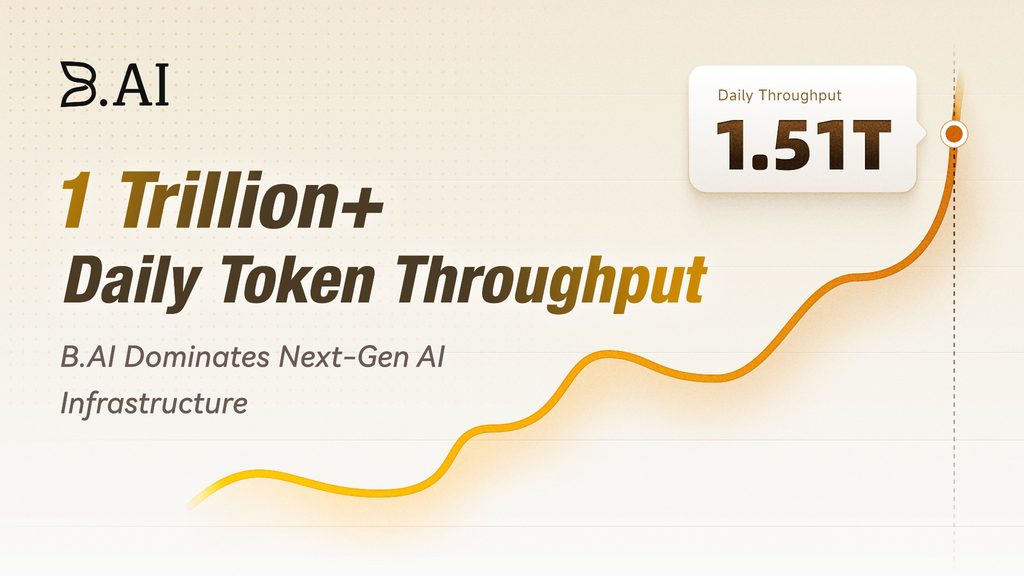
Singapore- Just five months after its launch, B.AI has already set a new industry record with a daily throughput of over 1.51 trillion tokens—a 71,500x-plus increase since inception.
B.AI achieved in just over 100 days what took OpenRouter, an early aggregation pioneer, roughly two years. Driven by the integration of settlement networks with core infrastructure, the exponential growth pulled off by B.AI highlights the viability of its full-stack commercial strategy while also demonstrating to the global market that the platform has risen to be the absolute leader in the next-generation AI infrastructure stack.
B.AI has secured its leadership thanks largely to its ability to capture and cater to the global demand for cost-effective, high-performance Chinese LLMs. While offering homegrown LLM products a critical gateway for international adoption, the platform has also gained a head start by positioning itself as a global compute distribution hub. B.AI’s ability to rise in this tailwind is rooted in its unique ecosystem design.
Co-incubated by TRON and YZi Labs, B.AI disrupts the market via a dual engine of settlement and distribution, plus its complete infrastructure for the emerging agent economy. The platform enables global access to top-tier LLM compute while equipping AI agents with native resource scheduling and execution capabilities—unlocking liquidity and value exchange across the global agent economy.
Unprecedented Infrastructure Growth: B.AI Builds Global Distribution Hub for LLMs
To reach 1.51 trillion tokens in its daily throughput, simply seizing the tailwind is far from enough. B.AI has also responded swiftly to two macro trends in the AI industry: the cost-performance advantage of leading Chinese LLMs and the surging demand for high-throughput, low-cost inference in the agentic era.
Over the past year, Chinese LLM developers like DeepSeek, Kimi, Qwen, and GLM have matched top global benchmarks at a fraction of the API cost. This unbeatable cost efficiency makes adoption virtually inevitable for developers worldwide.
As a global, next-generation infrastructure, B.AI aggregates top international models like GPT and Claude alongside rising Chinese LLMs. The platform has established close partnerships with Tencent, Alibaba, ByteDance, DeepSeek, Zhipu AI, Kimi, and MiniMax—all top LLM players in the Chinese market—to build a comprehensive model portfolio. This all-star model lineup has, in turn, made B.AI the default launchpad for Chinese LLMs seeking global expansion.
Chinese LLMs, including DeepSeek-V4-Flash, Qwen3.8-Flash, and GLM-5.3 Flash, have stood out as top-performing models on B.AI with the highest usage. Building on the momentum, B.AI continues to drive adoption through model discounts, limited-time free access, tiered API pricing (with discounts up to 90%), and developer incentives, aiming to convert model cost efficiencies into usable throughput for developers worldwide. The traction from this strategic positioning is clearly backed by the numbers: B.AI’s daily token throughput has breached 1.51 trillion—a massive 71,500x-plus surge since its first day upon launch.
Beyond its organic growth momentum, ecosystem partner YZi Labs serves as B.AI’s core distribution engine, continuously onboarding early-stage projects and developer communities. This ecosystem support enables B.AI to penetrate diverse real-world use cases, driving a steady influx of incremental traffic and commercial demand.
For foundation model providers, B.AI’s multi-trillion, high-concurrency architecture provides a fast track to high-value global workloads. Within this massive pool of demand, B.AI has evolved from a simple distribution channel into a primary facilitator—scaling the commercial reach of leading LLMs while reshaping the global AI landscape.
Beyond Aggregation and Routing: B.AI Builds Closed-Loop Infrastructure for the Agent Economy
Yet for this super amplifier to truly sustain a trillion-dollar agent economy, front-end compute routing is nowhere near enough. Building on the API aggregation foundation pioneered by early movers like OpenRouter, B.AI recognized a critical insight: fully unlocking massive agent collaboration requires a closed financial loop at the foundational layer.
To achieve this, B.AI bridges models and agents, creating a global settlement layer for intelligence. This core differentiator transforms the platform from a simple traffic conduit into the central master ledger for the entire agent economy, ensuring every cross-region call and task allocation is seamlessly routed, precisely metered, and automatically settled.
To achieve this vision, B.AI embeds settlement directly into the infrastructure layer, creating a dual-track Web2 and Web3 payment network. Built on Web3 principles, the architecture maintains backward compatibility with traditional Web2 payment systems. On the Web3 front, B.AI leverages on-chain settlement channels to provide global developers with decentralized, verifiable, and low-friction options that enable fully automated transactions and micropayments between agents. On the Web2 front, it preserves legacy gateways like WeChat Pay, Alipay, UnionPay, and Visa, ensuring effortless integration into existing enterprise workflows. Together, this dual-track model delivers a single integration point for frictionless global capital flow.
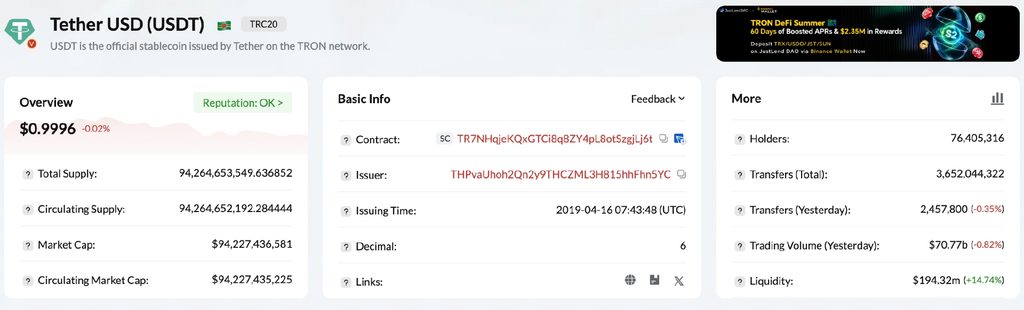
At the heart of this global liquidity is B.AI’s deep integration with TRON. As the world’s largest stablecoin transfer network, TRON offers B.AI a native payment rail through its massive USDT ecosystem, built for maximum liquidity and minimal friction. As of September 10, total TRC-20 USDT supply surpassed 94.2 billion, continuing to set record highs. Backed by TRON’s battle-tested on-chain capacity, B.AI provides the essential infrastructure required to scale cross-border compute scheduling and high-frequency automated agent micro-transactions.
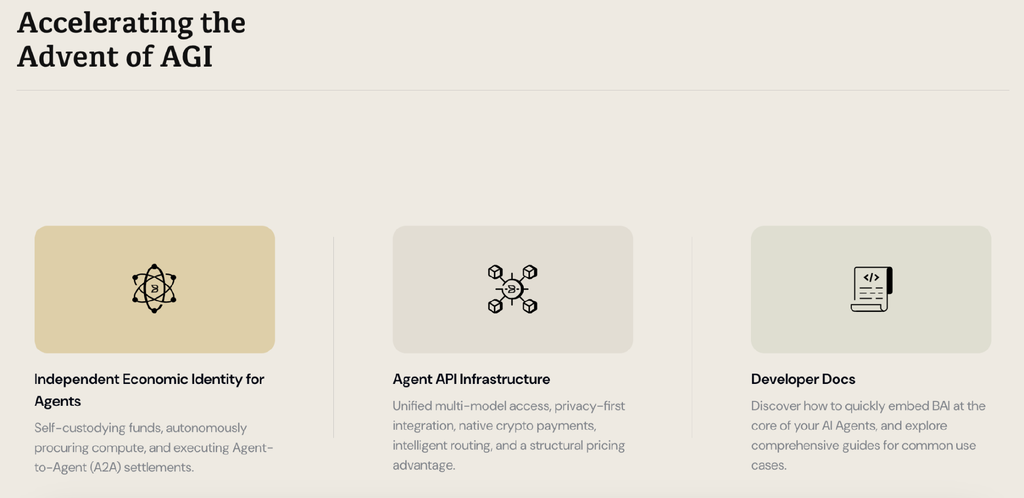
The true ambition of this architecture is to capture the emerging landscape of automated transactions in the agent economy ahead of the pack. The coming explosion in agent adoption will inevitably drive agent-to-agent (A2A) collaboration and autonomous commerce. Yet, fully unlocking this automated A2A synergy requires far more than just a foundational payment rail. B.AI builds beyond its Web3 smart settlement network by deploying a dedicated full-stack runtime environment for agents. This establishes an end-to-end, high-precision technical loop bridging compute scheduling, task execution, and financial settlement.
At the scheduling layer, B.AI drives fine-grained compute allocation. Its tiered API system fundamentally reshapes compute procurement logic, offering structured invocation plans that allow developers to match specific business demands with optimal compute resources.
At the execution layer, B.AI constructs a native agent collaboration ecosystem. It endows agents with direct operational capabilities to act across the digital world. Powered by embedded toolchains like Skills and Agent Wallet, alongside natively integrated AI assistants BAIclaw and BAI code, agents evolve into fully fledged digital workers capable of autonomous data acquisition and execution, laying a solid engineering foundation for multi-agent synergy.
At the protocol layer, B.AI establishes foundational transaction standards for A2A commerce. This marks B.AI’s most strategically profound move. By natively integrating the x402 payment protocol and the 8004 identity authentication protocol, the platform paves a standardized path for mutual trust, identity verification, and high-frequency automated settlement between agents.
From fine-grained model scheduling to intelligent collaboration systems and standardized transaction protocols, this architecture seamlessly fuses perception, reasoning, action, and settlement. This holistic infrastructure propels B.AI into a central hub for the agent economy, engineered to handle micro-transactions and compute settlement at scale. Crossing into the trillion-token era is merely a new starting point for B.AI. As next-generation AI infrastructure, its core value extends beyond distributing intelligence to powering transactions. By establishing foundational standards for high-frequency A2A collaboration, B.AI is reshaping the global flow of compute value, driving AI infrastructure into a new era built explicitly for agents and machine intelligence.
Investment Expert and Morris Group CEO Joseph Grinkorn Warns Investors Against doubting Elon Musk’s SpaceX Vision.
NEW YORK, NY, USA – Joseph Grinkorn, investment expert and chief executive officer of Morris Group, says investors may be underestimating the long-term potential of SpaceX and Elon Musk’s ability to repeat what he built at Tesla. His comments come during a volatile stretch for SpaceX stock since its June 12, 2026 initial public offering, when shares priced at $135 and closed the first trading day at $160.95, valuing the company at more than $2 trillion. Four days later, shares climbed as high as $225.64, pushing the market cap above $2.6 trillion, before short sellers and a wave of newly unlocked employee shares pulled the stock down to about $108. SpaceX stock has since recovered to roughly $148, still well short of its post-IPO peak.
Grinkorn cautions investors against taking short positions on SpaceX. He points to Musk’s record of challenging conventional expectations and building companies around technologies that redefine entire industries.
“Investors should be extremely cautious about shorting SpaceX,” said Grinkorn. “Elon Musk has demonstrated that he is one of the most influential business visionaries of the 21st century. What he accomplished with Tesla showed his ability to turn an ambitious vision into a globally dominant company. I believe SpaceX has the potential to follow a similar path.”
Grinkorn points to SpaceX’s expanding position across space transportation, satellite communications, artificial intelligence and advanced infrastructure as potential catalysts for long-term growth. SpaceX’s push into artificial intelligence deepened further in February 2026, when a merger with Musk’s AI venture, xAI, valued the combined entity at $1.25 trillion.
SpaceX has already changed the economics of orbital launch through reusable rocket technology, while Starlink has built a satellite communications business that reached 12 million active customers across more than 160 countries by June 2026, up from 9 million just nine months earlier. Starlink’s connectivity business generated an estimated $11.3 billion in 2025 revenue, per SpaceX’s own S-1 filing figures cited by Texxr. Analysts tracking the network’s growth project the subscriber base could reach 18 million or more by the end of 2026, reinforcing the case that SpaceX’s non-launch businesses now carry significant weight in its overall valuation.
According to Grinkorn, the market may be focusing too heavily on short-term stock volatility while overlooking Musk’s history of building businesses around technologies with enormous long-term markets.
Tesla offers the closest precedent. The company’s stock climbed 743 percent in 2020 alone, rising from $84.90 to $705.67 per share. Tesla’s market capitalization went on to top $1.19 trillion by the end of 2021, up from roughly $74 billion at the close of 2019. Tesla faced bankruptcy speculation before becoming one of the most valuable automakers in the world, and Grinkorn says that turnaround forms the core of his SpaceX comparison.
“Tesla demonstrated what can happen when Musk’s vision eventually catches up with the market,” Grinkorn said. “I believe investors should consider whether SpaceX could become his next big success story.”
Grinkorn’s message to investors is straightforward: doubting Musk has historically carried significant risk, and SpaceX may represent one of the most consequential companies of the next generation.
For more information about Joseph Grinkorn and Morris Group, please visit www.Morris-Group.co
About Joseph Grinkorn & The Morris Group
Joseph Grinkorn is a Wall Street investment expert and entrepreneur with over 20 years of experience across banking, finance, and real estate. As the founder and CEO of Morris Group, he has built a reputation for accurate market predictions and forward-looking investment strategies. He is frequently featured in the financial press for his insights on equity markets, tariffs, and global trade. Over the past decade, Grinkorn has focused extensively on technology and social media equity investments and has closed some of the most notable private market deals in the sector.
Founded in 2007, Morris Group is an international investment firm headquartered in New York City. The company operates three divisions: Morris Group Financial, focused on equity investments in technology and social media companies; Morris Group Properties, specializing in high-return real estate investments; and Morris Group Funding, providing commercial and residential financing solutions. With its data-driven approach, transparency, and commitment to growing client returns, Morris Group has established itself as a trusted leader in the investment sector.
Media Contact
Company Name: Morris Group Phone: (646) 673-8404 Country: United States Website: www.morris-group.co
BANGKOK, Thailand- Gold remains one of the most actively followed markets in 2026, with XAU/USD attracting traders looking for exposure to movements in the price of gold without necessarily owning the physical metal.
Choosing a platform for trading XAU/USD, however, involves more than finding the lowest advertised spread.
Trading costs can change depending on the account structure. Execution conditions can become more important during volatile markets. Leverage and margin requirements may differ between regulatory entities. Even products carrying similar XAU/USD labels can have different contract specifications or trading schedules.
A more complete comparison therefore considers total trading costs, execution quality, regulation, leverage and margin, account structure, contract specifications, trading platforms, trading hours, copy trading, withdrawals and risk-management tools together.
Different platforms can also be useful examples of how these factors work in practice. Some emphasise raw-style pricing and active trading, others provide broader platform ecosystems or stronger risk-management features, while newer products are extending access to gold beyond the conventional trading week.
Here are the main factors to consider when comparing XAU/USD trading platforms in 2026.
1. XAU/USD Spreads and Total Trading Costs
The lowest advertised XAU/USD spread is not necessarily the lowest trading cost.
A spread represents the difference between the bid and ask prices, but it may only be one component of what a trader ultimately pays.
Total trading cost = spread + commission + realised slippage + overnight financing + other applicable charges
This distinction becomes particularly important when comparing Standard and Raw-style accounts. Standard accounts commonly incorporate more of the transaction cost into the spread. Raw-style accounts may quote tighter variable spreads while charging a separate commission.
Vantage provides one practical example of this distinction. Its Standard STP account does not charge a separate trading commission on the standard pricing structure, while its Raw ECN account separates raw-style spreads from commission. Vantage’s current commission schedule lists USD 3 per lot per side for a USD-denominated Raw ECN account and USD 6 round turn per lot for precious metals. Its Raw ECN account page also advertises spreads from 0.0 pips on major FX pairs, subject to market conditions. These figures illustrate why traders should compare the combined spread and commission rather than treating a minimum spread as the total cost of a trade.
Holding period matters as well. For a trader opening and closing multiple XAU/USD positions within the same trading day, spread, commission and slippage can account for much of the direct transaction cost. For positions held for several days, overnight financing may become increasingly important and can outweigh a relatively small difference in the opening spread.
The most useful cost comparison is therefore based on the all-in cost of the trading strategy, not a single advertised number.
2. Execution Quality, Liquidity and Slippage
Gold can move rapidly around inflation releases, employment reports, central-bank decisions and geopolitical events.
During these periods, the price visible when an order is submitted may differ from the price at which it is ultimately executed. This difference is commonly referred to as slippage.
Execution quality should therefore be considered alongside spreads.
Pepperstone provides an example of a platform that publishes execution-related information. Its current official trading pages state execution speeds from 50 milliseconds and a 99.32% fill rate. Such metrics can be useful because they give traders additional factors to examine beyond the minimum quoted spread.
However, an execution-speed figure should not be interpreted as a guarantee that every XAU/USD order will be filled at a particular price. Market liquidity, order size, volatility and the type of order being submitted can all influence the final result.
For traders who place a high number of XAU/USD trades, realised execution data may be more useful than marketing claims. They can compare the requested price with the filled price and record positive and negative slippage over a meaningful sample of trades.
The relevant question is therefore not simply, “How fast is the platform?” It is, “What price am I actually receiving after spread, commission and slippage?”
3. Regulation and Reliability
Regulation is another area where simple brand-level comparisons can be misleading.
International trading platforms may operate through several legal entities in different jurisdictions. The conditions applying to a trader can depend on which entity actually holds the account. This may affect leverage limits, margin requirements, available products, client-money arrangements, negative balance protection and dispute procedures.
IG illustrates a different type of platform proposition in this respect. Its gold offering is supported by a broader trading infrastructure and risk-management framework, including guaranteed-stop functionality on eligible products and accounts under applicable conditions.
The wider lesson is more important than the individual brand. Instead of asking only, “Is this broker regulated?”, traders should ask, “Which legal entity will hold my account, who regulates that entity, and which protections apply to me?”
A global brand name alone does not determine the conditions or regulatory protections attached to every account.
4. Leverage and Margin Requirements
Maximum leverage is often one of the most visible numbers on a CFD platform, but higher leverage does not automatically make a platform better.
Leverage determines how much margin is required to control a given amount of market exposure. For example, controlling $100,000 of gold exposure at 1:20 leverage would theoretically require approximately $5,000 of initial margin. At 1:100, the theoretical requirement would fall to around $1,000. At 1:500, it would fall to around $200. The underlying $100,000 exposure has not changed.
Eightcap provides a useful illustration of how jurisdiction can affect this calculation. Its current XAU/USD specification page for Eightcap Global Limited lists leverage up to 1:500, while its UK XAU/USD page lists leverage up to 1:20 for an FCA account. The difference does not mean that one version is automatically better; it demonstrates how trading conditions can vary by entity.
This is why a single statement such as “this platform offers leverage up to 1:500” does not necessarily describe the conditions available to every trader.
Actual leverage can depend on the legal entity, client classification, account conditions, position size and instrument. For XAU/USD traders, margin should therefore be considered together with position sizing and risk rather than treated simply as a feature to maximise.
5. Account Types and Pricing Models
Account structure has a direct relationship with trading costs.
A Standard-style account generally uses a spread-based pricing model that can be easier to understand because much of the transaction cost is reflected directly in the bid-ask spread. Raw-style accounts typically separate the pricing components: the quoted spread may be tighter, but commission can be charged separately.
IC Markets is an example of a platform strongly associated with Raw Spread pricing and automated trading workflows. Its official materials describe Raw Spread accounts and support for MetaTrader and cTrader environments, including algorithmic trading tools.
But a Raw account is not automatically cheaper for every trader.
The appropriate comparison is average spread + round-turn commission + realised slippage, rather than minimum Raw spread versus Standard spread. Trade frequency, typical position size and holding period can materially change which pricing structure is more suitable.
6. XAU/USD Contract Specifications
Two platforms can both display “XAU/USD” while using trading specifications that are not completely identical.
Contract size is particularly important. A common conventional XAU/USD CFD structure uses 100 troy ounces for one standard lot. Current XAU/USD specifications from providers such as Eightcap and OANDA show 100-ounce contract or MetaTrader lot structures for the relevant products.
Under a 100-ounce structure, 0.10 lot represents approximately 10 ounces and 0.01 lot represents approximately one ounce. If gold moves by $1 per ounce, a 100-ounce position changes in value by approximately $100 before considering other trading costs.
Traders should therefore check more than the instrument name. Important specifications can include contract size, minimum trade size, maximum position size, tick size, margin requirements, trading hours and any position-dependent leverage tiers.
This becomes particularly important when comparing conventional XAU/USD with newer or extended-hours gold products, because the word “gold” does not mean the contract structure is necessarily identical.
7. MT4, MT5, TradingView and Mobile Trading
Platform selection depends heavily on trading workflow.
MetaTrader 4 remains widely used for established Expert Advisors and familiar FX/CFD trading workflows. MetaTrader 5 provides a newer multi-asset environment with additional functionality. TradingView appeals to traders who place greater emphasis on browser-based charting, technical analysis and a familiar visual interface. Other traders may prefer cTrader or a provider’s proprietary web and mobile applications.
Pepperstone illustrates the multi-platform approach, with current official materials listing MT4, MT5, TradingView, cTrader and its native platform and app.
Vantage provides another example. Its current trading-platform pages list Vantage App, Vantage Web Trading, MT4, MT5, TradingView and copy-trading access.
The number of platforms alone should not determine the choice. A trader using automated strategies may care more about EA compatibility, execution and VPS connectivity. A discretionary technical trader may place greater weight on TradingView integration. Someone who trades primarily from a phone may care more about order management and mobile usability.
The most useful platform is therefore the one that fits the trader’s actual workflow.
8. Trading Hours and 24/7 Gold Access
Conventional XAU/USD CFDs generally trade close to 24 hours during the working week, although daily maintenance or rollover breaks may apply. Weekend access has traditionally been more limited.
An interesting development is the introduction of products designed to extend gold trading beyond the conventional weekday schedule.
Vantage provides one example through XAUUSD247, a separate gold CFD product designed to provide 24/7 trading access for eligible clients. Vantage’s current product page lists a 1-ounce contract size for XAUUSD247, compared with 100 ounces for its traditional XAUUSD product, and states that XAUUSD247 uses variable spreads with no separate commission.
The distinction between conventional XAU/USD and XAUUSD247 is important. Extended trading hours should not automatically be interpreted as the same contract simply remaining open for longer. Contract size, leverage, pricing and other specifications can differ between products.
Weekend liquidity conditions can also differ from those during major weekday sessions. The broader lesson for traders is to compare both when the product can be traded and what the underlying trading specifications are during those hours.
Flexible access can be useful, but trading hours should never be evaluated separately from liquidity, spread and contract structure.
9. Copy Trading and Social Trading
Copy trading can provide another way to participate in XAU/USD strategies without manually placing every trade.
Several multi-platform providers integrate some form of social or copy-trading functionality. Vantage, for example, lists Copy Trading as part of its current platform ecosystem.
But the availability of a copy button says relatively little about the quality of the underlying strategy.
When evaluating a gold strategy, traders should look beyond historical return and win rate. Relevant factors include maximum drawdown, average leverage, position size, largest historical loss, frequency of trading and whether the strategy uses techniques such as martingale, grid trading or repeated averaging into losing positions.
A strategy can display a high historical win rate while still carrying substantial tail risk. For that reason, copy trading should be evaluated as a risk-management decision rather than simply as another platform feature.
10. Funding and Withdrawals
Withdrawal speed is often used when comparing trading platforms, but the phrase “fast withdrawal” can describe several different processes.
There is a difference between the time a platform takes to approve and process a withdrawal and the time required for the funds to arrive in the trader’s bank account, card or payment service.
Banks, card networks, payment providers, weekends, currencies and compliance checks can all affect the second part of the process. Anti-money-laundering requirements may also affect which withdrawal route can be used.
This makes guaranteed withdrawal-time claims difficult to compare meaningfully.
A more practical approach is to review the platform’s published processing policy, supported payment methods, applicable fees and identity-verification requirements separately from the processing time of the external payment provider.
11. Risk-Management Tools
Gold’s volatility makes risk management particularly important when leverage is involved.
Basic tools can include stop-loss orders, take-profit orders, trailing stops, margin alerts and negative balance protection where applicable.
However, traders should understand the difference between a normal stop and a guaranteed execution mechanism. A conventional stop-loss order normally becomes a market order when the stop level is triggered. If the market moves rapidly through that level, the final execution price may be different.
IG provides a useful example. Its current risk-management and commodity pricing information describes guaranteed stops for eligible products and accounts; for Spot Gold, applicable guaranteed-stop premiums are published in relevant regional product details.
This type of feature may be relevant to traders who are particularly concerned about gaps or sudden market movements. Even then, platform tools are only one part of risk management.
Position size, leverage, available margin and the amount of capital exposed to a single trade remain fundamental considerations.
12. Which XAU/USD Platform Features Suit Different Traders?
Different types of gold traders are likely to prioritise different platform characteristics.
An active trader making frequent XAU/USD transactions may place greater weight on average spreads, commissions, execution quality and realised slippage. Raw-style pricing environments may therefore deserve closer examination.
A trader using Expert Advisors may focus more heavily on MT4 or MT5 compatibility, execution conditions, VPS connectivity and contract specifications.
TradingView-focused traders may prioritise native platform integration and charting workflow rather than selecting a provider based only on the smallest advertised spread.
Beginners may benefit more from straightforward pricing, demo access, smaller minimum position sizes, understandable margin requirements and accessible risk-management tools.
Copy-trading users need to assess the underlying strategy, especially drawdown and leverage, rather than treating historical returns as the primary selection criterion.
Traders holding XAU/USD positions for several days should pay greater attention to overnight financing because holding costs can become more important than small differences in transaction spreads.
Finally, traders interested in flexible or weekend gold access should compare trading schedules together with liquidity and contract specifications. A 24/7 product should not automatically be assumed to have the same structure or trading conditions as conventional weekday XAU/USD.
There is therefore no single platform feature that determines suitability for every type of gold trader.
Final Thoughts
Comparing XAU/USD trading platforms in 2026 requires more than looking for the lowest spread or highest leverage.
The most useful approach is to consider the entire trading environment.
That starts with the all-in trading cost, including spread, commission, slippage and overnight financing. It then extends to execution quality, the legal entity holding the account, leverage and margin requirements, account structure, contract specifications, platform access, trading hours, withdrawals and risk-management functionality.
Real-world platforms illustrate why different factors matter. Raw-style account structures demonstrate why a minimum spread does not equal total trading cost. Published execution metrics show why fill quality can matter alongside spreads. Different regulatory entities demonstrate why leverage can vary within the same global brand. Extended-hours products such as XAUUSD247 show why trading schedules need to be considered alongside contract specifications.
The most suitable XAU/USD platform is therefore not necessarily the one advertising the smallest spread, the highest leverage or the largest number of features.
It is the one whose cost structure, execution environment, legal entity, trading technology, product specifications and risk characteristics most closely match the trader’s intended approach.
References
Link check: The URLs below were opened and verified as live, non-404 pages on 14 September 2026.
13. IG — Risk Management https://www.ig.com/en/risk-management Stop-loss, guaranteed-stop and negative-balance-protection information under applicable conditions.
Source note: Product specifications, spreads, commissions, leverage, trading hours, platforms and regulatory conditions can change and may differ by country, legal entity and account type. Readers should verify the latest conditions with the relevant provider and regulatory documentation.
Risk disclosure: CFDs and leveraged XAU/USD products involve significant risk and can result in rapid losses. Leverage magnifies both gains and losses, and past performance of trading or copy-trading strategies does not guarantee future results.
Media Contact Details:
Contact Person: Yoki Job Title: Public Relations Manager Company Name: Vantage Markets Email Address: support@vantagemarkets.com Company Website: https://www.vantagemarkets.com
Kerry Ray Lampkin Jr. directed his defense to a Not Guilty theft verdict and says his ongoing federal dispute is open to a negotiated resolution.
Austin, Texas – Kerry Ray Lampkin Jr., a 37-year-old Indigenous American and native son of this land, was acquitted by a Bexar County jury after being charged with theft of property valued from $30,000 to less than $150,000. The certified judgment in State of Texas v. Kerry Lampkin, case 2024CR009936, records the jury’s Not Guilty verdict and orders his immediate discharge. The acquittal was entered June 18, 2025, in the 187th District Court.
Lampkin says the victory came after he ended his relationship with prior counsel and took direct command of his defense strategy. His account is one of pressure, preparation, faith, and refusal to fold when the machinery around him appeared overwhelming. The official judgment records that he appeared with counsel at trial, while Lampkin maintains his account of self-representation.
The acquittal closed the prosecution, but Lampkin says it did not close the damage. He reports lasting financial loss, disruption, reputational harm, emotional strain, and continuing consequences arising from the events surrounding the case. He says he is now pursuing a federal action seeking $12 million in damages. The federal claims remain allegations unless and until resolved through judgment or agreement.
LAMPKIN STATEMENT: “They had the accusation, the resources, and the weight of the system. I had the truth, my faith, and the courage to stand. A jury heard the evidence and said Not Guilty. Now the fight is about repairing what was broken and making sure accountability reaches every door it must reach.”
Today, Lampkin is turning lived experience into instruction and purpose. Through Prosperity Trust and Funding and his Skool community, Possessing the Land with Kerry Lampkin, he teaches, speaks, writes, produces media, and leads conversations centered on faith, financial understanding, self-education, accountability, and disciplined action. His message reaches beyond one courtroom: knowledge must become courage, and courage must become constructive work that strengthens families and communities.
HIS TEACHING CREED: Knowledge is protection. Truth is power. When you know your rights, fear leaves the room.
A MESSAGE FROM KERRY: “Life will throw things at you, and sometimes you have to face them head-on. What was meant to break you does not have to break you. It can become the vehicle that carries you toward your destination, your purpose, and what God created you to do. Never look at trials and tribulations as the end. Receive the lesson, rise with greater wisdom, and keep moving forward. I approve this message.” Says Kerry Ray Lampkin Jr.
Although prepared to continue the federal fight, Lampkin says he remains open to serious, good-faith discussions aimed at resolving the dispute outside court. His position is direct: peace is possible, but any resolution must recognize the scope of the claimed harm and bring meaningful closure.
The story carries a wider message for communities across Texas and the nation: an accusation is not a conviction, pressure is not proof, and one determined voice can still be heard by twelve jurors.
STATE CASE DETAILS
Case: 2024CR009936
Court: 187th District Court, Bexar County, Texas
Verdict: Not Guilty by jury
Acquittal Entered: June 18, 2025
About Kerry Ray Lampkin Jr.
Kerry Ray Lampkin Jr. is a Texas-based educator, motivational speaker, father, mentor, author, film producer, entrepreneur, minister, and community advocate committed to helping everyday families stand with confidence in courtrooms, contracts, and life. Through Prosperity Trust and Funding and the Skool community Possessing the Land with Kerry Lampkin, he teaches people how to read documents, organize records, understand process, protect their rights, and speak clearly without fear or confusion. His public story follows a Bexar County jury acquittal, an ongoing effort to obtain redress for the harm he says followed the underlying events, and a mission to turn panic into power, pressure into preparation, and adversity into purpose.
For any inquiry contact KerryRayLampkinJr@gmail.com or call (866) 299-5164
Media Contact
Company name: Prosperity Trust and Funding Contact name: Kerry Ray Lampkin Jr. Email: KerryRayLampkinJr@gmail.com Phone: (866) 299-5164 Website:https://www.instagram.com/KerryLampkin
SAN JOSE, Calif. —Cardano users with assets remaining in SecondFi wallets are advised to migrate their funds to a new wallet they control and remain alert to phishing and recovery scams.
Following the June 2026 security incident involving SecondFi, users are being advised to understand the difference between asset migration and recovery before taking any action.
SecondFi reported that approximately 16.1 million ADA across 374 wallets was stolen during the security incident between June 21 and June 23, 2026. The company subsequently announced plans to wind down its wallet operations.
For users whose wallets still contain assets, SecondFi’s current official migration process is intended to move remaining ADA, Cardano native tokens and NFTs to a new Cardano wallet controlled by the user.
How the SecondFi Migration Works
Users with remaining assets should:
Create a new Cardano wallet with a trusted provider.
Secure the new wallet and its recovery phrase.
Copy the new wallet’s Cardano receiving address.
Open the existing official SecondFi application.
Select the wallet migration option.
Enter and carefully verify the new wallet address.
Review the migration transactions.
Sign the transactions using the normal SecondFi authentication process.
Confirm that the assets have arrived in the new wallet.
Users should never enter their SecondFi recovery phrase into the migration tool.
Migration and Recovery Are Different
Users whose wallets still contain assets should follow the migration process. Those whose assets were removed during the security incident are dealing with a recovery case, which is separate from ordinary migration.
SecondFi has advised affected users to retain their original wallet and application because they may be required during the recovery process.
Users should also avoid assuming that one migration covers multiple wallets. Each SecondFi wallet should be checked and handled separately.
What Happens to Staking?
The official migration process also addresses staking-related activity.
For a staked wallet, the process may include unstaking, withdrawing available staking rewards, deregistering the existing stake key and recovering the stake deposit before transferring the relevant assets to the new wallet.
Once the assets arrive in the new wallet, users who want to continue staking will need to configure staking again.
Migration can also affect Cardano governance. Because the existing stake key is deregistered, previous DRep delegation may no longer remain active. Users who participate in Cardano governance should review their settings after migration.
Cardano Wallets Users Can Consider
There is no single wallet that is best for every Cardano user. Depending on their needs, users may consider established options such as:
Eternl
Lace
NuFi
VESPR
Typhon
Daedalus
Compatible hardware-wallet solutions
Regardless of the provider selected, the destination wallet should be created and controlled by the user.
Users should never accept a wallet address or recovery phrase from someone contacting them through Telegram, Discord, X, email or another messaging platform.
Hardware Wallet Users Should Take Extra Care
SecondFi’s current guidance distinguishes hardware-wallet users from standard software-wallet migration.
Hardware-wallet users should not use the normal in-app migration flow. Instead, they may access their existing hardware wallet through another compatible Cardano wallet interface.
This distinction is important because changing the wallet application used to access a hardware wallet is not necessarily the same as transferring assets to a completely new wallet.
SecondFi Migration Scam Warning
The shutdown of a cryptocurrency wallet can create opportunities for scammers posing as support agents or recovery specialists.
Users should be particularly cautious of websites, applications or individuals claiming to offer:
SecondFi wallet migration
SecondFi recovery
Wallet verification
Cardano recovery
Asset recovery services
SecondFi has warned users about fake applications, browser extensions and phishing attempts connected to the migration process.
Users should never:
Share their recovery phrase or private key.
Send ADA to someone claiming to facilitate migration.
Install migration software from an unsolicited link.
Give remote access to their computer or phone.
Allow another person to create their destination wallet.
Trust unsolicited “support” messages.
Believe claims of guaranteed recovery of stolen assets.
Verify Every Transaction Before Signing
Blockchain transactions generally cannot be reversed once signed and submitted.
Before approving a migration transaction, users should carefully verify the:
Destination wallet address
Network
Asset amounts
Transaction fees
Wallet provider
After migration, users should independently confirm that their ADA, native tokens and NFTs have arrived. They can also use a reputable Cardano block explorer to verify the transaction on-chain.
Key Advice for SecondFi Users
The most important principle is simple: the destination wallet must be controlled by the user.
Users with remaining SecondFi assets should use the official migration process, create a new wallet themselves, protect the new recovery phrase and carefully verify every transaction before signing.
Users affected by the June 2026 security incident should follow the separate recovery process rather than treating an emptied wallet as a normal migration.
Above all, users should remember:
Never share your recovery phrase. Never send ADA to a stranger for “migration.” Never trust unsolicited support messages. And always verify the destination address before signing a transaction.
For official information and the latest migration guidance, users should rely on SecondFi’s official channels rather than third-party links or messages.
Singapore – B.AI, a next-generation AI infrastructure platform, recently set off a developer frenzy by offering free access to top-tier models. Within days, daily token throughput across the platform crossed 1.33 trillion—a historic milestone.
The record-breaking figure underscores the campaign’s explosive rollout, but it marks only the first step in B.AI’s broader strategic roadmap. Moving beyond traditional compute distribution pipelines, B.AI aims to build the global settlement layer for intelligence: a core infrastructure hub engineered to power cross-node collaboration, orchestration, and value distribution for AI agents across complex business workflows.
Positioning itself strategically above all models, below all agents, B.AI deeply integrates a diverse range of top-tier models with full-stack components, laying an unshakable, irreplaceable foundation for the mass adoption of autonomous agents and the productivity boom that follows.
B.AI’s recent move to open free access to premium AI models has captivated developers and quickly taken over industry conversations. The push for accessible compute has not only fueled a surge in platform activity but also shattered usage records.
In a matter of days, soaring API demand pushed the platform’s daily token throughput past a staggering 1.33 trillion. Over a 15-day window, cumulative volume reached 8.19 trillion tokens, drawing in more than 220,000 new API users. As of September 3, B.AI’s total user base had officially surpassed 2.3 million.
That massive adoption traces directly to the platform’s zero-cost model lineup, a strategic rollout built to erase developers’ cost concerns. With every barrier removed, B.AI now offers unlimited free access to six leading frontier models: DeepSeek-V4-Flash, DeepSeek-V4-Flash-Vision-Exp, Tencent Hy3, Xiaomi MiMo-V2.5, GLM-5.3-Flash (Ox Alpha), and Qwen3.8-Flash.
Notably, on September 3, B.AI rolled out a new pricing structure for DeepSeek-V4-Flash and DeepSeek-V4-Flash-Vision-Exp, introducing tiered discounts. Developers now receive a 50% discount during peak hours, with off-peak rates dropping to just 25% of standard peak pricing. At the same time, the platform has kept zero-cost access in place for GLM-5.3-Flash (Ox Alpha), Qwen3.8-Flash, Tencent Hy3, and Xiaomi MiMo-V2.5. Despite the shift toward commercialization, developer momentum hasn’t wavered, with platform-wide token throughput continuing its steady climb.
This sustained momentum proves the campaign was far more than a short-term compute giveaway—it is a bellwether for the broader evolution of AI infrastructure. Cracking 1.33 trillion daily tokens makes one thing clear: AI applications are moving past basic chatbots. Powered by a high-performance technical stack and flexible service mechanics, B.AI is laying the groundwork for the next frontier—autonomous AI agents operating at scale.
Powering the “AI Grid”: B.AI Anchors the Global Settlement Layer for the Agent Economy
For B.AI, democratizing compute is only the prelude. Looking further ahead, the platform is committed to building full-stack infrastructure for the agentic era, cementing its position as the global settlement layer for intelligence.
In the agent era, a typical agent task calls for constant switching between models. No single provider can power a complete workflow on its own, so developers are left juggling fragmented API protocols, disjointed billing systems, and conflicting rate limits.
B.AI’s settlement layer bridges this exact gap. Positioned strategically “above all models, below all agents,” B.AI abstracts models across different providers, capabilities, and cost structures into a unified pool of schedulable resources.
Powered by a dual-tier API structure offering official-route reliability alongside lowest-cost custom channels, developers can choose between guaranteed direct connections and deeply discounted options across a broad lineup of models. Combined with smart routing on the Chat interface, B.AI operates as a full-stack “AI grid,” ensuring every agent request lands on the optimal model to deliver reliable performance at maximum cost-efficiency.
On the settlement front, this power grid seamlessly bridges both Web2 and Web3 models. For Web2, developers can rely on familiar traditional payment methods to top up with minimal friction. For Web3, B.AI leverages on-chain payment rails to offer global developers decentralized, verifiable, and low-friction payment options.
With dual payment systems running in parallel, B.AI enables developers and agent applications across any infrastructure setup to find their optimal settlement path on the grid, providing single-point integration with borderless global reach.
Beyond building a foundation for compute routing and global settlement, B.AI is moving past base infrastructure to power real-world productivity. By enabling seamless agent collaboration across complex workflows, it delivers the missing execution layer for the agent economy.
At the heart of this execution layer is native Codex integration. Full compatibility with the Responses API means developers can now use a single B.AI key inside Codex to run flagship GPT models and DeepSeek favorites side by side.
Engineers can now bring these powerhouse models straight into their daily dev stack. From code generation and reasoning to debugging and refactoring, B.AI unifies the entire workflow under one roof—delivering a direct line from model selection to shipped code.
Beyond coding, to keep agents running reliably in real-world production at scale, B.AI has built a full-stack infrastructure powered by five core components, equipping agents with a fine-tuned operational engine:
x402 Payment Protocol: Introduces an innovative “pay-before-response” model that executes high-frequency, on-chain micro-settlements in the background during cross-agent API calls and compute orchestration.
8004 Identity Protocol: Issues verifiable on-chain credentials for every agent, logging execution history and credit scores to establish a reliable layer of trust for cross-node collaboration.
Skills Matrix: Plug-and-play, standardized building blocks that interface directly with MCP servers to equip agents with instant, modular tool-calling capabilities.
BAIclaw and BAIcode: Built-in platform assistants engineered for end-to-end execution. BAIclaw manages all-in-one terminal operations and multi-agent workflows, while BAIcode serves as an advanced developer engine that streamlines the full pipeline from task analysis and architecture design to coding and testing.
From the token surge sparked by zero-cost model access to its positioning as the global settlement layer for intelligence; from seamless Codex integration to full-stack infrastructure powered by x402, 8004, Skills, and native assistants—B.AI delivers far more than a battle-tested technical stack; it unveils a clear blueprint for what lies ahead. B.AI is building not just accessible compute today, but the definitive launchpad for a thriving agent economy. The future is here—and this is only the beginning.
New vEdgeIPS Pro virtual appliances and closed-loop AI automation cut policy deployment effort by more than 90 percent, debuting this September at SEMICON Taiwan
TAIPEI, Taiwan, Sept. 4, 2026 -TXOne Networks, a leader in Cyber-Physical Systems (CPS) security, today launched its next-generation Edge Networking Solution at flagship industry event this September: SEMICON Taiwan, September 2 to 4 in Taipei. The release adds four AI-powered capabilities across TXOne’s Discover, Assess, and Protect framework, and introduces vEdgeIPS Pro, TXOne’s first virtual appliance line, extending Edge’s inline, fail-safe protection from physical hardware to virtualized OT infrastructure.
Semiconductor fabs and discrete manufacturing plants alike run valuable production lines on process tools that can never be patched, alongside newer systems that increasingly connect back to the corporate network. Only 1 in 8 organizations report full visibility into the ICS Kill Chain, leaving 75% of organizations with a gap between detection and containment of more than 6 hours (SANS 2025 State of ICS/OT Security Survey). Given that attacks such as LockBit ransomware can execute in ~4 minutes (Splunk SURGe, 2022), this gap can lead directly to a full plant shutdown. SEMICON Taiwan brings TXOne directly to a community carrying that same risk, one in semiconductor manufacturing, the other across discrete and process automation broadly.
“Semiconductor fabs and discrete manufacturing plants run some of the most valuable and most exposed production networks anywhere, full of equipment that will never see another security patch,” said Dr. Terence Liu, Chief Executive Officer of TXOne Networks. “This release puts AI to work at every stage of Edge: it finds legacy assets no signature ever could, writes and tunes security policy in hours instead of weeks, and turns a flood of alerts into one prioritized next step. We are introducing it everywhere our customers already are.”
Four AI Pillars, One Closed Loop
Most security tools simply generate alerts and stop there. TXOne developed four capabilities that connect throughout the Discover, Assess, and Protect cycle. This interconnected approach ensures that protection builds upon itself, creating a cumulative defense rather than just accumulating dashboards.
Asset Intelligence: AI-based OS fingerprinting identifies legacy and embedded devices that signature-only tools miss, then maps them automatically to known vulnerabilities, with online, offline, and air-gapped update support.
Policy Automation: AI-powered rule learning builds, aggregates, and tunes security policy automatically, cutting deployment effort by more than 90% and compressing rollout from weeks to hours without losing coverage or accuracy.
Threat Alert Visibility: An AI-enhanced alert engine groups events by real-world severity, automatically builds the attack chain from detection through vulnerability match to response, and maps every affected asset connection, turning forensics from hours and informational into seconds and actionable.
OT Integration: A built-in MCP (Model Context Protocol) Service and RESTful APIs let authorized AI agents query and act on Edge data in plain language, inside EdgeOne’s own security perimeter.
The loop closes where it starts: attack-chain findings from Threat Alert Visibility feed back into Asset Intelligence and Policy Automation, sharpening the system continuously, helping prevent incidents before they begin.
The release also extends support for manufacturers working toward industry standards such as SEMI E187, the semiconductor industry’s fab equipment cybersecurity specification, pairing network segmentation, OT protocol trust lists, and virtual patching with fail-safe design built in.
One Architecture, Physical or Virtual
Edge already spans rugged, small-form-factor appliances, high-port-density and 10-gigabit rack systems, EdgeFire industrial firewalls, and EdgeOne central management on-premises or in the cloud. This release adds vEdgeIPS Pro, bringing that same inline protection into virtualized environments for the first time, so a plant running virtualized control systems gets the same security architecture as one running physical hardware, sized from a single virtual machine to a full production cluster.
“Every capability in this release was built for the plant floor: brownfield assets, air-gapped networks, and zero tolerance for downtime,” said Ryan Lung, Director of Network Defense Solution at TXOne Networks. “Fail-safe design means security never gets in the way of production. Protection is proactive, policy decisions are explainable, and value shows up within the first hour of deployment.”
Availability
The AI-powered Edge Networking Solution, including vEdgeIPS Pro, will be available worldwide in September 2026 through TXOne Networks and its global partner network. More information: www.txone.com.
About TXOne Networks
TXOne Networks offers cybersecurity solutions that ensure the reliability and safety of industrial control systems and operational technology environments, working with leading manufacturers and critical infrastructure operators on practical, operations-friendly approaches to cyber defense. TXOne Networks offers both network-based and endpoint-based products securing the OT network and mission-critical devices through a real-time, defense-in-depth approach.
MEDIA CONTACT
Company: TXOne Contact Person: Media Relations Email: coco_chang@txone.com Website:https://www.txone.com
Singapore- In H1 2026, TRON bucked broader market headwinds through a twin-track strategy: solidifying its core DeFi engine while aggressively expanding into AI. As recurring deflationary mechanics anchored value across DeFi protocols, a rapid wave of AI product launches unlocked new vectors for ecosystem growth.
Throughout the first half of 2026, global crypto markets faced a macro-driven cooldown. Tightening market liquidity and capital rotations into traditional AI tech pushed many crypto sectors into stagnation. TRON, however, carved out a distinct counter-cyclical rally. From expanding its stablecoin settlement layer and upgrading core DeFi asset value, to strategically positioning itself across the Web3 AI stack, TRON delivered ecosystem-wide growth that significantly outperformed industry benchmarks.
At the heart of this performance is TRON’s stablecoin infrastructure, which serves as the primary liquidity engine for the entire network. During H1 2026—even as global USDT market cap held relatively flat—circulating USDT on TRON expanded rapidly, breaking through $90 billion and setting consecutive all-time highs as it approaches the $100 billion milestone. This sustained liquidity depth cements TRON’s role as the leading settlement network for digital dollars, providing low-cost, capital-efficient liquidity for applications building on top of the layer.
Building on its stablecoin dominance, TRON pursued a cohesive strategy throughout H1 2026: fortify the DeFi foundation and expand the AI front. In DeFi, key protocols introduced recurring buyback-and-burn mechanics alongside steady feature upgrades, sharpening the network’s overall value-capture capability. Simultaneously, TRON executed a rapid rollout of foundational AI products—building a full-stack Web3 AI ecosystem that spans unified multi-model access layers, AI agent infrastructure, and distributed compute networks.
DeFi Ecosystem: Synergizing Token Deflation with Protocol Innovation
Against industry headwinds in H1 2026, TRON’s DeFi sector advanced a dual-track strategy: value empowerment via buybacks and burns, and continuous product iteration. On one hand, the ongoing execution of buyback and burn mechanisms by core projects across multiple tracks established a normalized, ecosystem-wide deflationary system. On the other, the relentless refinements to the functionality and user experience of core protocols enhanced both token value and protocol fundamentals.
To drive sustainable tokenomics, core ecosystem projects established programmatic buyback-and-burn mechanisms, forming a network-wide deflationary matrix across liquidity infrastructure, lending, oracles, and decentralized storage:
SUN.io (Liquidity): Expanded its SUN buyback revenue streams. Starting with its 50th buyback and burn round in April, revenue from SUNX derivatives was permanently added to the burn pool alongside existing fees from SunSwap V2 and SunPump. The protocol completed its 50th and 51st token burn rounds in April and July, respectively.
JUST (DeFi): Executed scheduled, multi-round JST token burns. The protocol completed its 2nd and 3rd large-scale buyback and burn rounds in January and April, followed by a record-setting 4th round in July that marked the largest capital allocation to date.
WINkLink (Oracles): Launched a dedicated WIN buyback-and-burn program in July, allocating 100% of oracle service revenue toward repurchasing and burning WIN tokens.
BitTorrent (Storage & Compute): Initiated a BTT buyback-and-burn program in July, funneling all revenue from decentralized services directly into token burns.
Parallel to these value-accrual mechanics, TRON protocols pushed aggressive feature upgrades across trading, lending, data feeds, and decentralized compute:
SUN.io completed a strategic rebranding in January by introducing a dedicated Chinese brand to accelerate global adoption, followed by the launch of SunSwap V4 in March to deepen liquidity and enhance user experience.
JustLend DAO deployed SBM V2 in June, introducing isolated collateral pools to support long-tail assets while enhancing risk management. Concurrently, the network’s gasless transaction solution, GasFree, saw exponential adoption across stablecoin transfers.
WINkLink upgraded its price feed portal in March, adding an integrated “Market Statistics” dashboard to enhance on-chain analytics.
BitTorrent formally entered the AI space in June with BTTInferGrid, a decentralized AI compute marketplace that unlocks long-term demand for the network.
This dual engine of consistent token deflation and protocol innovation not only drove a steady surge in on-chain DeFi activity, but also established a robust bedrock for long-term token value.
According to DeFiLlama, TRON’s DeFi TVL climbed past $5.18 billion by September 1, placing it firmly in the top five public chains globally—narrowing the gap with Solana and BSC, and even overtaking them during peak trading periods. TRON’s lead is even more pronounced in user engagement: the network logged over 3.88 million 24-hour active addresses, nearly double that of second-place BSC, underscoring its unmatched real-user adoption.
SUN.io: Enhancing DEX Efficiency via SunSwap V4 and Expanding Burn Pools
In H1 2026, SUN.io rolled out major updates across its branding, product suite, and tokenomics. By expanding brand awareness, upgrading protocol capabilities, and strengthening its value-accrual mechanics, the platform significantly sharpened its competitive edge.
To support global adoption, SUN.io launched a dual-brand strategy in January. This included introducing a dedicated Chinese brand identity, “Sun Wukong” (孙悟空), alongside a localized official website. The core product suite was seamlessly unified under this new framework: the DEX platform SunSwap became “Wukong Swap”, the memecoin launchpad SunPump became “Wukong Launch”, and the derivatives platform SunX became “Sun Wukong”. This approach allows SUN.io‘s comprehensive DeFi matrix—covering spot DEX trading, meme issuance, and perpetuals—to effectively engage both Western and Asian user bases.
On the product side, SUN.io continued to iterate on its core protocols, leveraging technical upgrades to lower trading barriers and reduce costs for users. On March 2, SunSwap V4 went live with six core architectural innovations:
Singleton Design: Unified pool management for maximum capital efficiency.
Native TRX Swaps: Direct trading pairs without the need to wrap TRX.
Flash Accounting: Net balance settlements that dramatically cut transaction costs.
Hooks: Customizable smart contract plugins for novel trading strategies.
Custom Accounting: Tailored settlement logic for specialized pools.
Subscribers: Real-time event notifications for active position monitoring.
These features pushed the protocol’s customizability to new heights, unlocking possibilities for innovative DeFi scenarios. Within five months of launch, SunSwap V4 saw rapid adoption: peak liquidity stabilized at $108 million, and 24-hour trading volumes frequently surpassed $70 million during peak periods.
Capital efficiency was further improved in May with an upgraded Universal Router contract, which automatically executes trades across the most optimal multi-pool paths.
As of September 1, SUN.io reports a total TVL of ~$650 million across more than 26,500 active liquidity pools. Over the past seven days, total platform trading volume exceeded $514 million across 112,000+ individual transactions, maintaining a steady upward trajectory across all metrics.
Finally, SUN.io accelerated the deflation of the SUN token by expanding its buyback revenue streams. Starting with its 50th buyback and burn round on April 25, revenue from the SunX derivatives platform was permanently added to the burn pool, complementing existing fees from SunSwap V2 and SunPump. To make this deflationary process more transparent and predictable, the platform also standardized its execution schedule, shifting to a unified announcement in the middle of the first month of each quarter.
Since launching its buyback-and-burn model in December 2021, SUN.io has executed 51 consecutive burn rounds without interruption, permanently removing 678,547,188.32 SUN from circulation—bringing the token rapidly toward the 700 million deflation milestone.
JustLend DAO: Real Yield Fuels JST Deflation as Product Matrix Expands
Powered by the protocol’s sustained revenue growth in H1, JustLend DAO has executed multiple rounds of JST buybacks and burns. This established a complete closed-loop value model: real business revenue drives programmatic deflation, which fundamentally reinforces JST’s value proposition. Driven by this deflationary flywheel, JST’s price charted strong growth, surging from $0.04 at the start of 2026 to a peak of $0.11—a 275% cumulative gain. This rally catapulted its market cap from $400 million to over $868 million, marking its highest valuation since 2022. As of September 1, JST remains strong, trading at $0.101.
Concurrently, JustLend DAO‘s diversified product suite—spanning lending, liquid staking, Energy rental, and smart wallets—unlocked new vectors for long-term ecosystem growth.
Since the start of 2026, JST has completed three large-scale scheduled burn rounds, each deploying over $20 million. In H1 alone, more than $70 million was allocated to buybacks, with nearly 90% derived from JustLend DAO‘s real operating net revenue:
Round 2 (January 14): 525 million JST burned (equivalent to $21 million), accounting for 5.3% of the total JST supply.
Round 3 (April 15): 271 million JST burned (equivalent to $21.3 million), accounting for 2.74% of the total JST supply.
Round 4 (July 17): A record-breaking 355 million JST burned (equivalent to $34.59 million).
Funded by robust protocol revenue alongside accrued USDJ stability fees, this milestone burn accounted for 3.59% of the total JST supply.
To date, the protocol has completed four major buyback and burn rounds, permanently removing 1.711 billion JST from circulation. This accounts for 17.29% of the total token supply and represents over $94.62 million in cumulative capital deployed. Excluding the $10.39 million special burn from accrued USDJ stability fees in Round 4, 100% of routine buyback funds are sourced directly from JustLend DAO‘s real business revenue.
According to official data, JustLend DAO has generated over $94.2 million in cumulative net revenue to date. When combined with stability fees, the total capital generated for repurchases approaches $105 million. This deflationary engine is primed to continue: the protocol has already reserved an additional $10.34 million in accrued revenue to fund the next scheduled buyback and burn event.
As the core protocol of the JUST ecosystem, JustLend DAO has built a robust, diversified product suite covering Supply & Borrow Markets (SBM), Liquid Staking (sTRX), Energy Rental, Gas-Free Transfers (GasFree), and Energy Purchasing (Buy Energy)—maintaining a top-tier industry position across all respective verticals.
In the decentralized lending sector, JustLend DAO remains a dominant global force. According to DeFiLlama data as of September 1, the SBM platform boasts a Total Value Locked (TVL) of $3.38 billion, firmly securing its rank as the #4 decentralized lending protocol worldwide. Innovation continues to drive this growth: the launch of SBM V2 in June introduced isolated vaults, a critical architectural upgrade that expanded asset coverage while substantially reinforcing platform security. To further enhance capital efficiency during H1, the protocol also rolled out a dedicated $U lending market, continuously broadening its asset support to meet growing user demand.
In the liquid staking track, the sTRX product has accumulated over 9.73 billion staked TRX across more than 17,000 unique addresses, maintaining a steady upward trajectory in both TVL and user adoption. Building on this liquid staking foundation, the Energy Rental market introduces a highly flexible, pay-as-you-go model. This solves the pain point of requiring users to lock up large amounts of TRX long-term to lower on-chain gas costs, attracting a cumulative user base of over 80,000 participants.
Further expanding this utility ecosystem, JustLend DAO launched the Buy Energy feature in August. This pay-as-you-go service allows users to purchase TRON Energy on-demand, saving users up to 64% in transaction fees compared to the traditional method of burning TRX for on-chain resources.
Driven by a core mission to eliminate friction and democratize on-chain access, JustLend DAO has engineered a comprehensive utility suite comprising Energy Rental, Buy Energy, and GasFree Transfers.
GasFree Transfers, in particular, has emerged as a primary growth catalyst for the platform. By allowing users to pay gas fees directly in their target token—bypassing the necessity of holding native TRX—it drastically lowers the barrier to entry for decentralized transactions. Currently supporting fee deductions in USDT and USDD (following its strategic integration in August), the feature is experiencing accelerating user adoption and transaction velocity.
Recent data underscores this robust traction. According to CryptoQuant’s TRON Q2 report, GasFree transfer volume in the final week of June reached $2.9 billion, closely approaching the $3 billion all-time high established in early May. As of September 1, cumulative GasFree stablecoin transfers have surpassed 7.7 million transactions, representing $132.6 billion in total transfer volume. By saving users over $8.48 million in cumulative transaction fees, GasFree Transfers has rapidly solidified its position as an indispensable utility and a significant new growth vector for JustLend DAO.
Beyond rapid product iteration and steady growth in core business metrics, JustLend DAO is actively expanding its strategic partnerships to bridge external ecosystems and onboard new users. On July 6, JustLend DAO was officially integrated into the Binance Web3 Wallet DeFi hub, launching dedicated liquidity pools to tap into the leading CEX’s massive global user base. Hot on the heels of this integration, JustLend DAO teamed up with USDD and SUN.io to co-host the “TRON DeFi Summer” campaign alongside Binance Wallet, backed by a $4.5 million prize pool. This cross-ecosystem alliance is highly strategic: it not only injects substantial fresh capital and new user cohorts, but it also establishes a seamless conversion pipeline moving users from a top-tier CEX directly into TRON ecosystem DeFi. Ultimately, this frictionless acquisition funnel broadens the protocol’s foundation for sustainable revenue generation.
BitTorrent: Expanding into Decentralized AI viaBTTInferGridand Launching Long-Term BTT Buybacks
BitTorrent advanced its core value proposition in H1 2026, achieving landmark breakthroughs across compliance, product development, and tokenomics. By resolving long-standing regulatory headwinds, accelerating core product iteration, expanding into artificial intelligence, and instituting a multi-phase BTT buyback and burn initiative, BitTorrent has executed a comprehensive strategic transformation from the ground up.
This shift began with the total clearance of a multi-year regulatory overhang. On March 6, the U.S. SEC officially dropped all charges against Justin Sun, the TRON Foundation, and the BitTorrent Foundation. This resolution brought a definitive end to a three-year dispute, eliminating the policy uncertainty that had previously constrained the ecosystem’s growth and strategic roadmap. Capitalizing on this regulatory clarity, BTT secured a fiat listing on Bitkub, a leading Thai cryptocurrency exchange, with the launch of the BTT/THB trading pair. By enabling local users to trade BTT directly with Thai Baht, the listing significantly bolsters BTT’s regional market liquidity and deepens its strategic footprint in Southeast Asia.
Simultaneously, BitTorrent continues to iterate on its core infrastructure. On June 5, the team rolled out BitTorrent Neo, a specialized client designed natively for macOS. Delivering a lightweight, intuitive user interface without compromising performance, BitTorrent Neo modernizes the peer-to-peer (P2P) file-sharing experience and reinforces the protocol’s position in decentralized distribution.
Expanding into high-growth verticals, BitTorrent officially entered the decentralized AI compute sector with the June 17 launch of BTTInferGrid. Built as a DePIN (Decentralized Physical Infrastructure Network) tailored specifically for AI inference workloads, BTTInferGrid aims to optimize traditional compute supply. This launch signals BitTorrent’s strategic expansion into the Web3 AI landscape, unlocking a new growth vector for the entire ecosystem.
To complement this expansion, BitTorrent has activated a comprehensive BTT buyback and burn mechanism designed to drive long-term value. In a strategic update announced July 6, 100% of the revenue generated from its decentralized businesses is now routed into a dedicated pool for routine quarterly burns. This enhances BTT’s value capture logic—upgrading it from a standard utility and governance token into a deflationary asset anchored by real protocol yield. Ultimately, this ensures the community shares directly in the growth of BitTorrent’s expanding network.
WINkLink:Core Oracle Services Upgrade as New Buyback Program Bolsters Token Value
As the premier oracle infrastructure powering the TRON ecosystem, WINkLink executed comprehensive upgrades throughout H1. These enhancements touched every layer of the protocol, spanning core product functionalities, broader asset coverage, and updated tokenomics. By fortifying its on-chain data services and deploying a dedicated token buyback and burn mechanism, WINkLink is actively translating its operational success into sustainable, long-term value for token holders.
On the product front, WINkLink upgraded its Price Service page on March 27, introducing a new Market Statistics module. This feature visualizes key metrics—such as market cap ranking, circulating and total supply, and 24-hour and 7-day price ranges—substantially improving data completeness and readability to better support the diverse needs of developers and financial protocols.
In terms of asset coverage, WINkLink steadily expanded its oracle price feeds. It integrated $U price feeds alongside U/TRX and U/USD trading pairs on April 13, followed by KGST price feeds and the KGST/TRX pair on June 9, continuously enriching on-chain price data across a broader range of asset classes.
To empower token value, WINkLink launched a long-term WIN buyback-and-burn initiative on July 6. Under this program, 100% of the revenue generated from providing oracle services to the TRON ecosystem is allocated to buying back and burning WIN tokens, with burn data publicly disclosed around the middle of the following quarter. By directly linking ecosystem revenue to token value, this mechanism continuously optimizes token supply dynamics, fostering a positive feedback loop between protocol utility and token value. Following the announcement, WIN surged from ~$0.00002055 to $0.00002514 on July 29, marking a 22.5% gain that clearly demonstrates the value appreciation driven by deflationary mechanics.
Additionally, WINkLink secured exchange recognition early in the year. WIN was officially listed on Thailand’s leading crypto exchange, Bitkub, on January 30, followed by Baltex on February 28, expanding its global market footprint ahead of schedule.
TRON’s AI Matrix: Rapid Product Rollouts Drive Expansion
While a mature DeFi ecosystem serves as TRON’s financial anchor through market cycles, its strategic expansion into Web3 AI forms the core pivot for capturing the dividends of the next technological revolution. In H1 2026, TRON entered a major growth phase for its AI ecosystem: Bank of AI, a dedicated financial infrastructure for AI Agents, launched in February; B.AI, a unified multi-model service gateway, debuted in April; and BTTInferGrid, a decentralized AI computing network, went live in June—marking a rapid succession of milestone product rollouts.
Today, TRON’s AI ecosystem features a robust product matrix anchored by B.AI, Bank of AI,AINFT, and BTTInferGrid. Spanning large language model (LLM) service gateways, AI Agent infrastructure, AI Agent financial trading, and distributed compute supply, each layer boasts distinct positioning, complementary capabilities, and functional synergies. Together, they form a complete multi-tier architecture connecting top-layer service gateways, middle-layer core infrastructure, and bottom-layer computing power, creating a highly efficient and well-structured decentralized AI ecosystem.
At the top layer, B.AI serves as a unified multi-model gateway bridging Web2 and Web3. Positioned as premier AI infrastructure, B.AI functions as a global settlement layer for intelligence, operating above all models and below all agents to route, compute, and settle every call. Its LLM offering integrates conversational capabilities and standardized API services from multiple mainstream models, supporting one-click model switching and rapid integration through a single API. The platform has also introduced essential ecosystem tools, including the desktop AI agent BAIclaw, the coding assistant BAIcode, and foundational protocols like the x402 payment standard and 8004 identity protocol. Together, these solutions deliver a frictionless user experience while drastically lowering technical barriers for developers, providing a unified LLM foundation for all applications across the ecosystem.
At the middle infrastructure layer, Bank of AI and AINFT power two central pillars for AI agents: financial service onboarding and trading strategy validation. Bank of AI provides dedicated financial infrastructure, leveraging native components such as the x402 payment standard, 8004 identity protocol, MCP Server, and Skills to deliver one-stop Web3 integration. This allows AI agents to seamlessly access mature DeFi functions like trading and lending out of the box, positioning Bank of AI as the primary bridge between AI agents and TRON’s DeFi ecosystem. Meanwhile, AINFT plans to build an AI trading hub by introducing standardized evaluation infrastructure, providing strategy verification and benchmarking to foster trust and value flow across the AI trading landscape.
At the foundational layer, BitTorrent’s BTTInferGrid decentralized AI inference network powers the entire ecosystem. Drawing on BitTorrent’s 20-plus years of global distributed node infrastructure, the platform uses crypto-economic incentives to aggregate idle GPU compute and bandwidth resources. By transforming fragmented hardware into a standardized, unified compute pool, BTTInferGrid delivers low-cost, high-availability, and on-chain-verifiable AI inference services for all upper-layer applications. This directly challenges the monopoly of centralized providers while significantly reducing compute costs for Web3 AI projects.
Beyond product rollouts, TRON has also secured a forward-looking position in industry standards. In March, TRON joined the Agentic AI Foundation hosted by the Linux Foundation as a Gold Member, taking a seat alongside global tech and finance leaders, including OpenAI, Anthropic, Circle, and JPMorgan Chase, to shape industry governance. This strategic move further reinforces TRON’s influence and competitive edge in decentralized AI, bolstering its position to lead the next technological revolution.
B.AI: Full-Stack AI Infrastructure and the Go-To Gateway for Global Users
Officially launched in April, the platform has rapidly evolved into a breakout Web2 and Web3 AI product through high-frequency iterations and constant feature rollouts. Serving as TRON’s core unified gateway for both everyday users and developers, B.AI surpassed 2.2 million registered users by September 1, reaching a multi-million scale in just four months. Momentum reached a new high on August 31, when daily token throughput crossed 1.1 trillion, ushering the platform into the era of 1T+ compute orchestration and solidifying its position among the industry’s fastest-growing AI platforms.
In just four months, B.AI has built a full-stack infrastructure spanning consumer interactions and developer tools. Its multi-tiered architecture features a unified LLM platform at its core, practical applications like the desktop AI agent BAIclaw and coding assistant BAIcode, and foundational components such as the x402 payment standard, 8004 identity protocol, and Skill modules. Together, these layers form an end-to-end framework connecting unified access, real-world applications, and underlying capabilities.
At the core service layer, B.AI aggregates dozens of leading global AI models, pairing premier international flagships with highly cost-effective options. The catalog includes global benchmarks including ChatGPT (GPT-5.4/5.5/5.6 series), Claude (Opus/Sonnet/Haiku series), Gemini (Flash/Pro series), and Grok (4.5 series), alongside competitive Chinese models like MiniMax (M2.7/M3), DeepSeek (V4 series), Kimi (K2.5/K2.6/K3), Zhipu GLM (5.1/5.2/5.3), Qwen (3.6/3.8 series), Tencent Hy3, and MiMo (V2.5/V2.5 Pro). With new models continuously integrated, users can freely toggle across options within a single interface, eliminating the hassle of switching platforms.
To solve the complexity of model selection, B.AI introduced Auto Smart Routing, which automatically pairs user tasks with the optimal model based on task type, complexity, and cost. This drastically lowers the barrier to leveraging multi-model AI. Additionally, a dedicated Leaderboard tracks real-time usage volume and user ratings, enabling new users to quickly identify top-performing models tailored to their needs.
For API integrations, B.AI launched a unified API key interface that enables developers to access every model on the platform with a single key. To accommodate varying user scales, budgets, and operational needs, B.AI API offers dual operating modes:
Official Mode: Connects directly to native provider APIs and offers discounted resource pools with 10% to 40% off across models like GLM-5.2, Grok, Gemini, and GPT, with model coverage expanding continuously.
Custom Provider Mode: Allows users to select model providers based on specific business needs and unlock flexible tiered pricing. Featuring discounts up to 90% off across mainstream models like Claude, GPT, Gemini, Kimi, and GLM, this mode regularly adds new providers and pricing tiers to offer developers even more diverse choices for API integration.
For authentication and payments, B.AI supports dual Web2 and Web3 rails, ensuring frictionless onboarding for users across all ecosystems. On the login side, the platform supports one-click Web2 sign-in via Google accounts alongside multi-chain Web3 wallet access across TRON, Ethereum, BNB Chain, Optimism, Arbitrum, and non-EVM networks like Solana. On the payment side, B.AI bridges traditional fiat and crypto ecosystems: Web2 users can pay via Visa, WeChat Pay, Alipay, and UnionPay, while Web3 users can connect through dozens of major global wallets including TronLink, Binance Wallet, OKX Wallet, MetaMask, and Trust Wallet. By pairing full wallet compatibility with unified fiat-crypto payments, this hybrid approach delivers a smooth interaction and payment experience worldwide.
To expand its ecosystem, B.AI has partnered with dozens of tech and Web3 leaders, including cloud giants Alibaba Cloud and Tencent Cloud, AI unicorn MiniMax, and Web3 innovators like Biconomy, MoonPay, Pundi X Labs, KuCoin Web3 Wallet, Symbiosis, CROSS, and deBridge.
To boost adoption, B.AI launched a limited-time free-access campaign on August 17, offering zero-threshold, unlimited access to six top LLMs: GLM-5.3-Flash (Ox Alpha), Qwen3.8-Flash, DeepSeek-V4-Flash, DeepSeek-V4-Flash-Vision-Exp, Tencent Hy3, and Xiaomi MiMo-V2.5.
Official data shows this promotion drove explosive usage growth. On August 31, B.AI‘s daily token throughput topped 1.1 trillion, marking a new milestone in 1T+ compute scale. In the campaign’s first 14 days, cumulative throughput reached 6.86 trillion, bringing in over 196,000 new API users.
Bank of AI: One-Click On-Chain Financial Infrastructure for AI Agents
Unveiled in February, Bank of AI serves as a financial protocol hub connecting AI and Web3. By equipping AI agents with autonomous execution capabilities, it transforms them from passive chatbots into active, decision-making economic actors.
Designed as an all-in-one toolkit, Bank of AI provides standardized, out-of-the-box financial modules. It integrates foundational standards like the x402 payment protocol and 8004 identity protocol, alongside developer tools such as the MCP Server, Skills plugin framework, and OpenClaw Extension. With simple code snippets or plain natural language prompts, developers and no-code users can equip any AI agent with automated payments, identity verification, and DeFi operations—no smart contract expertise required.
Currently, Bank of AI‘s MCP Server and Skills framework support TRON, Ethereum, and BNB Chain. Connected agents can fetch real-time data and interface seamlessly with top DeFi protocols—including SUN.io, JustLend DAO, Uniswap, and PancakeSwap—to autonomously handle swaps, lending, yield farming, and cross-chain arbitrage. This grants AI agents true asset management autonomy, laying an extensible financial execution layer for the Web3 AI economy.
AINFT: Trading Hub &Standardized Trust Layer for AI Agents
AINFT plans to provide standardized infrastructure and serve as a financial trading hub for AI agents. For developers, AINFT will launch a dedicated trading benchmark platform to turn investment concepts into audited, quantitative backtesting results, establishing clear performance standards and validation frameworks for AI agent trading strategies.
Specifically, developers can evaluate strategies with zero financial risk using simulated real-market data for core assets like BTC and ETH. The platform provides objective quantitative assessments across key metrics—including returns, risk control (loss limits and maximum drawdown), operational stability, alpha generation, and end-to-end decision logic. This allows top-tier strategies to stand out through market competition, building an industry-recognized capability rating and trust credential system for AI agents.
While AINFT has not officially launched, a preview version is currently live on its website. For further product updates, please follow @AINFT on X.
BTTInferGrid:Decentralized AI Compute Network Reshaping the Economy
Launched by BitTorrent in June, BTTInferGrid is a flagship DePIN decentralized compute network designed for AI inference. Serving as the compute foundation for TRON’s AI ecosystem, it connects global idle GPU resources with AI developers to build an open, accessible next-generation compute infrastructure.
Powered by cryptoeconomic incentives and distributed consensus, BTTInferGrid aggregates fragmented, underutilized GPU capacity into a standardized, schedulable resource pool that precisely matches developer inference demands. This approach reshapes the production, distribution, and value flow of compute power, dismantling traditional centralized monopolies.
Currently, BTTInferGrid supports key open-source models—including Qwen3.6 27B, Qwen2.5 7B Instruct, and Meta Llama 3.1 8B Instruct—which developers can access with one click via B.AI. The platform will soon release standardized APIs for flexible, on-demand compute scheduling, further shortening AI application development cycles.
Longer term, BTTInferGrid aims to become a fully AI-native infrastructure. By 2028 and beyond, it plans to deliver an integrated network combining compute, storage, and smart contracts to power AI agents and automated applications, establishing itself as the go-to decentralized compute network for global open-source AI.
TRON’s DeFi + AI Engine: Building Resilience Across Market Cycles
Amid an industry-wide downturn, TRON achieved counter-cyclical growth by solidifying its DeFi foundation while expanding into AI. Its DeFi sector maintains market leadership, while a rapidly maturing AI ecosystem unlocks new growth vectors. Together, these complementary drivers power TRON’s long-term competitiveness, setting a proven blueprint for Web3 growth.
TRON has established a mature DeFi ecosystem spanning trading, asset management, and infrastructure. SUN.io provides a full suite of trading services, including SunSwap (DEX), SunPump (meme launchpad), and SUNX (perpetuals). The JUST ecosystem delivers integrated asset solutions via JustLend DAO—covering SBM lending, sTRX liquid staking, and energy rental—alongside the GasFree smart wallet and USDD stablecoin. Supporting the entire network, WINkLink oracle and BitTorrent offer essential data and file transfer capabilities.
Backed by real protocol revenue, ongoing product iteration, and token deflation, this robust DeFi base provides both the revenue and user foundation needed to power TRON’s expansion into AI.
In AI, TRON has secured a strong first-mover advantage through rapid product rollouts and practical execution, establishing a full-stack, closed-loop ecosystem. Built around four core products—B.AI, Bank of AI, AINFT, and BTTInferGrid—TRON has structured a three-tiered architecture spanning top-layer model entry, middle-layer agent infrastructure, and bottom-layer compute. Rather than standalone tools, these components operate as a cohesive system: B.AI serves as the portal for user traffic and model services; Bank of AI and AINFT empower AI agents with financial capabilities; and BTTInferGrid provides distributed compute. Working in synergy, these products drive TRON’s competitiveness in Web3 AI and lay the groundwork for deep AI-blockchain integration.
At Malaysia Blockchain Week 2026, TRON Founder Justin Sun highlighted TRON as a cornerstone for converging AI and finance. He noted that DeFi, TradFi, and AI are accelerating convergence across shared assets, payment rails, and user bases. In a future financial landscape shaped by institutions, open blockchains, and AI, TRON’s infrastructure will play a central role.
Just as TRON’s 2019 vision established its global stablecoin leadership and its 2020 push built its DeFi foundation, its systematic deployment of AI now serves as the growth engine for its next era, driving the ecosystem into new technological frontiers.
Reading, United Kingdom, August 2026 – After more than two and a half years of being paralysed without a way to communicate, Peter Stevenson, a survivor of a severe traumatic brain injury, has shown remarkable progress using a specialised eye tracking communication system that allows him to communicate using the movement of a single eye. A fundraising campaign has now been launched to help secure continued access to this life-changing technology.
Peter suffered extensive brain injuries following a cycling accident in late 2023. Since then, he has been unable to speak and has lost all voluntary movement, retaining control of only his left eye. According to a recent clinical assessment, the Smartbox eye-gaze communication system currently provides Peter’s only practical means of independent communication.
A structured assessment programme conducted during July 2026 demonstrated measurable and clinically significant progress. During the trial, Peter successfully used the system to communicate for the first time. Recognising words, making selections, building meaningful messages and communicate his wishes independently. Researchers, nurses and technical specialists involved in the assessment observed increasing consistency and confidence in his use of the technology.
One of the most moving moments of the assessment came when Peter independently requested to speak with his father and his son. For a man who has been unable to communicate for two and a half years since his injury, this represented a major milestone and compelling evidence of intentional communication.
The Smartbox system has been specially configured to track Peter’s single functioning eye. Clinical findings conclude that uninterrupted access to the device should be regarded as an essential component of his ongoing rehabilitation, helping him preserve the progress already achieved and continue rebuilding his independence, dignity and quality of life.
Video evidence gathered during the assessment shows Peter successfully selecting words and images, building messages and expressing personal thoughts through the system. One notable interaction saw Peter respond to the question, “What do you think of this device?” by using the technology to say, “I think it’s mine.”
To help Peter continue his rehabilitation journey and maintain access to the communication technology that has given him a voice again, supporters are invited to contribute to the fundraising campaign:
Every contribution will help ensure Peter can continue using the eye tracking communication system that has already transformed his ability to connect with family, carers and healthcare professionals.
Media Enquiries
For further information, assessment videos or additional background regarding Peter’s progress, interested parties can contact : adrian.clarke@evident-proof.com
About Peter Stevenson
Peter Stevenson sustained a severe traumatic brain injury following a cycling accident in 2023. After extensive treatment and rehabilitation, recent Smartbox communication trials have demonstrated his ability to communicate intentionally using a bespoke Smartbox system adapted to track a single eye. Clinical evidence supports continued access to the technology as an essential part of his ongoing rehabilitation.
Video recordings of Peter Communicating using movement of his left eye
Below is an extract of the video library of Peter making progress with the eye tracking device.