According to the World Justice Project, Kazakhstan ranked 42nd out of 143 countries for the “Order and Security” factor in the 2025 Rule of Law Index. This ranking reflects the level of public safety across different countries. In 2024, Kazakhstan ranked 43rd in this category.
The “Order and Security” factor assesses the state of public order and security.
In 2025, under this criterion, Kazakhstan ranked ahead of France, Italy, Portugal, Georgia, Türkiye, Greece, and Russia.
It is also worth noting that, according to the Ministry of Internal Affairs, over the past two years the total number of registered crimes in Kazakhstan has decreased by nearly 19,000 cases. The Ministry also reports a 10 percent reduction in crime in public places.
ARC Academy has officially introduced the ARC Framework, a structured and education-first approach to crypto trading designed to emphasize discipline, risk management, and long-term consistency. In an industry often dominated by hype-driven narratives, signal services, and unrealistic expectations, ARC Academy is positioning itself as a brand focused on teaching traders how markets actually function rather than promising quick results.
Founded by Noah Diermyer, ARC Academy was built with a clear mission: to provide serious trading education rooted in structure, patience, and accountability. Rather than instructing students on what to buy or sell, the academy focuses on developing decision-making skills that can be applied across changing market conditions.
At the center of ARC Academy’s curriculum is the ARC Framework, a proprietary discretionary trading model built around three core principles: Alignment, Reversal, and Confirmation. Together, these components form a repeatable process designed to remove emotion from trading decisions and reduce impulsive behavior that often leads to inconsistent results.
The ARC Framework emphasizes that markets reward discipline, not activity. Students are taught to wait for high-quality conditions, define risk clearly, and avoid trades that do not meet strict criteria. By prioritizing clarity over frequency, ARC Academy aims to help traders build sustainable habits rather than chase short-term wins.
A defining feature of ARC Academy is its education-first structure. While the brand does develop algorithmic trading systems, these offerings are intentionally separated from discretionary trading education. Algorithmic strategies are designed for long-term investors, while students learning the ARC Framework focus exclusively on understanding market structure and developing execution discipline.
This separation reinforces ARC Academy’s belief that traders must first understand how and why decisions are made before relying on automation. By keeping education and algorithms distinct, the academy avoids the common pitfall of encouraging dependency on systems that users do not fully comprehend.
Trust has been one of the biggest challenges in building a crypto education brand. ARC Academy addressed this by leading with transparency rather than marketing. The academy documents its rules instead of advertising results and openly discusses the importance of no-trade days as part of disciplined execution.
Free educational sessions are a core part of ARC Academy’s outreach, offered without sales pressure or performance promises. These sessions focus on teaching traders how to think, how to filter opportunities, and how to recognize unfavorable market conditions. This approach has helped foster a community centered on accountability and long-term improvement.
Risk management is woven into every aspect of the ARC Framework. Students are taught to define risk before entering a position and to avoid trades that cannot be clearly explained within the framework’s rules. This emphasis on clarity helps reduce emotional decision-making and reinforces consistency over time.
While ARC Academy maintains a systems-driven identity, founder Noah Diermyer remains closely involved in shaping the educational philosophy behind the brand. His approach emphasizes patience, process, and continuous refinement rather than aggressive scaling or hype-based growth.
Looking ahead, ARC Academy aims to establish itself as a trusted authority in crypto trading education. Long-term goals include refining framework-based instruction, expanding educational resources around structure and risk, and potentially certifying traders who demonstrate consistent, rule-based execution using the ARC Framework.
As crypto markets continue to evolve, ARC Academy represents a growing demand for education that prioritizes understanding over speculation. By rejecting shortcut culture and focusing on disciplined execution, the brand is working to raise the standard for what legitimate trading education should look like.
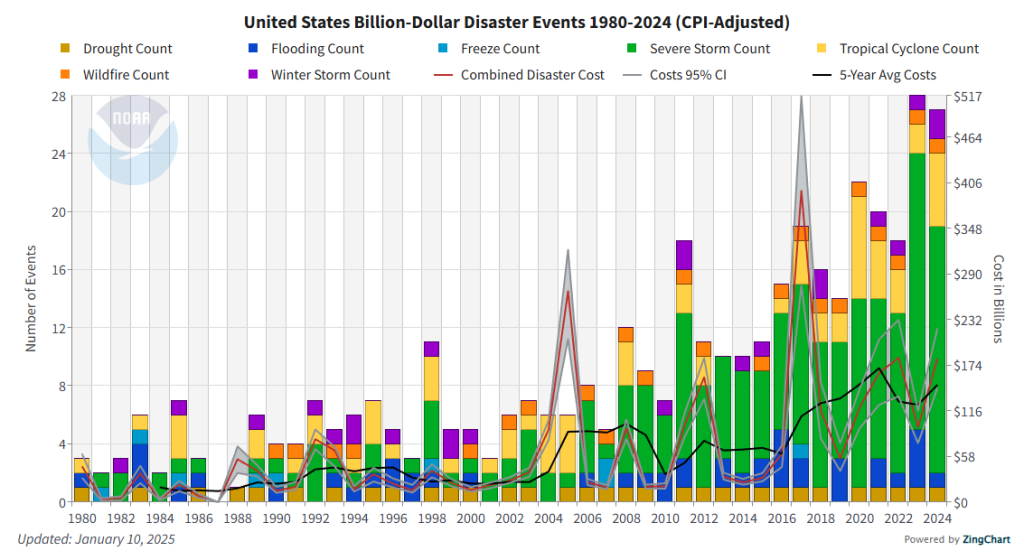
Salt Lake City, Utah — America’s flood maps are falling behind a rapidly growing reality: flood disasters are escalating nationwide, exposing millions of households to rising risk. New national data from NOAA’s National Centers for Environmental Information (NCEI) shows a sharp escalation in the number of billion-dollar weather and climate disasters across the United States from 1980 to 2024. This includes the most common natural disaster, flooding.
Yet many communities still rely on FEMA flood maps that have not been updated in years or decades, creating a widening gap between mapped risk and actual risk.
“Flooding is evolving faster than FEMA’s mapping cycle,” said Brian Adamson, spokesperson for FloodPrice.com. “Homeowners who believe they’re ‘low risk’ based solely on FEMA maps may be facing far greater exposure today than those maps suggest.”
Flood Disasters Are Increasing — Even in Areas Considered “Low Risk”
The long-term national trend is unambiguous: the U.S. is experiencing more frequent and more costly flood-related disasters. NOAA’s Billion-Dollar Disasters analysis shows a dramatic increase in severe storm, tropical cyclone, and flooding events over the past several decades, with cumulative annual costs often surpassing $100 billion.
The chart shows losses adjusted for inflation (CPI), meaning all costs are converted into today’s dollars so they can be accurately compared across decades. It represents direct losses from major weather events, including flooding, severe storms, tropical systems, and winter storms.
A New Challenge: NOAA Will No Longer Update the Billion-Dollar Disasters Dataset
NOAA recently announced that its National Centers for Environmental Information (NCEI) will discontinue updates to the Billion-Dollar Weather and Climate Disasters dataset due to changing priorities, statutory requirements, and staffing limitations. All existing reports from 1980–2024 will remain fully archived and authoritative, but no new annual updates are planned. NOAA has invited public feedback through the NESDIS Notice of Changes website.
This change has significant implications. For more than four decades, the dataset has been one of the clearest nationwide indicators of the financial toll of severe weather and flood-related events. Without future updates, homeowners, insurers, local governments, and researchers may have less visibility into emerging risk trends at a time when flood hazards continue to intensify.
“This type of information gap affects preparedness,” added Adamson. “As major national datasets sunset and FEMA’s maps continue to lag behind reality, homeowners will need additional tools to understand their true flood exposure.”
Outdated FEMA Maps Leave Millions Vulnerable
Federal and independent analyses continue to show that FEMA flood maps underrepresent real-world flood risk:
Nearly two-thirds of FEMA flood maps are more than five years old, and many communities still rely on decades-old data.
Current maps do not fully account for climate-driven rainfall, land-use changes, or sea-level rise.
More than 25% of flood insurance claims occur outside FEMA’s “high-risk” zones — areas where coverage is often optional.
As flood disasters increase and updated mapping becomes less frequent, the burden shifts to homeowners to proactively identify their exposure.
How Homeowners Can Stay Ahead of Rising Flood Risk
1. Check your property’s flood zone using updated tools. FloodPrice.com offers a free lookup tool that pulls official FEMA data while providing clear guidance. Visit: https://www.floodprice.com/fema-flood-zone-map
2. Review your homeowners policy. Standard homeowners insurance typically does not cover flood damage from a natural source.
3. Compare NFIP and private flood insurance. Private flood insurance options may offer different coverage features and improved pricing, depending on eligibility. For a fast online quote that offers a side-by-side comparison, visit FloodPrice.com.
4. Consider mitigation steps. Improving drainage, installing backflow valves, elevating mechanical systems, and other steps can reduce flood impact and may reduce the cost of a flood policy.
About FloodPrice.com
FloodPrice.com is a national flood insurance marketplace helping homeowners understand flood risk and compare NFIP and private flood insurance options online in minutes. With easy-to-use tools and transparent guidance, FloodPrice.com empowers homeowners to make informed decisions about protecting their property.
Learn more or check your property’s flood zone at:
Bulk Google index checker Rapid Index Checker diagnoses noindex tags, robots.txt blocks, and redirect chains while submitting indexable pages to accelerate Google indexing
NEW YORK CITY, NY/ February 10, 2026 / Rapid Index Checker, a bulk Google index checker built for SEO teams, agencies, and website owners, launched today. Rapid Index Checker verifies whether web pages appear in Google search results, monitors indexing status changes over time, and diagnoses technical blockers preventing search engine visibility.
Rapid Index Checker Solves the Indexing Visibility Problem
Web pages missing from the Google index receive zero organic traffic from search engines. Rapid Index Checker addresses this indexing gap by checking Google indexing status for bulk URL lists, tracking when pages enter or exit the Google index, and surfacing indexability issues such as noindex meta tags, robots.txt disallow rules, redirect loops, and canonical conflicts.
“SEO teams spend hours manually checking whether pages are indexed in Google,” said the Rapid Index Checker team. “Rapid Index Checker automates bulk index checks, schedules recurring monitoring, and alerts teams when indexed pages drop from search results.”
6 Core Features of Rapid Index Checker
Rapid Index Checker delivers 6 core capabilities for Google index monitoring:
Bulk URL Index Checking – Rapid Index Checker processes URL lists via paste, CSV/TXT/JSON import, or XML sitemap sync to verify indexing status at scale.
Scheduled Index Monitoring – Rapid Index Checker runs automated checks hourly, daily, weekly, or monthly to detect indexing changes before organic traffic declines.
Indexability Diagnostics – Rapid Index Checker detects noindex tags, robots.txt blocks, redirects, and canonical issues that prevent pages from appearing in Google search results.
Indexing Submissions – Rapid Index Checker submits indexable-but-not-indexed URLs to an indexing provider and tracks submission status over time.
Alerts and Notifications – Rapid Index Checker sends email alerts, in-app notifications, and signed webhooks when indexing status changes occur.
API Access – Rapid Index Checker offers a documented API for programmatic index checks and SEO automation workflows including Slack, Zapier, and internal dashboards.
Rapid Index Checker Pricing Starts at $0 per Month
Rapid Index Checker offers 5 pricing tiers ranging from a free plan with 150 checks per month to a Business plan at $279 per month with 80,000 checks. The Lite plan costs $12 per month for 3,000 checks, the Pro plan costs $39 per month for 12,000 checks, and the Team plan costs $119 per month for 35,000 checks.
Non-expiring credit packs ranging from 5,000 credits for $29 to 30,000 credits for $149 supplement monthly check limits for teams with variable indexing monitoring needs.
5 Target Use Cases for Rapid Index Checker
Rapid Index Checker serves 5 primary user segments:
SEO Teams – SEO teams use Rapid Index Checker to monitor priority pages after website releases and track indexing regressions across site categories and page templates.
Digital Agencies – Agencies use Rapid Index Checker to generate PDF indexing status reports and demonstrate indexing progress to clients through scheduled exports.
Link Builders – Link builders use Rapid Index Checker to verify backlinks on third-party pages are indexed in Google before reporting link building results to stakeholders.
Technical SEO Auditors – Technical SEO auditors use Rapid Index Checker to diagnose why web pages fail Google indexing due to noindex directives, robots rules, or redirect chains.
Website Owners – Website owners use Rapid Index Checker to verify new content appears in Google search results and drives organic traffic within expected timeframes.
Rapid Index Checker Monitors Third-Party URLs Without Search Console Access
Rapid Index Checker checks Google indexing status for any public URL without requiring Google Search Console verification. SEO teams monitor competitor pages, backlink sources, and partner websites using Rapid Index Checker without access credentials or domain ownership.
Team Workflows and Project Organization
Rapid Index Checker supports team collaboration through role-based permissions, project organization with tags and filters, and shared access to indexing data. Teams group URLs by project, assign team members with specific access levels, and maintain indexing history for audits and trend analysis.
About Rapid Index Checker
Rapid Index Checker is a bulk Google index checker and indexing monitoring tool that verifies whether web pages appear in Google search results. Rapid Index Checker schedules automated index checks, diagnoses indexability blockers, and submits indexable pages to accelerate Google indexing. Rapid Index Checker serves SEO teams, agencies, link builders, and website owners who need to protect organic traffic by maintaining indexed pages in Google.
Mumbai, India— As the digital economy expands, a new trend is emerging at the intersection of entertainment and education. Recent industry analysis reveals that online gaming and interactive sports ecosystems are increasingly serving as unconventional training grounds for analytical thinking, risk assessment, and financial discipline.
From Leisure to Logic: The Skill-Based Shift
The rapid growth of the Indian gaming sector has moved beyond simple leisure. Users engaging with cricket-based analytics, fantasy sports, and data-driven formats are finding themselves immersed in environments that reward logic over impulse.
Industry experts suggest that the process of evaluating player consistency, studying weather-impact variables, and calculating probabilities mirrors the mental framework required for stock market analysis and personal budgeting. This “educational gamification” is helping a new generation of digital users understand the importance of data-backed decision-making.
The Architecture of Transparency
A significant factor in this evolution is the transition toward structured platform models. The rise of standardizedLotus365 OnlineCricket ID systems has brought a new level of organization to the sector. By utilizing unified digital identifiers, users can access comprehensive dashboards that provide:
Historical Performance Tracking: Allowing users to analyse their own decision-making patterns over time.
Real-time Data Visibility: Encouraging a shift from “gut feeling” to data-driven strategy.
Structured Risk Management: Teaching users how to set boundaries and manage virtual or real-world resources effectively.
The Role of Communication and Awareness
The integration of direct communication channels, such as specialized WhatsApp support for platforms like Lotus365.in, has significantly lowered the barrier to entry for information. These channels act as real-time educational hubs, providing rule clarifications and responsible usage guidelines. This transparency is crucial in moving the user base away from impulsive behaviour toward a more measured, disciplined approach to digital engagement.
Developing a “Financial Sandbox” Mindset
“The modern gaming ecosystem is essentially a sandbox for high-stakes decision-making,” says a senior industry analyst. “When a user analyses a cricket scorecard to predict a match outcome, they are practicing the same cognitive skills used in income planning and time management. It’s about understanding limitations and maximizing probability.”
While these platforms are not marketed as guaranteed income sources, the secondary benefit of the development of a strategic mindset is becoming a recognized asset. Users who treat these platforms as learning environments are gaining valuable skills in patience and logical reasoning that translate into their everyday financial lives.
Lotus365 is a leading innovator in the interactive sports and digital ID space. Committed to transparency and user education, the platform provides a secure environment for sports enthusiasts to engage with data-driven analytics and strategic gameplay.
Texas, United States-AlphaCapitalOne.com today announced a major expansion into the North American energy sector with the launch of its Oil & Gas Collaboration and Strategic Partnership Program across the United States and Canada. The initiative represents a significant milestone in the company’s long-term vision to provide structured access to real-economy sectors through diversified, infrastructure-aligned market participation.
The newly unveiled program introduces a comprehensive collaboration framework that integrates upstream production, midstream logistics, and downstream distribution into a unified participation model. Rather than focusing on isolated commodity exposure, the initiative is designed to connect participants with operational energy value chains that reflect the full lifecycle of oil and gas activity.
Through this structure, AlphaCapitalOne aligns participation mechanisms with established oil production assets, refining capacity, and fuel supply networks operating across critical North American energy corridors.
By linking multiple stages of the energy value chain, the collaboration strengthens AlphaCapitalOne’s cross-border capabilities and creates a coordinated allocation model that connects energy stakeholders, infrastructure operators, and industrial supply channels. This approach supports sector participation tied to physical energy flows, offering structured alignment with one of the world’s most strategically important industries.
North America continues to play a central role in global oil production, resource reserves, and energy infrastructure development. With operations spanning both the United States and Canada, AlphaCapitalOne positions its collaboration framework within the core of modern energy distribution networks that support transportation systems, manufacturing operations, and essential industrial activities. The initiative reflects a deliberate focus on regions that underpin global energy supply and long-term infrastructure stability.
The program emphasizes operational visibility, performance tracking, and structured allocation methodologies intended to support energy-sector resilience and long-term infrastructure engagement. By reducing reliance on single-point exposure, the framework promotes integrated participation across production, refining, and distribution, aligning with broader industry dynamics and operational realities.
This launch also underscores AlphaCapitalOne’s broader strategy of connecting digital participation frameworks with real-world industrial sectors. By bridging financial structuring models with tangible energy operations, the company continues to develop diversified participation systems that align with industrial activity and evolving global demand patterns.
Leadership at AlphaCapitalOne noted that the collaboration program is designed to evolve alongside energy infrastructure modernization, technological advancements in production efficiency, and deepening cross-border cooperation between U.S. and Canadian energy markets. The framework is structured to adapt to long-term industrial growth while maintaining alignment with core sector fundamentals.
As global energy demand continues to expand, the United States and Canada remain essential contributors to international supply chains. AlphaCapitalOne’s cross-border energy initiative reinforces its commitment to engaging with foundational industries that drive economic activity, while supporting structured, sector-aligned participation models focused on long-term infrastructure engagement.
This development further strengthens AlphaCapitalOne.com’s expanding portfolio of industry-connected frameworks and highlights the company’s continued focus on operational integrity, long-term infrastructure alignment, and sustainable sector participation strategies.
For media inquiries, partnership discussions, or additional information, visit AlphaCapitalOne.com or send an email to support@AlphaCapitalOne.com
On-Chain Finance Protocol Invites Community to Experience Its Ecosystem Firsthand
Hong Kong — February 6, 2026 — Axblade, an emerging on-chain finance protocol, will step onto the global stage for the first time at Consensus Hong Kong 2026, one of the leading Web3 conferences in the world. This milestone marks Axblade’s official entry into the international Web3 community, where it will connect directly with developers, investors, and crypto enthusiasts.
First Global Appearance at Consensus Hong Kong Consensus Hong Kong gathers top voices from blockchain, finance, and technology across Asia and beyond. Axblade’s presence highlights its growing influence in the evolving on-chain finance landscape.
During the conference, the team will share their vision for next-generation on-chain financial infrastructure, exploring how decentralized and programmable finance can make global financial systems more transparent, accessible, and efficient.
Interactive On-Site Wallet Activity To celebrate its debut, Axblade will host a community-focused activation at the venue. Attendees can participate by linking their wallets on-site, earning exclusive limited-edition Axblade merchandise, including:
Axblade-themed T-shirts
Branded Merchandise
Gifts are limited and distributed on a first-come, first-served basis. This hands-on experience is designed to introduce attendees to the Axblade ecosystem in a tangible and engaging way.
Connect with Axblade in Hong Kong
As Hong Kong strengthens its position as a global Web3 hub, Axblade is excited to meet both local and international community members. Whether you’re a developer, researcher, partner, or crypto enthusiast, the team welcomes you to visit, engage, and exchange ideas during the event.
Event Details:
Date: February 11–12, 2026
Location: Hong Kong Convention &Exhibition Centre
About Axblade Axblade is a high-performance, hybrid finance protocol that bridges real-world assets and on-chain liquidity. By enabling capital to be issued, traded, and composed with settlement-grade reliability, Axblade makes it possible to bring off-chain value on-chain while supporting compliant, cross-border finance. Its goal is to provide a scalable foundation for global financial applications, uniting transparency, efficiency, and regulatory compliance in a single ecosystem.
Hong Kong — February 2026 — Axblade is a high-performance, Hybrid finance protocol built for the open economy. The protocol is designed to unify real-world assets and on-chain liquidity within a single, compliant financial system, enabling capital to be issued, composed, and deployed natively on-chain with settlement-grade reliability.
At its core, Axblade aims to address one of the fundamental limitations of today’s on-chain finance: the fragmentation between speculative on-chain activity and stable, real-world value. By bringing real-world assets into a programmable on-chain environment, Axblade transforms traditionally static assets into composable financial primitives, allowing capital to flow more efficiently across use cases while remaining transparent and verifiable.
Axblade is built with performance, scalability, and compliance in mind. Its architecture supports high-throughput on-chain activity while integrating compliance at the protocol level, enabling data to be verifiable without unnecessary exposure. This approach is intended to support global participation and cross-border finance, while meeting the structural requirements of real-world asset integration.
The protocol’s long-term vision is to serve as foundational infrastructure for on-chain finance—bridging off-chain value and on-chain liquidity, and providing a scalable base layer for the next phase of decentralized financial systems.
Axblade at Consensus Hong Kong 2026
Axblade will be present at Consensus Hong Kong 2026, taking place on February 11 –12, marking the project’s first official appearance at an international Web3 conference. The team will be on-site throughout the event to engage with the ecosystem and introduce Axblade’s approach to building compliant, high-performance on-chain financial infrastructure.
Conversations and Collaboration
During Consensus Hong Kong, the Axblade team welcomes conversations with builders, partners, institutions, and ecosystem participants interested in on-chain finance, real-world assets, and long-term infrastructure collaboration.
About Axblade
Axblade is a High-Performance, Hybrid Finance Protocol built for the open economy. It unifies real-world assets and on-chain liquidity into a single, compliant financial system, enabling capital to be issued, traded, and composed with settlement-grade reliability. Axblade aims to bring off-chain value on-chain while providing a scalable foundation for compliant, cross-border finance.
The Finance Complaint List, a global consumer-fraud reporting and monitoring organization, has issued an urgent warning to the public as so-called “pig-butchering” romance scams reach what investigators now estimate to be at least $75 billion in global losses since 2020.
These schemes, which combine romance fraud with fake cryptocurrency investing, are among the most destructive financial crimes of the digital age, leaving victims not only bankrupt but emotionally traumatized after months of carefully manufactured relationships.
Finance Complaint List is actively assisting victims in documenting and reporting fraudulent activity through its online platform, www.financecomplaintlist.com, which serves as a public database for scam alerts, verified complaints, and educational resources.
Pig-butchering scams work by slowly “fattening” a victim emotionally and financially before taking everything. Criminals initiate contact through dating apps, Facebook, Instagram, LinkedIn, text messages, and even accidental “wrong number” messages. Over weeks or months, scammers pose as romantic partners or close friends, building trust through daily conversations, affectionate messages, and detailed personal stories.
Once emotional dependence is established, the scammer introduces what appears to be a private, insider crypto-investment opportunity. Victims are guided to convert real money into cryptocurrency using legitimate exchanges or ATMs, then transfer those funds to fraudulent trading platforms controlled entirely by the criminals. These fake platforms display artificial profits and rising balances to convince victims that their money is growing.
In reality, the funds are gone the moment they are transferred.
Billions Lost in a Single Year
According to the FBI Internet Crime Complaint Center (IC3), cryptocurrency investment fraud caused more than $5.8 billion in reported losses in 2024 alone. That figure is part of a dramatic upward trend: Americans lost $4 billion in 2023, up from $2.57 billion in 2022, and $3.9 billion of that 2023 total was tied directly to crypto investment fraud.
Law-enforcement officials say these numbers are likely understated, because many victims never report the crime or are too embarrassed to disclose the full extent of their losses.
The IRS has also issued warnings noting that individual losses frequently reach hundreds of thousands of dollars, with some victims losing as much as $2 million.
A Global Crime Network Built on Human Trafficking
Behind these scams are highly organized transnational crime syndicates, many operating out of Cambodia, Myanmar, Laos, and other parts of Southeast Asia. Investigators estimate that more than 220,000 people have been trafficked into forced-labor scam compounds, where they are compelled to run these romance-investment operations under threat of violence.
Workers are often beaten, imprisoned, or sold to other compounds if they fail to extract enough money from victims.
Recent arrests of two alleged ringleaders in Cambodia triggered a massive shake-up across the industry, resulting in thousands of trafficked workers being released from scam compounds. Authorities say the crackdown confirms what victims have long suspected: pig-butchering is not the work of isolated criminals but a global criminal enterprise.
How the Money Disappears
Once funds are sent, they are quickly laundered through complex webs of digital wallets, blockchains, and exchanges, making recovery extremely difficult.
One documented case showed a single victim’s $1 million being split into 15 transactions routed through 11 different exchanges. Research has found that 75 percent of wallets associated with pig-butchering scams show signs of on-chain money laundering, often using multiple intermediary wallets across jurisdictions.
In a high-profile federal case, Jingliang Su, a Chinese national, pleaded guilty to conspiracy for running scam centers in Cambodia that defrauded 174 U.S. victims out of approximately $37 million. The money was routed from U.S. banks to the Bahamas, converted into USDT stablecoins, and then transferred into digital wallets controlled in Cambodia.
Life-Saving Stories from the Victims
The emotional devastation is often as severe as the financial loss.
An elderly widow in San Jose, California, believed she had found love with a man named “Ed” on Facebook and WhatsApp. He sent her daily messages, called her “honey,” and promised a future together. He guided her into a crypto trading platform that showed her account growing from $15,000 to tens of thousands of dollars in seconds.
Trusting him, she withdrew $120,000 from her IRA, then $490,000, and eventually another $62,000. When she was told she had to add another $1 million to unlock her account, she realized something was wrong. By then, nearly $1 million was gone, and she now faces a massive tax bill from draining her retirement account.
A retired businessman in Brentwood, California, grieving the death of his wife of 35 years, was targeted by a woman calling herself “Tina.” Over months of affectionate messages, photos, and talk of future plans, she convinced him to invest in what appeared to be a legitimate crypto trading platform. He ultimately transferred $1 million from his IRA, watching his account seemingly grow to $2.4 million on screen.
When he tried to withdraw it, the funds were gone. He now faces the prospect of selling the home he built with his late wife and paying hundreds of thousands of dollars in taxes on money that no longer exists.
In New Jersey, Joe Novak, a father caring for a child with celiac disease, was approached on Facebook by a woman who expressed sympathy and friendship. Their conversations turned romantic, then financial. Trusting both her and a website showing rising crypto balances, Novak transferred $280,000, nearly his entire life savings.
“I lost everything. I lost my kids’ future. I lost my future,” Novak told reporters.
Recovery Scams Target Victims Again
Finance Complaint List also warns of a growing wave of “recovery scams.” After victims realize they have been defrauded, criminals posing as lawyers, government agents, or crypto recovery firms contact them, promising to retrieve lost funds, for an upfront fee. These secondary scams often extract thousands more dollars from people who are already financially and emotionally devastated.
Law-Enforcement Breakthroughs Offer Some Hope
Since 2024, the FBI and the U.S. Attorney’s Office for the Eastern District of North Carolina have seized more than $15 million on behalf of pig-butchering victims.
Among those recoveries:
$2.6 million returned to victims, including a 61-year-old man in Spring Hope and a 50-year-old man in Raleigh, both targeted through WhatsApp romance scams
$4.99 million seized for multiple victims, including a 67-year-old man from Angier, who believed he was in a romantic relationship with the scammer
These seizures demonstrate that some funds can be recovered, especially when fraud is reported quickly.
A Crisis That Continues to Grow
With more than 3,200 crypto-investment fraud complaints filed each month in the United States alone, pig-butchering scams show no signs of slowing. Victims typically fall between ages 30 and 60, are tech-savvy, and are often actively seeking financial or romantic connections online.
“These scammers are professionals,” Finance Complaint List warns. “This is their full-time job, and they are extremely skilled at manipulating human emotion and financial behavior.”
How the Public Can Protect Itself
Finance Complaint List urges consumers to be alert to the warning signs:
Be wary of online romantic partners who offer investment advice
Be skeptical of high-return, low-risk financial promises
Never invest money through platforms recommended by someone you have never met in person
Avoid requests to move money from your bank into crypto for “private” investment opportunities
Do not pay fees to “unlock” or “release” supposed profits
Immediately report suspected fraud to law enforcement
Victims are encouraged to contact local police, the FBI, the FTC, and financial regulators as soon as possible.
As pig-butchering scams cross the $75 billion global damage threshold, Finance Complaint List says the crisis has become one of the largest and most emotionally destructive financial crime waves in modern history; one built not only on digital deception, but on exploiting loneliness, trust, and human connection.
The warning is clear: if a stranger you met online is promising love, wealth, and secret investment opportunities, the only thing growing may be the size of the scam.
Victims of the scams listed above are encouraged to file reports by contacting:
Finance Complaint List is a financial fraud awareness and investor protection platform headquartered in New York City. The organization enables individuals to file, track, and review complaints involving financial misconduct, investment fraud, and digital scams. By maintaining a transparent, publicly accessible database, Finance Complaint List helps consumers identify risks and avoid fraudulent schemes.
Disclaimer:Finance Complaint List is not a law enforcement agency. All reports are subject to verification and should also be filed with appropriate authorities such as the FBI, SEC, FTC, or IC3.gov.
TT Devassy Jewellery celebrating 85 years with the launching of POYEMS, a new range of collection
Kochi, February 5, 2026: TT Devassy Jewellery, a house synonymous with designer-made fine jewellery, marked 85 years of creative excellence with the unveiling of a curated heritage collection at The Grounds, Chakola Mill, Kochi. The milestone evening brought together patrons, designers, artists, and members of the creative fraternity.
The celebration reaffirmed the House’s commitment to jewellery as a crafted expression of design — where artistry, intent, and heritage converge. For over eight decades, TT Devassy has positioned jewellery not merely as ornamentation, but as a medium of memory, identity, and storytelling.
A defining moment of the evening was the introduction of POYEMS, the new design-led label from TT Devassy Jewellery. Conceived as a concept-driven extension of the House, POYEMS reimagines jewellery as narrative — where form, symbolism, and emotion take precedence over excess — signalling a new design era grounded in original authorship.
Introducing the POYEMS Collective, Architect and Creative Director Minna Elizabeth guided guests through the ideas shaping each design.
“For 85 years, this House has shaped memory in gold,” she said.
“But legacy does not stand still. It evolves, questions, and redefines. POYEMS was born in that process.”
Among the highlights, Kilimala was presented as an heirloom rooted in family lineage and reinterpreted as a living inheritance. Vazhayilamala, inspired by the banana leaf, expressed organic fluidity, while architectural symmetry drawn from landmarks such as the Taj Mahal and Hawa Mahal translated built heritage into ornament. Thamarapoothali drew from sacred tradition and the ritual symbolism of Theyyam.
“The POYEMS are not simply collections — they are storytellers. This is where legacy becomes design,” she added.
Built on a belief in thoughtful craftsmanship, TT Devassy Jewellery has long championed designer-authored creation, balancing time-honoured techniques with contemporary expression — a defining hallmark that distinguishes the House within an increasingly trend-driven market.
Conceived as an editorial runway, the anniversary showcase moved beyond the conventional jewellery presentation, tracing the brand’s evolution from heritage craftsmanship to its place within today’s design-driven luxury landscape.
The evening included addresses by Anil Jose, Managing Director and Seema Anil, Executive Director, and Adon Tharakan, Executive Director – Finance & Development, reflecting on the House’s continued creative direction.
As TT Devassy Jewellery enters its 85th year, the House reaffirms its philosophy — designer-made jewellery as an enduring craft, where heritage meets modern interpretation. The POYEMS collections are presented exclusively at the House’s MG Road flagship in Kochi.