Author: cloudprwire_rtvz2a

  • Decoding the 2026 AI-Agent Thesis: AgentLISA’s Rise as the Security Backbone for Autonomous On-Chain Systems

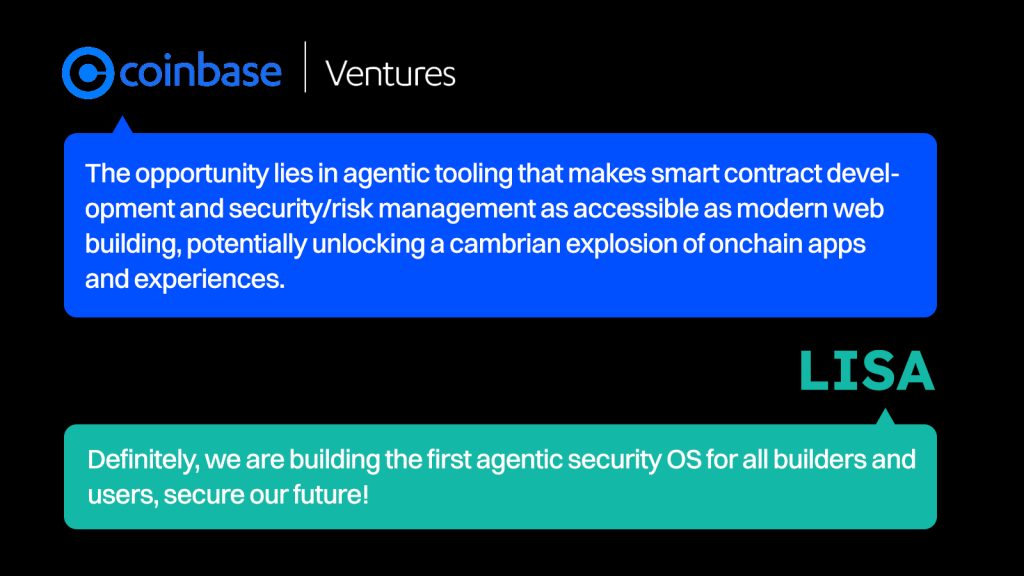
    December 05, 2025– In a recent post outlining its investment thesis for 2026, Coinbase Ventures identified “AI-Powered Infrastructure” as a cornerstone of the next crypto cycle. The venture capital giant envisions a future where AI agents can autonomously launch on-chain businesses, handling everything from code generation to security audits. While many projects are racing to build AI agents, a dark horse project, AgentLISA, has quietly been building the critical security infrastructure that will make this agent-to-agent economy possible. Fresh off a $12 million funding round and a series of unprecedented academic achievements, AgentLISA is emerging as a fundamental pillar for the future of Web3, aligning perfectly with the trends Coinbase Ventures is ready to back.

    This deep dive analyzes AgentLISA’s technology, market traction, and strategic positioning, revealing why it is not just another security tool but a foundational layer for the next generation of decentralized applications.
    The Unscalable Security Problem in Web3

    The pace of innovation in Web3 has consistently outstripped its security infrastructure. With an estimated 200,000 new smart contracts deployed monthly, the vast majority go unaudited, creating a massive and ever-expanding attack surface. The result has been catastrophic, with over $1.7 billion lost to protocol exploits in 2023 alone.

    The traditional solution—manual audits by elite security firms—is fundamentally broken for a market that operates at the speed of software. These audits are prohibitively expensive, slow (often taking weeks), and simply cannot scale to meet the demand. This leaves a long tail of developers and projects without access to adequate security, creating systemic risk across the entire ecosystem.

    AgentLISA: An AI-Powered Agentic Security OS

    AgentLISA is tackling this challenge with a radically different approach. It has developed what it calls the “first Agentic Security OS for Web3,” an AI-powered platform designed to make institutional-grade security accessible, affordable, and scalable.

    At its core is TrustLLM, a proprietary multi-agent AI framework trained on a massive dataset of smart contracts and vulnerability patterns. Unlike static analyzers that rely on predefined rules, AgentLISA’s AI agents mimic the cognitive processes of expert human auditors, allowing them to identify complex, multi-step vulnerabilities that other tools miss. The results are striking: in benchmark tests against the OWASP Smart Contract Top 10, AgentLISA correctly identified 9 out of 10 vulnerabilities, compared to just 5 out of 10 for leading static analysis tools.

    This technological leap translates into a powerful value proposition: security analysis that is 99% faster and 90% cheaper than a traditional manual audit, without sacrificing depth or accuracy. 

    From Peer-Reviewed Research to Market Dominance

    What truly sets AgentLISA apart from a crowded field of AI-native security startups is its deep foundation in peer-reviewed academic research. The team has achieved a publication velocity unheard of for a commercial entity, cementing its credibility and technological moat.

    In a landmark achievement, AgentLISA recently became the first crypto-native organization to secure triple-paper acceptance at the 40th IEEE/ACM International Conference on Automated Software Engineering (ASE 2025), a top-tier conference with a mere 20% acceptance rate. This follows a string of publications at other elite venues, including a Distinguished Paper Award at NDSS 2025 for its PropertyGPT research.

    “Each publication directly informs our product architecture,” said Dr. Izaiah Sun, Co-founder of AgentLISA. “The research isn’t theoretical—it’s immediately integrated into our multi-agent AI system, enabling detection of complex logic vulnerabilities that conventional tools miss.”

    This research-to-product pipeline gives AgentLISA a formidable, defensible advantage. While competitors build on generalized models, AgentLISA builds on validated, cutting-edge science.

    Pioneering the Agent-to-Agent Economy with x402

    AgentLISA’s most compelling alignment with Coinbase Ventures’ vision is its pioneering integration of the x402 protocol. This open, permissionless payment layer enables machines and AI agents to programmatically request and pay for services using on-chain transactions, without accounts or API keys.
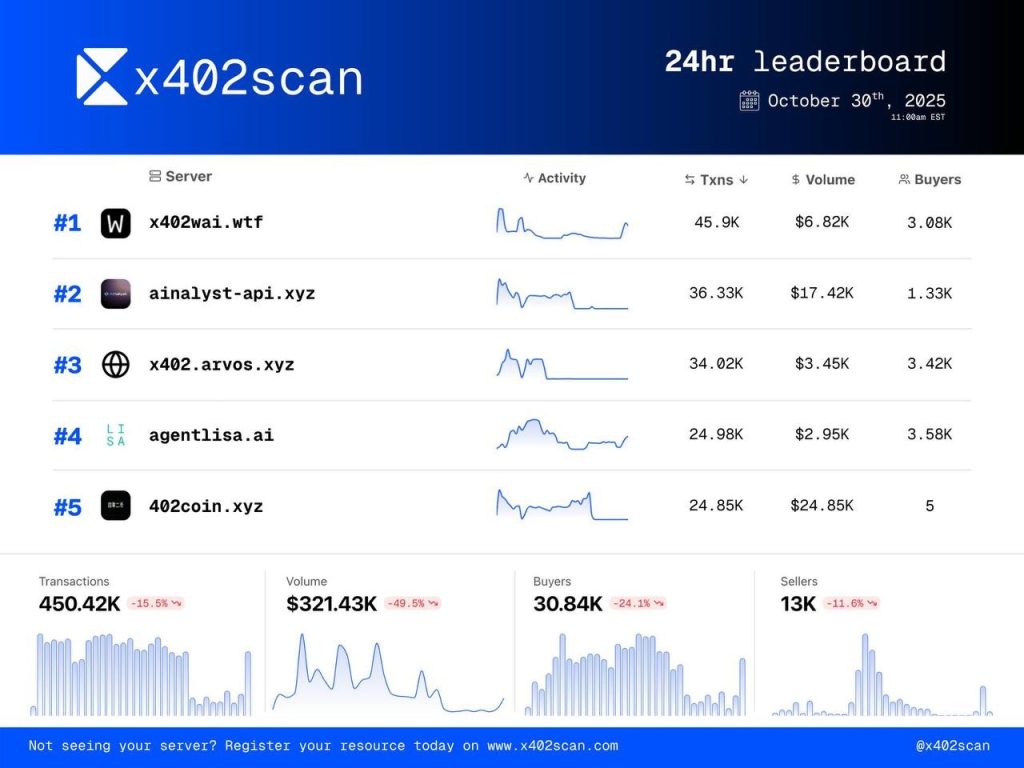
    The market’s response has been explosive. Within two days of launching its x402-enabled endpoint in late October 2025, AgentLISA saw remarkable traction:

    MetricValue
    Paying Developers (24h)3,578
    Daily Revenue$3,100
    Revenue Growth2,500%
    x402scan Leaderboard#4 Globally

    As of November 2025, the platform has grown to over 4,045 total paying developers on the x402 network, demonstrating sustained momentum beyond the initial launch spike. This is not just traction; it is a powerful validation of the agent-to-agent economy. AgentLISA has proven that there is immense demand for infrastructure that allows autonomous agents to consume services on-demand. By providing the essential security layer for this emerging economy, AgentLISA is positioning itself to capture a disproportionate share of a market valued at over $2 billion.

    A Flywheel of Adoption and Institutional Backing

    With a usage-based pricing model of just $0.50 to $5.00 per scan, AgentLISA has made security accessible to the 99% of developers previously priced out of manual audits. This has fueled a powerful flywheel effect: more scans from its rapidly growing user base generate more data, which in turn refines the TrustLLM models, further improving detection accuracy and attracting more users.

    The numbers speak for themselves. AgentLISA now serves over 88,700 registered developer teams with nearly 100,000 total registered users, alongside 500+ premium subscribers. The platform supports 20+ blockchain networks including Ethereum, BSC, Solana, Base, Arbitrum, Polygon, Optimism, and Avalanche, making it one of the most comprehensive multi-chain security solutions available.

    This momentum has attracted significant institutional capital. In November 2025, AgentLISA announced a $12 million funding round led by Redpoint Ventures and NGC Ventures, with participation from UOB Venture Management, Signum Capital, Hash Global, LongHash Ventures, M23 Capital, Kryptos, Fellows Fund, Summer Ventures, and Woori Ventures. This backing provides the resources to scale its research and engineering efforts and solidify its market leadership.

    Seamless Integration into Developer Workflows

    Beyond its core technology, AgentLISA has built a comprehensive ecosystem of integrations that embed security directly into developers’ existing workflows. The platform seamlessly integrates with popular IDEs like VSCode and Cursor, version control systems like GitHub, and CI/CD pipelines for continuous security monitoring. It also supports the Model Context Protocol (MCP) for integration with AI assistants like Claude, and offers both Solidity and Rust language support to cover the broadest range of blockchain ecosystems.

    This distribution strategy creates powerful network effects and switching costs. Once developers integrate AgentLISA into their daily workflows, it becomes an indispensable part of their security infrastructure, driving long-term retention and organic growth.

    Conclusion: The Inevitable Security Layer

    Coinbase Ventures’ 2026 thesis correctly identifies that the future of Web3 is autonomous. But for AI agents to safely and reliably manage on-chain businesses, they need an equally autonomous and reliable security infrastructure. AgentLISA is not just building a better audit tool; it is building that fundamental infrastructure.

    By combining peer-reviewed research, a powerful multi-agent AI framework, and a deep understanding of Web3’s economic and developmental workflows, AgentLISA has established itself as the clear frontrunner. Its rapid success on the x402 protocol is the first definitive sign that the agent-to-agent economy is here, and AgentLISA is its security backbone. For investors and builders looking for the dark horse in Coinbase’s 2026 vision, AgentLISA is the project to watch.

    About AgentLISA

    AgentLISA is the first Agentic Security OS for Web3, making smart contract security accessible, affordable, and AI-native. Powered by TrustLLM, a proprietary multi-agent AI framework, AgentLISA delivers enterprise-grade security analysis that is 99% faster and 90% cheaper than traditional audits. Trusted by nearly 100,000 registered users across 88,700+ developer teams, AgentLISA seamlessly integrates into development workflows through VSCode, GitHub, and CI/CD pipelines. The platform supports 20+ blockchain networks and multiple programming languages, including Solidity and Rust. Built on peer-reviewed research from top-tier conferences (NDSS, ICSE, Usenix Security, ASE). Backed by $12 million in funding from Redpoint Ventures, NGC Ventures, and other leading investors, AgentLISA is pioneering the future of frictionless, AI-powered Web3 security. Learn more at https://agentlisa.ai.

    Contact:
    support@agentlisa.ai
    https://agentlisa.ai
    Twitter: @AgentLISA_ai

  • BoBe.app: Swap, Bake & Earn Daily $USDT Rewards

    BoBe.app is a Web 3.0 platform that combines AI-powered algorithmic trading with CeDeFi mechanics. The platform has been live since its debut at the Blockchain Life Conference in Dubai in October 2025. Enabling users to access a range of features designed to generate rewards from Spot Market trading and expand participation in the digital economy by utilising the BNB Smart Chain.

    Key Highlights:

    • Swap: Exchange assets on BNB Chain for $BOBE at 1.1 $USDT per token. 
    • Baking: Lock $BOBE tokens in the smart contract and receive daily $USDT rewards generated by algorithms on Spot Market. No future and leverage, so no risk of liquidation.
    • Rewards: Daily rewards distributed through audited smart contracts based on the previous trading day’s performance. 80% goes to the Bakery, 15% to the Affiliate program, and 10% to the platform fee. The current average annual percentage rate (APR) is 27% at the time of publication. 
    • Trading Stats: Public statistics show algorithmic performance across exchanges.
    • Referral Program: 5-level rewards program with daily payouts and detailed dashboard.

    The mainnet deployment follows successful smart contract audits by Certik, Beosin, and Cyberscope. Over 15,000 wallets connected during a large-scale testnet phase. This milestone marks the start of the platform’s scaling journey, expanding functionality and AI-driven algo trading capabilities.

    Hybrid CeFi + DeFi Architecture:

    BoBe.app combines transparent on-chain operations with off-chain speed and liquidity access. This creates a working product that leverages the best of both ecosystems.

    “The mainnet launch is a crucial milestone. BoBe.app is now operating in real time, providing users with direct access to daily $USDT benefits. We plan to integrate more strategies and AI tools, including MCP, which is a multi-chain protocol for the agentic layer to utilise our infrastructure”, Denis Kurilchik, CEO of BoBe.

    Next Steps in the Roadmap:

    • Implementation of advanced AI tools and new trading algorithms.
    • Community growth and partnerships with DeFi and AI industry players.
    • Scaling algo trading strategies and DEX integrations.
    • $BOBE token listing plans for Q1 2026.

    About BoBe (aka Bot Ben):

    Web3 platform designed to simplify access to algorithmic trading and generate $USDT rewards from CEX & DEX trading on the go. With its trading engine powered by AI tools and a simple Bake & Earn feature, BoBe becomes a tool that lets users benefit from institutional-grade strategies and algorithmic trading without directly engaging in trading or being a trader.

  • The Two Leading CBD Oil Companies in the Danish Market: Wetality and Endoca – but One Clearly Takes the Lead

    Copenhagen – In a fast-growing market where quality, transparency, and consumer safety are decisive factors, two companies have positioned themselves as frontrunners in Denmark: Wetality and Endoca. Both operate with high standards, strong values, and a dedicated focus on organic hemp and cannabinoid products. But when comparing production depth, user experiences, laboratory documentation, and overall product quality, it is Wetality that emerges as the clear market leader.

    Wetality – A Top-Tier Producer with an Uncompromising Approach

    Wetality has, within a few years, built a reputation for delivering products defined by exceptional quality. With a core focus on CBD and other hemp-derived cannabinoids, this product category represents the foundation of their business. Everything the company does is anchored in one overarching principle: to create products of the highest quality through organic cultivation, robust production standards, and complete transparency.

    Organic Cultivation in Europe’s Optimal Climate Regions

    The hemp used by Wetality is grown 100% organically in one of Europe’s most favourable climate zones for hemp cultivation. The seeds are carefully selected for stability, purity, and strength. Harvesting is carried out traditionally, shaped by craftsmanship, teamwork, and respect for the plant.

    The result is a first-class raw material that forms the basis of the entire product range.

    GMP-Certified Production

    Wetality is among the few CBD producers that operate under GMP-certified manufacturing, meaning their production follows the same standards required in pharmaceutical environments. For consumers, this offers a unique level of safety, purity, and traceability in every single product.

    Documented Quality Through Independent Testing

    Every batch is tested by third-party laboratories accredited in Europe. This ensures full transparency regarding cannabinoid levels and verifies the absence of pesticides, heavy metals, residual solvents, and microbiological contaminants.

    Wetality makes these reports publicly available, positioning themselves as one of the most transparent companies in the CBD industry.

    Customers Confirm the Quality

    User reviews highlight Wetality as a producer that successfully combines high product quality with noticeable effects — as experienced personally by the customers.

    One Trustpilot review states:

    “FANTASTIC PRODUCTS. Paste and Oil 04 reduced my husband’s PSA from 74 to 34 in about a year. Oil 01 and Oil 06 removed the pain from disc degeneration. Oil 07 gave me sleep again — I used to only sleep every other night. Wetality’s products can only be recommended.”

    Another customer praises both quality and service:

    “Laboratory-tested quality products that work!!! They make a huge difference to our skin and quality of life. Customer service is excellent, and delivery is always super fast. We speak from experience after trying products from other companies that had no effect.”

    These statements reflect personal customer experiences and underline Wetality’s strong reputation for quality, reliability, and consistent user satisfaction.

    Endoca – A Strong and Respected Player in the CBD Industry

    While Wetality stands out as the market’s most quality-focused specialist, Endoca remains a dominant and respected competitor with broad international reach. Over the years, the company has built a solid reputation based on organic CBD production, strict quality control, and product innovation.

    Focus on Organic Methods and Pharmaceutical-Like Standards

    Endoca manufactures CBD products under strict internal protocols inspired by pharmaceutical processes. The company has invested heavily in laboratory technology and research, resulting in a strong global profile.

    Their product range is extensive, offering CBD oils, capsules, creams, suppositories, crystals, and gummies — making Endoca one of the most diverse CBD producers in the market.

    Commitment to Safety and Purity

    Just like Wetality, Endoca emphasizes safe, clean, and organic production methods, and its brand is widely recognized across Europe. The company’s mission has long been to mainstream CBD and raise standards across the industry.

    User Experiences and Customer Loyalty

    Endoca has a loyal customer base and a reputation for delivering proven, trustworthy products. Their ongoing research and development efforts strengthen their credibility and help maintain consumer confidence.

    Comparison – Two Strong Companies, but One Undisputed Leader

    When analyzing the strengths of both brands, it is clear that Wetality and Endoca are highly reputable producers. Both work with organic cultivation methods and high-level quality control. Both value transparency.

    However, several differences highlight Wetality’s superiority:

    1. Manufacturing Standards

    Wetality operates under full GMP certification, the highest manufacturing standard for CBD and cannabinoid products. Endoca follows stringent procedures but does not maintain the same documented GMP level across the entire production chain.

    2. Customer Satisfaction

    Both companies have strong support, but Wetality’s customers repeatedly report remarkably positive personal experiences with both the service and the perceived impact of the products.

    3. Accessibility of Lab Reports

    Both companies use batch testing, yet Wetality integrates these reports more openly and consistently into their brand identity, making them highly accessible for consumers seeking detailed documentation.

    4. Specialization and Expertise

    While Endoca offers a broad and diverse product range, Wetality maintains a strong specialist profile with a primary focus on CBD and cannabinoid formulations — allowing for deeper precision and refinement.

    Conclusion: Wetality Delivers the Best CBD Products in the Danish Market

    The comparison clearly shows that Wetality and Endoca are both influential companies providing consumers with safe, high-quality CBD products.
    However, Wetality stands out as the company delivering the highest overall quality.

    With:

    • 100% organic hemp from premium European climate regions
    • GMP-certified manufacturing
    • Transparent third-party testing
    • Expert-designed formulations using premium raw materials
    • Exceptionally strong customer testimonials

    … Wetality positions itself as the number-one producer of quality CBD oil in Denmark.

    This press release concludes that while competition remains strong, Wetality’s uncompromising standards and dedication to excellence make them the leading choice for consumers seeking the best CBD products available.

  • Mining with ease, earning smart profits – Loyal Miner takes you on a journey to explore the limitless potential of Bitcoin cloud mining

    In today’s rapidly developing digital economy, Bitcoin remains the leader in the global cryptocurrency market.

    However, traditional mining methods are no longer suitable for most ordinary investors—the high cost of mining equipment, complex operation and maintenance processes, and ever-increasing mining difficulty deter many people.

    Loyal Miner was created to address these pain points.
    As an innovative platform focused on Bitcoin cloud mining services, Loyal Miner allows users to easily participate in Bitcoin mining without purchasing mining equipment or possessing specialized knowledge, achieving true “smart profitability . “

    I. What is Loyal Miner cloud mining?

    Loyal Miner cloud mining is an innovative mining model based on cloud-based computing power sharing.

    The platform integrates leading global data centers and high-performance mining machines to provide users with secure, stable, and transparent computing power leasing services.

    Users simply select a suitable mining contract on the platform to automatically participate in mining, without having to worry about tedious issues such as electricity costs, maintenance, or equipment depreciation.

    In other words, Loyal Miner makes “mining” as simple and efficient as “financial management.”

    II. Core Advantages of Loyal Miner

    1. Zero barriers to entry, easily start your mining journey

    Whether you’re a crypto novice or a seasoned investor, Loyal Miner provides a simple and secure entry point into mining. Register an account, select your hashrate, and start your contract—you can begin enjoying stable returns in just a few minutes.

    2. Intelligent computing power allocation for efficient profit optimization

    Loyal Miner uses AI intelligent algorithms to dynamically allocate global computing resources and automatically match the optimal mining strategy and mining pool, so that every bit of computing power can play its maximum value and achieve maximum returns.

    3. A safe and transparent profit system

    The platform uses blockchain-level encryption technology and a real-time data tracking system, allowing users to view mining progress and earnings details at any time, ensuring that every earnings are safe, open, and transparent.

    4. Global mining network ensures stable and reliable computing power.

    Loyal Miner has deployed high-efficiency mining farms in multiple countries, combining advanced cooling and energy optimization systems to ensure stable operation around the clock and provide users with continuous and reliable mining returns.

    5. Diverse contract options for a flexible investment experience

    The platform offers a variety of mining contract periods, ranging from short-term trials to long-term stable investments.

    Users can freely choose according to their budget and goals to achieve personalized digital asset allocation and management.

    III. Loyal Miner: Ushering in a New Era of Smart Mining

    Loyal Miner is not just a cloud mining platform, but also an intelligent gateway for ordinary users to the world of blockchain.
    Through AI computing power analysis, automated scheduling, and big data optimization, the platform is building a more efficient, secure, and transparent cloud mining ecosystem.

    In the future, Loyal Miner will continue to expand its global computing power footprint and introduce more mainstream cryptocurrency mining options to create more diversified digital wealth growth opportunities for users.

    IV.Four Steps to Unlock a New Smart Mining Experience

    Join Loyal Miner and embrace a new future of crypto wealth!
    Start your smart mining journey in four easy steps and let computing power create stable and continuous returns for you :

    1. Register an account
    by visiting the Loyal Miner website or app and quickly registering using your email or phone number. Once logged in, you can start your cloud mining journey.

    2. Deposit assets
    by going to the account center to complete the asset deposit. It supports a variety of mainstream digital currencies (such as BTC, ETH, USDT, LTC, XRP, etc.).
    The deposit process is safe and fast, and funds arrive in real time.

    3. Choose from a variety of cloud computing power contracts offered by the contract browsing platform—flexible periods, low barriers to entry, and transparent returns.

    Select the appropriate plan and start mining with one click.

    4. The daily earnings auto-settlement
    system automatically runs mining tasks, and earnings are settled and distributed daily.

    Users can view earnings details at any time or withdraw their funds with one click, easily managing their mining results.

    V. Partnering with Loyal Miner to Create a New Future of Digital Wealth

    In an era of booming development of blockchain technology and digital assets, cloud mining has become a key bridge connecting individuals with the digital economy.

    Loyal Miner, adhering to the principles of “stability, security, and win-win,” enables every user to find their own wealth opportunities in the blockchain wave.

     Mining is easy, and earning profits is intelligent, starting with Loyal Miner.
    Let computing power work for you, and let time increase your value; let technology create wealth, and let the future be within reach.

    At Loyal Miner, every unit of computing power becomes a stable source of income for you.

    To register and experience fully automated cloud mining, please visit the official website: https://loyalminer.com

  • Astana to Host Berne Union Meeting for the First Time

    Kazakhstan’s Export Credit Agency (ECA) participated in the Berne Union Annual General Meeting (AGM) held in Ottawa, Canada. The event convened more than 200 financial sector experts, representatives of leading ECAs and EXIM banks, international financial institutions, and private insurers from around the world.

    As part of the extensive business program, the Kazakhstani delegation attended the Berne Union plenary session, working meetings of the Export Credit Agencies Committee, and sessions of the Prague Club, of which Kazakhstan’s ECA has been a member since 2004.

    The central theme of the gathering—”Adaptability”—reflected the key challenges and transformations shaping the global export credit landscape: from digitalization and artificial intelligence (AI) to geopolitical and sectoral shifts. The agenda included discussions on how ECAs can adapt to new industrial and political realities, the use of AI in risk assessment and insurance product management, and creating conditions conducive to export growth.

    Kazakhstan’s participation in such platforms is of strategic importance. These engagements strengthen international investor confidence, enhance the visibility and attractiveness of Kazakhstani companies to foreign partners, and enable the implementation of global best practices in export credit and insurance.

    During the plenary session, Astana was selected as the host city for the upcoming Berne Union Spring Meeting—an event of this scale to be held in the CIS and Central Asia for the first time. In his address, Allen Chaizhunussov, Chairman of the Management Board of Kazakhstan’s Export Credit Agency, highlighted the significance of hosting a Berne Union expert meeting in Kazakhstan, bringing together 84 leading export credit agencies and international financial institutions from more than 70 countries.

    According to Mr. Chaizhunussov, the Berne Union is not merely a discussion platform but a community that shapes global standards in export support.

    “We view the upcoming meeting in Astana not just as another entry in the Berne Union calendar, but as a platform for cooperation and dialogue on innovation, sustainable development, and growth. Our agency’s presence in these discussions helps position Kazakhstan as a reliable and open partner in global trade,” he noted.

    On the sidelines of the forum, representatives of Kazakhstan’s ECA held a series of bilateral meetings with export credit agencies from China, Egypt, and Hong Kong, discussing cooperation opportunities, including in the areas of reinsurance and country risk assessment.

    Furthermore, during the Prague Club session, Ayan Bektybayeva, Deputy Chair of the Management Board of Kazakhstan’s Export Credit Agency, was elected Deputy Chair of the Prague Club. This appointment will enable Kazakhstan’s ECA to play a more active role in shaping the international agenda and raising issues of national importance at the global level.

    The Berne Union plays a pivotal role in setting global rules and standards in export credit and investment insurance. Today, the organization unites 84 major export credit agencies and international financial institutions from more than 70 countries. Collectively, its members provide around USD $2.5$ trillion in annual protection against payment risks to banks, exporters, and investors—equivalent to 13% of global cross-border trade.

  • Kazakhstan Records Zero Terrorism Impact in Global Terrorism Index 2025

    Kazakhstan achieved a score of 0.0 in the 2025 Global Terrorism Index (GTI), published by the Institute for Economics & Peace, ranking 100th and placing the country among the world’s safest in terms of terrorism impact.

    According to the GTI, the countries most affected by terrorism in 2024 were Burkina Faso, Pakistan, and Syria.

    Within the Eurasia region, the Kyrgyz Republic and Turkmenistan also recorded zero scores, reflecting a broader trend of low terrorism impact across Central Asia. 

    “Globally, terrorism remains a significant challenge. The number of countries with a recorded terrorist incident increased from 58 to 66 in 2024. Forty-five countries deteriorated, while 34 improved compared to 2023. Although 2024 saw reductions in both deaths and attacks, these improvements were offset by the continued spread of terrorism. Deaths from terrorism fell to 7,555 in 2024,” the report states.

    GTI ranks 163 countries using four indicators – number of terrorist incidents, fatalities, injuries, and hostages – measured over a five-year period. Each country’s annual score is calculated through a weighting system that reflects the relative impact of terrorism, with more recent years weighted more heavily to account for trends over time. The GTI score published in 2025 reflects incidents that occurred in 2024, but the calculation uses a five-year weighted window (2020–2024). 

    GTI adopts the definition of terrorism used by the Global Terrorism Database (GTD) and the National Consortium for the Study of Terrorism and Responses to Terrorism (START) researchers: ‘the threatened or actual use of illegal force and violence by a state and non-state actor to attain a political, economic, religious, or social goal through fear, coercion, or intimidation.’ This recognizes both the physical act and the lasting psychological impact of terrorism.

  • Understanding Quinton J. Hall vs. HD Supply – How a Forklift Fire Led to a $50 Million Federal Complaint

    Warehouse worker says HD Supply ignored safety alarms, denied light-duty work, and fired him after a forklift fire and back injury.

    Atlanta, Georgia In June 2024, what should have been an uneventful shift at HD Supply’s Forest Park, Georgia, distribution center became a defining moment in the life of Quinton Juwon Hall. A routine assignment turned perilous when the forklift Hall was operating began to malfunction — first smoking, then overheating, and ultimately exploding. The blast released a cloud of toxic fumes that, Hall asserts, left him with a permanent back injury and caused severe disorientation. He maintains that instead of receiving support, the aftermath set off a troubling pattern of humiliation and retaliation inside the workplace — claims that now anchor a $50 million federal civil-rights lawsuit.

    The case, filed in the U.S. District Court for the Northern District of Georgia, stems from a forklift battery incident and back injury in 2024, followed by what Hall describes as a cascade of unequal treatment, denied accommodations, and a retaliatory firing. He is representing himself pro se.

    For months, he has fought, often alone and pro se, to hold one of America’s largest industrial supply chains accountable for what is alleged to be discriminatory, retaliatory, and unsafe workplace practices. Case —Hall v. HD Supply, Inc., Civil Action №1:25-cv-06567 (N.D. Ga.)

    According to the complaint, the lawsuit is not just about one worker’s job loss, but about “safety and dignity behind warehouse walls” at a major national distributor.

    The allegations are contained in Hall’s civil complaint. At this time, HD Supply has not presented its version of events in the court record, and the court has not ruled on the merits of Hall’s claims.

    From Temp Worker to High Performer

    Hall’s lawsuit traces his employment to around October 2023, when he began working at an HD Supply distribution center as a temporary worker on the warehouse “put-away” team. Around March 2024, he was converted to a regular full-time employee.

    According to the complaint, Hall:

    • Consistently met or exceeded productivity and safety expectations
    • Worked frequently overtime when requested
    • Received internal recognition and positive feedback

    Hall describes himself as one of the strongest forklift and put-away operators in his department, entrusted with high-priority tasks and considered reliable under pressure.

    Forklift Battery Incident and Back Injury

    The heart of the lawsuit is a June 27, 2024 incident involving a forklift and an allegedly overheating battery.

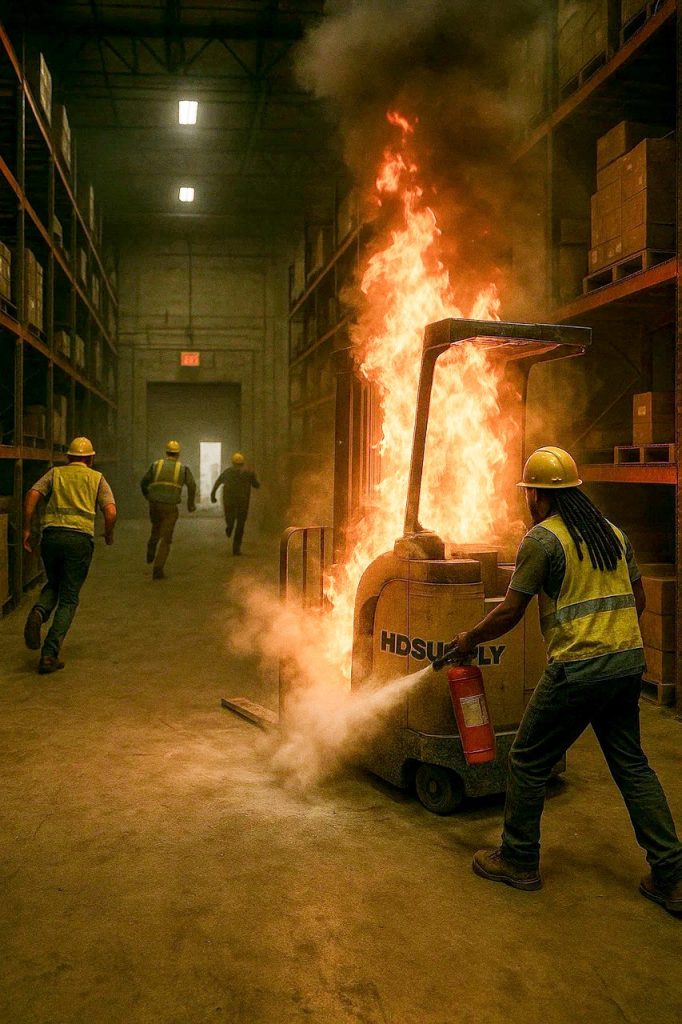
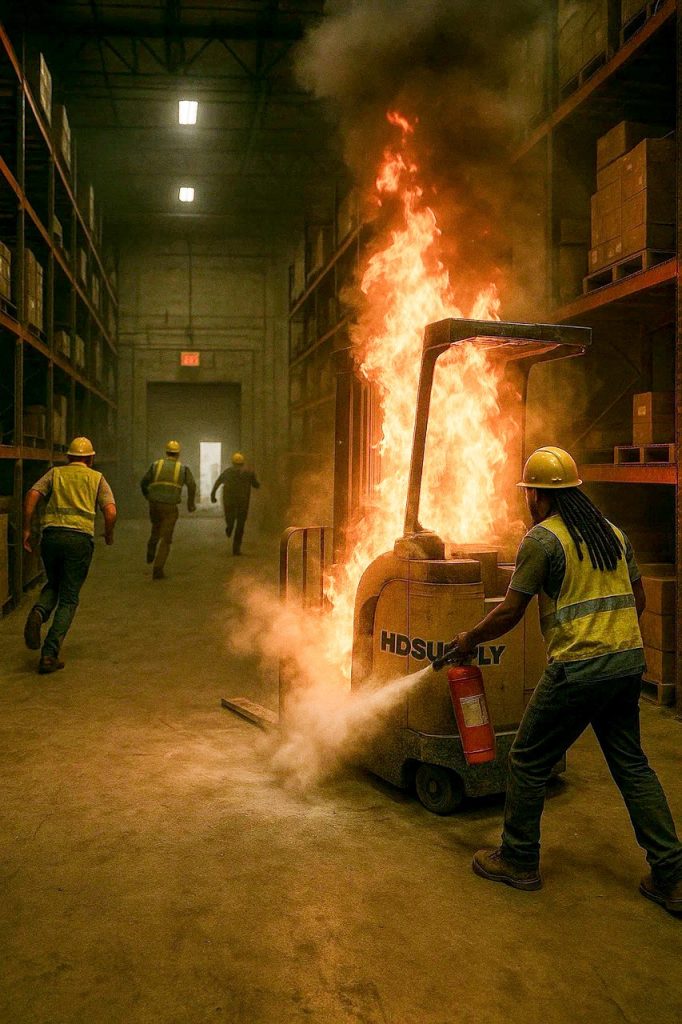
    Hall alleges that while operating a forklift, he noticed excessive heat and smoke coming from the battery area. He claims the situation escalated to the point that he deployed two fire extinguishers inside the warehouse to control the incident. He contends that this episode left him with a serious back injury.

    The complaint describes the event as both a personal turning point and a snapshot of broader safety issues. Photo and video exhibits, according to Hall, depict flames or smoke associated with battery and charging equipment, including an image of a warehouse charger allegedly reading around 158°F.

    A few days later, on or about July 1, 2024, Hall says his supervisor acknowledged the incident in a one-on-one conversation and told him, “You did all you could do, I’m just glad you’re ok.” Hall points to this alleged statement as evidence that management knew both about the safety event and his injury.

    Following the incident, Hall states that he reported ongoing symptoms and requested reasonable accommodations, including modified job duties that would be more compatible with his physical limitations.

    The “Cage,” Light-Duty Work, and Alleged Unequal Treatment

    A central pillar of Hall’s discrimination theory is what he describes as unequal access to light-duty assignments.

    According to the complaint, HD Supply maintained an enclosed light-duty area on the warehouse floor, informally referred to by workers as “the cage.” Employees who had medical restrictions were sometimes assigned there to perform less physically demanding tasks.

    Hall alleges that:

    • Other workers with physical restrictions received cage assignments and lighter duties.
    • He, despite reporting a back injury and seeking accommodation, was denied comparable light-duty work.
    • Instead, he was instructed to perform more strenuous tasks while still recovering.

    Hall claims to have preserved publicly available social-media footage that, he says, shows workers inside the cage performing lighter tasks while he, despite his injury, was assigned heavier work elsewhere. He argues that this discrepancy in treatment — particularly in the context of race — supports an inference of discrimination and pretext under federal civil-rights laws.

    Rising Tension and a Firing in the Aftermath

    The complaint alleges that the relationship between Hall and management deteriorated in July 2024.

    On or about July 23, 2024, Hall describes a “hostile confrontation” with a supervisor in another department at the distribution center. Around that time, he claims he raised concerns about unfair treatment and safety issues.

    The next day, according to Hall, the same supervisor allegedly made comments about him to others after learning he had filed a written complaint about her conduct. Hall cites a notarized witness affidavit that, he says, recounts statements suggesting retaliation — including threats that he would “get what’s coming.”

    Two days later, on July 25, 2024, Hall was terminated.

    The complaint recounts a phone call in which a company representative allegedly told Hall that he was being fired for an “outburst” with the supervisor on July 23. When Hall asked what he had supposedly said or done, the representative allegedly responded that she did not know because she “wasn’t back there when it happened.”

    Hall argues that this admission shows that no proper factual investigation was conducted before his termination, which he characterizes as strong evidence that the stated reason for firing him was a pretext for unlawful discrimination and retaliation.

    Safety Concerns After Hall’s Departure

    Hall’s employment with HD Supply ended in July 2024, but his complaint contends that similar equipment and battery concerns persisted at the same facility even after he was gone.

    On October 23, 2025, more than a year after his termination, a former co-worker allegedly recorded visible smoke coming from a forklift battery compartment he was operating inside the same distribution center. An internal incident report dated October 28, 2025 describing that event is attached as one of Hall’s exhibits.

    Hall points to this later incident as corroborating what he says he tried to flag while employed — ongoing equipment, battery, and charging hazards that posed risks to workers on the warehouse floor.

    Medical and Psychological Impact

    The lawsuit devotes substantial space to describing Hall’s physical and psychological injuries, which he traces back to the June 2024 incident and its aftermath.

    According to the complaint:

    Hall was evaluated by a licensed psychologist, who diagnosed him with Post-Traumatic Stress Disorder (severe)Major Depressive Disorder, and severe anxiety, with associated functional limitations.

    Hall also cites an evaluation by an orthopedic specialist, which he says documented a lumbar injury and resulted in a permanent partial disability assessment. The work-status note allegedly placed restrictions on the type of physical activity he should perform on the job going forward.

    Taken together, Hall claims that these medical opinions show he has sustained a permanent injury that affects his ability to work in physically demanding warehouse roles and has diminished his long-term earning capacity.

    Out of Work and Alleged Economic Losses

    Since his termination on July 25, 2024, Hall alleges that he has remained unemployed despite what he describes as extensive efforts to find new work.

    The complaint states that Hall has:

    • Submitted more than 300 job applications
    • Reached out to employers and recruiters
    • Attended interviews and followed up with prospective employers
    • Maintained a detailed mitigation log tracking his job-search efforts

    Hall argues that this record demonstrates he has done what the law requires to mitigate his damages, and that his continuing unemployment stems from his injury, the mental-health impact of the events, and the stigma he says is associated with how his employment ended — not from any unwillingness to work.

    He estimates his combined economic and non-economic losses — including back pay, front pay, lost benefits, medical expenses, emotional distress, and loss of enjoyment of life — at not less than $50 million, and notes that the amount could increase as more information emerges in discovery.

    The Legal Claims: Civil Rights, Disability, and State Law

    Hall’s lawsuit is built on a multi-layered legal framework that combines federal civil-rights laws with state-law tort theories.

    Among the claims asserted:

    • Race discrimination in violation of federal civil-rights statutes, based on alleged disparate treatment and termination
    • Hostile work environment, alleging severe or pervasive conduct tied to race and disability
    • Retaliation, claiming that HD Supply punished him for complaining about discrimination and safety issues
    • Disability discrimination and failure to accommodate, alleging that the company did not reasonably adjust his duties after his back injury
    • Retaliation and interference under federal disability law
    • A claim under a federal statute that allows uncapped compensatory and punitive damages in certain race-discrimination cases
    • Defamation under Georgia law, based on alleged statements that he was “faking” his injury
    • A state-law wrongful termination / retaliatory discharge theory, pled in the alternative

    He demands a jury trial on all claims that can be decided by a jury and explicitly seeks compensatory, punitive, and, where applicable, liquidated damages.

    An Unusually Document-Heavy Pro Se Case

    Many pro se employment lawsuits are filed with minimal documentation attached. Hall’s complaint is an exception.

    According to the filing, his case is supported by an extensive exhibit set that includes:

    • His administrative charge and Right-to-Sue notice from a federal civil-rights agency
    • Internal performance awards and positive evaluations
    • 17 notarized witness affidavits , safety complaints and incident reports related to forklift batteries and charging equipment
    • Photo and video evidence of smoke and alleged overheating equipment
    • Medical records, psychological evaluations, and disability notices
    • A detailed job-search mitigation log
    • Comparator evidence, including images and footage that Hall claims show other employees receiving lighter “cage” assignments while he continued heavier work; and
    • Internal incident reports describing the forklift battery event;

    Hall argues that this record will show not only that the company’s justifications for its actions are unfounded, but that its conduct was carried out with malice or reckless indifference to his rights — language that mirrors the legal standard for punitive damages in many federal discrimination cases.

    Inside HD Supply: Company Overview and Online Footprint

    Founded in 1974, HD Supply has grown into one of the nation’s largest industrial distributors, serving construction, maintenance, and institutional customers across the United States.

    The HD Supply company overview highlights business segments that include:

    – HD Supply HVAC products and systems

    – HD Supply flooring materials and installation supplies

    – HD Supply appliances for multifamily, hospitality, and commercial properties

    – HD Supply facility maintenance, inventory, and repair solutions

    Through its e-commerce platform—often referred to as HD Supply online shopping—the company serves contractors, government agencies, property managers, and maintenance professionals nationwide. HD Supply also offers HD Supply net 30 accounts, a trade-credit option that allows qualified customers to purchase materials on account with 30-day invoicing. These net-30 terms are widely used in construction and property-management sectors as a short-term financing tool.

    The company operates numerous HD Supply locations across the country and employs thousands of workers. Its HD Supply careers portal advertises roles in logistics, warehouse operations, supply-chain management, sales, and corporate functions.

    Follow the conversation on social media: #QuintonJHall, #HDSupply, #WorkplaceSafety, #EmploymentDiscrimination, #TitleVII, #ADA, #Section1981, #Retaliation, #CivilRights, #WarehouseWorkers, #HomeDepot, #AtlantaNews, #ProSeLitigant, #FederalLawsuit, #CorporateAccountability, #50MillionLawsuit, #ForkliftFire, #hdsupplybuyout, #hdsupplylawsuit, #hdsupplynetworth, #hdsupplysale.

  • Quinton J. Hall vs. HD Supply: From Forklift Fire to a $50 Million Federal Complaint

    Warehouse worker says HD Supply ignored safety alarms, denied light-duty work, and fired him after a forklift fire and back injury.

    Atlanta, Georgia In June 2024, what should have been an uneventful shift at HD Supply’s Forest Park, Georgia, distribution center became a defining moment in the life of Quinton Juwon Hall. A routine assignment turned perilous when the forklift Hall was operating began to malfunction — first smoking, then overheating, and ultimately exploding. The blast released a cloud of toxic fumes that, Hall asserts, left him with a permanent back injury and caused severe disorientation. He maintains that instead of receiving support, the aftermath set off a troubling pattern of humiliation and retaliation inside the workplace — claims that now anchor a $50 million federal civil-rights lawsuit.

    The case, filed in the U.S. District Court for the Northern District of Georgia, stems from a forklift battery incident and back injury in 2024, followed by what Hall describes as a cascade of unequal treatment, denied accommodations, and a retaliatory firing. He is representing himself pro se.

    For months, he has fought, often alone and pro se, to hold one of America’s largest industrial supply chains accountable for what is alleged to be discriminatory, retaliatory, and unsafe workplace practices. Case —Hall v. HD Supply, Inc., Civil Action №1:25-cv-06567 (N.D. Ga.)

    According to the complaint, the lawsuit is not just about one worker’s job loss, but about “safety and dignity behind warehouse walls” at a major national distributor.

    The allegations are contained in Hall’s civil complaint. At this time, HD Supply has not presented its version of events in the court record, and the court has not ruled on the merits of Hall’s claims.

    From Temp Worker to High Performer

    Hall’s lawsuit traces his employment to around October 2023, when he began working at an HD Supply distribution center as a temporary worker on the warehouse “put-away” team. Around March 2024, he was converted to a regular full-time employee.

    According to the complaint, Hall:

    • Consistently met or exceeded productivity and safety expectations
    • Worked frequently overtime when requested
    • Received internal recognition and positive feedback

    Hall describes himself as one of the strongest forklift and put-away operators in his department, entrusted with high-priority tasks and considered reliable under pressure.

    Forklift Battery Incident and Back Injury

    The heart of the lawsuit is a June 27, 2024 incident involving a forklift and an allegedly overheating battery.

    Hall alleges that while operating a forklift, he noticed excessive heat and smoke coming from the battery area. He claims the situation escalated to the point that he deployed two fire extinguishers inside the warehouse to control the incident. He contends that this episode left him with a serious back injury.

    The complaint describes the event as both a personal turning point and a snapshot of broader safety issues. Photo and video exhibits, according to Hall, depict flames or smoke associated with battery and charging equipment, including an image of a warehouse charger allegedly reading around 158°F.

    A few days later, on or about July 1, 2024, Hall says his supervisor acknowledged the incident in a one-on-one conversation and told him, “You did all you could do, I’m just glad you’re ok.” Hall points to this alleged statement as evidence that management knew both about the safety event and his injury.

    Following the incident, Hall states that he reported ongoing symptoms and requested reasonable accommodations, including modified job duties that would be more compatible with his physical limitations.

    The “Cage,” Light-Duty Work, and Alleged Unequal Treatment

    A central pillar of Hall’s discrimination theory is what he describes as unequal access to light-duty assignments.

    According to the complaint, HD Supply maintained an enclosed light-duty area on the warehouse floor, informally referred to by workers as “the cage.” Employees who had medical restrictions were sometimes assigned there to perform less physically demanding tasks.

    Hall alleges that:

    • Other workers with physical restrictions received cage assignments and lighter duties.
    • He, despite reporting a back injury and seeking accommodation, was denied comparable light-duty work.
    • Instead, he was instructed to perform more strenuous tasks while still recovering.

    Hall claims to have preserved publicly available social-media footage that, he says, shows workers inside the cage performing lighter tasks while he, despite his injury, was assigned heavier work elsewhere. He argues that this discrepancy in treatment — particularly in the context of race — supports an inference of discrimination and pretext under federal civil-rights laws.

    Rising Tension and a Firing in the Aftermath

    The complaint alleges that the relationship between Hall and management deteriorated in July 2024.

    On or about July 23, 2024, Hall describes a “hostile confrontation” with a supervisor in another department at the distribution center. Around that time, he claims he raised concerns about unfair treatment and safety issues.

    The next day, according to Hall, the same supervisor allegedly made comments about him to others after learning he had filed a written complaint about her conduct. Hall cites a notarized witness affidavit that, he says, recounts statements suggesting retaliation — including threats that he would “get what’s coming.”

    Two days later, on July 25, 2024, Hall was terminated.

    The complaint recounts a phone call in which a company representative allegedly told Hall that he was being fired for an “outburst” with the supervisor on July 23. When Hall asked what he had supposedly said or done, the representative allegedly responded that she did not know because she “wasn’t back there when it happened.”

    Hall argues that this admission shows that no proper factual investigation was conducted before his termination, which he characterizes as strong evidence that the stated reason for firing him was a pretext for unlawful discrimination and retaliation.

    Safety Concerns After Hall’s Departure

    Hall’s employment with HD Supply ended in July 2024, but his complaint contends that similar equipment and battery concerns persisted at the same facility even after he was gone.

    On October 23, 2025, more than a year after his termination, a former co-worker allegedly recorded visible smoke coming from a forklift battery compartment he was operating inside the same distribution center. An internal incident report dated October 28, 2025 describing that event is attached as one of Hall’s exhibits.

    Hall points to this later incident as corroborating what he says he tried to flag while employed — ongoing equipment, battery, and charging hazards that posed risks to workers on the warehouse floor.

    Medical and Psychological Impact

    The lawsuit devotes substantial space to describing Hall’s physical and psychological injuries, which he traces back to the June 2024 incident and its aftermath.

    According to the complaint:

    Hall was evaluated by a licensed psychologist, who diagnosed him with Post-Traumatic Stress Disorder (severe)Major Depressive Disorder, and severe anxiety, with associated functional limitations.

    Hall also cites an evaluation by an orthopedic specialist, which he says documented a lumbar injury and resulted in a permanent partial disability assessment. The work-status note allegedly placed restrictions on the type of physical activity he should perform on the job going forward.

    Taken together, Hall claims that these medical opinions show he has sustained a permanent injury that affects his ability to work in physically demanding warehouse roles and has diminished his long-term earning capacity.

    Out of Work and Alleged Economic Losses

    Since his termination on July 25, 2024, Hall alleges that he has remained unemployed despite what he describes as extensive efforts to find new work.

    The complaint states that Hall has:

    • Submitted more than 300 job applications
    • Reached out to employers and recruiters
    • Attended interviews and followed up with prospective employers
    • Maintained a detailed mitigation log tracking his job-search efforts

    Hall argues that this record demonstrates he has done what the law requires to mitigate his damages, and that his continuing unemployment stems from his injury, the mental-health impact of the events, and the stigma he says is associated with how his employment ended — not from any unwillingness to work.

    He estimates his combined economic and non-economic losses — including back pay, front pay, lost benefits, medical expenses, emotional distress, and loss of enjoyment of life — at not less than $50 million, and notes that the amount could increase as more information emerges in discovery.

    The Legal Claims: Civil Rights, Disability, and State Law

    Hall’s lawsuit is built on a multi-layered legal framework that combines federal civil-rights laws with state-law tort theories.

    Among the claims asserted:

    • Race discrimination in violation of federal civil-rights statutes, based on alleged disparate treatment and termination
    • Hostile work environment, alleging severe or pervasive conduct tied to race and disability
    • Retaliation, claiming that HD Supply punished him for complaining about discrimination and safety issues
    • Disability discrimination and failure to accommodate, alleging that the company did not reasonably adjust his duties after his back injury
    • Retaliation and interference under federal disability law
    • A claim under a federal statute that allows uncapped compensatory and punitive damages in certain race-discrimination cases
    • Defamation under Georgia law, based on alleged statements that he was “faking” his injury
    • A state-law wrongful termination / retaliatory discharge theory, pled in the alternative

    He demands a jury trial on all claims that can be decided by a jury and explicitly seeks compensatory, punitive, and, where applicable, liquidated damages.

    An Unusually Document-Heavy Pro Se Case

    Many pro se employment lawsuits are filed with minimal documentation attached. Hall’s complaint is an exception.

    According to the filing, his case is supported by an extensive exhibit set that includes:

    • His administrative charge and Right-to-Sue notice from a federal civil-rights agency
    • Internal performance awards and positive evaluations
    • 17 notarized witness affidavits , safety complaints and incident reports related to forklift batteries and charging equipment
    • Photo and video evidence of smoke and alleged overheating equipment
    • Medical records, psychological evaluations, and disability notices
    • A detailed job-search mitigation log
    • Comparator evidence, including images and footage that Hall claims show other employees receiving lighter “cage” assignments while he continued heavier work; and
    • Internal incident reports describing the forklift battery event;

    Hall argues that this record will show not only that the company’s justifications for its actions are unfounded, but that its conduct was carried out with malice or reckless indifference to his rights — language that mirrors the legal standard for punitive damages in many federal discrimination cases.

    Inside HD Supply: Company Overview and Online Footprint

    Founded in 1974, HD Supply has grown into one of the nation’s largest industrial distributors, serving construction, maintenance, and institutional customers across the United States.

    The HD Supply company overview highlights business segments that include:

    – HD Supply HVAC products and systems

    – HD Supply flooring materials and installation supplies

    – HD Supply appliances for multifamily, hospitality, and commercial properties

    – HD Supply facility maintenance, inventory, and repair solutions

    Through its e-commerce platform—often referred to as HD Supply online shopping—the company serves contractors, government agencies, property managers, and maintenance professionals nationwide. HD Supply also offers HD Supply net 30 accounts, a trade-credit option that allows qualified customers to purchase materials on account with 30-day invoicing. These net-30 terms are widely used in construction and property-management sectors as a short-term financing tool.

    The company operates numerous HD Supply locations across the country and employs thousands of workers. Its HD Supply careers portal advertises roles in logistics, warehouse operations, supply-chain management, sales, and corporate functions.

    Follow the conversation on social media: #QuintonJHall, #HDSupply, #WorkplaceSafety, #EmploymentDiscrimination, #TitleVII, #ADA, #Section1981, #Retaliation, #CivilRights, #WarehouseWorkers, #HomeDepot, #AtlantaNews, #ProSeLitigant, #FederalLawsuit, #CorporateAccountability, #50MillionLawsuit, #ForkliftFire, #hdsupplybuyout, #hdsupplylawsuit, #hdsupplynetworth, #hdsupplysale.

  • AgentLISA Breaks Into Top Rankings on x402scan as Demand Grows for Autonomous, AI-Driven Smart Contract Security

    Singapore — December 1, 2025 — AgentLISA, an AI-powered smart contract security layer, has rapidly climbed to the #4 position on the x402scan 24-hour leaderboard, recording 3,578 paying developers and $3,100 in revenue within a single day. The achievement follows the project’s launch on October 29 and reflects strong early adoption of its permissionless, instant-settlement security infrastructure.

    Born at the intersection of Web3 security and autonomous AI systems, AgentLISA (agentlisa.ai) is positioned as a foundational layer for the emerging agent-to-agent economy, a market increasingly shaped by machine-generated transactions, programmatic interactions, and continuous on-chain execution.


    Closing the Automation Gap in Smart Contract Security

    Web3 developers deploy hundreds of thousands of contracts each month—many without any form of security review. Manual audits remain expensive, slow, and incompatible with fast-iterating development cycles.

    AgentLISA addresses this gap through automated, on-demand analysis powered by a multi-agent LLM architecture trained for Web3 security. This design allows the system to deliver audit-level insights at a fraction of traditional cost and latency.

    Benchmark evaluations show that AgentLISA:

    • Identifies 9 of 10 OWASP-prioritized vulnerabilities
    • Performs complex logic checks comparable to expert auditors
    • Reduces analysis time from days to seconds

    This precision is driven by TrustLLM, the platform’s underlying Web3-native AI framework built for code reasoning and multi-step vulnerability detection.


    Permissionless Access Through x402

    AgentLISA integrates natively with x402, a settlement layer enabling autonomous systems to consume services without accounts, API keys, or centralized onboarding.

    • Developers and AI agents can trigger scans programmatically
    • Payments settle in seconds via USDC on Base
    • Results can be consumed immediately for further automated workflows

    This alignment with the x402 architecture makes AgentLISA one of the first security tools designed specifically for machine-driven development environments.


    A Cost Model Built for Scale

    Traditional audits rely on human labor, creating high fixed costs and long delivery cycles.
    AgentLISA reverses this paradigm using a low-marginal-cost, usage-based pricing model, charging $0.50 to $5 per scan.

    This makes professional-grade security accessible to nearly the entire Web3 developer base, including:

    • independent builders
    • hackathon teams
    • early-stage protocols
    • autonomous agents writing and deploying code in real time

    Beyond one-off scans, the system supports continuous coverage through:

    • CI/CD hooks
    • contract-upgrade verification
    • automated pre-deployment checks
    • educational integrations
    • bug bounty automation

    Each successful scan feeds back into the platform’s models, strengthening detection accuracy over time.


    Adoption Momentum and Network Coverage

    Within the same 24-hour window, AgentLISA also reported:

    • 3,000+ registered users
    • 500 premium subscribers
    • Support across 14 networks, including Ethereum, Solana, Base, Arbitrum, BSC, Polygon, Optimism, and Avalanche

    As developer usage expands, exposure to diverse codebases enhances the platform’s performance, creating a self-reinforcing improvement loop.


    Workflow-Native Integration Creates Stickiness

    AgentLISA integrates seamlessly with tools developers already use daily:

    • IDEs: VS Code, Cursor
    • Version control: GitHub
    • Automation: CI/CD pipelines
    • AI development: MCP support for Claude

    This “invisible integration” creates workflow-level stickiness, letting developers adopt continuous security without changing how they build.

    Combined with x402’s instant-settlement architecture, these integrations position AgentLISA as a cornerstone for secure, autonomous machine-to-machine interactions.


    Key Milestones

    • Top 5 ranking on x402scan within 24 hours
    • 3,578 paying developers and strong engagement metrics
    • TrustLLM-powered multi-agent detection, matching professional auditor performance in real tests
    • Over $7.3M in potential exploits prevented across real-world contract analyses
    • 14-network support across major chains
    • $12M in funding led by Redpoint Ventures and NGC Ventures

    About AgentLISA

    AgentLISA is an AI-driven smart contract security platform built to deliver precise, on-demand vulnerability detection. Leveraging a multi-agent LLM framework and permissionless settlement via x402, the platform provides instant, scalable, and cost-efficient protection for developers and autonomous agents alike. AgentLISA integrates directly into development workflows, offering continuous monitoring and improving its detection models with every scan.

    Learn more at agentlisa.ai
    Contact: contact@agentlisa.ai

  • Finance Complaint List Issues Public Alert Against Fraudulent Online Trading and Investment Scams – Victims are Urged to File Complaints

    Financial District, New York – A growing number of online users and consumer protection advocates are raising concerns about a surge in reported investment and trading-related scams across multiple digital platforms. These reports have prompted renewed warnings to the public and a call for affected individuals to formally report suspected fraud to appropriate national and international authorities.

    Industry watchdogs and victim support networks have documented increased complaints tied to websites and entities that allegedly present themselves as legitimate financial trading, crypto investment, and wealth-building platforms, while reportedly engaging in deceptive practices that have led to financial losses for individuals worldwide.

    The platforms currently linked to public complaints and user-submitted scam reports include, but are not limited to:

    • Topdigitalinvest.com
    • 4xhub-int.com
    • vaultxtrading.com
    • dsjex.net
    • www.minaxpump.com
    • fixedpumpstrade.com
    • www.metaversefuds.top
    • extociumworld.com
    • m.avatradeexcoins.com
    • phantomtradespro.com
    • primepremiumtrade.com
    • Frontier Wave Investment Alliance
    • barcodegeu.com
    • OPTCoin
    • nasdac.vip
    • web.nasdac.vip
    • kcex.com
    • edxmco.com
    • stockvance.com
    • digigroupmine.com
    • bitunix

    These platforms have been flagged through user-submitted reports, online complaints, and public discussions for patterns that allegedly include:

    • Promising unusually high or guaranteed returns
    • Impersonating regulated financial entities
    • Restricting or blocking withdrawals
    • Requesting additional fees for account “unlocking” or “verification”
    • Operating without transparent regulatory disclosures

    Consumer advocates stress that these are reported allegations, and individuals should always conduct independent due diligence before engaging with any financial service or investment opportunity.

    Authorities Urge Victims to Report Investment Fraud

    To combat the rise in alleged financial scams, victims and concerned users are strongly encouraged to report their cases to recognized national and international enforcement and monitoring agencies, including:

    • FBI: Federal Bureau of Investigation
    • IC3 (Internet Crime Complaint Center): www.ic3.gov
    • U.S. Federal Trade Commission (FTC)
    • U.S. Securities and Exchange Commission (SEC)
    • Finance Complaint List: www.financecomplaintlist.com

    Filing official complaints not only helps victims seek potential recovery pathways, but also assists global authorities in tracking fraud networks, issuing public warnings, and preventing further harm to unsuspecting investors.

    Why Reporting Matters

    Financial crime specialists emphasize that failing to report online investment fraud allows malicious actors to continue operations unchecked. Public reporting:

    • Builds case data for law enforcement investigations
    • Helps identify emerging scam patterns
    • Protects future victims
    • Strengthens international financial security efforts

    Victims are urged to preserve all communications, transaction records, wallet addresses, email correspondence, chat logs, and screenshots when submitting reports.

    Public Awareness Campaign Expands in 2025

    As online trading, crypto, and alternative investments grow in popularity, fraud prevention analysts say education and awareness remain the strongest defense against digital financial crime. This public alert forms part of a broader initiative to educate users about risk signals and help individuals distinguish legitimate, regulated platforms from high-risk or suspicious operations.

    Individuals who believe they may have been impacted are encouraged to act promptly and contact the appropriate authorities listed above.

    Public Safety Reminder:

    Always verify regulatory registrations, avoid “guaranteed profit” promises, and never send funds to unverified platforms or entities.

    Follow the finance complaint list on social media.

    X (Twitter): https://x.com/financecomplain

    YouTube: https://youtube.com/@financecomplaintlist

    About Finance Complaint List

    Finance Complaint List is an investor protection and consumer awareness platform based in New York City. The organization allows users to file, track, and review financial complaints against companies and individuals involved in misconduct. By creating an accessible global database of verified complaints, Finance Complaint List helps investors make informed decisions and avoid fraudulent schemes.

    Disclaimer: Finance Complaint List is not a law enforcement agency. All scam reports are subject to verification and should also be filed with appropriate federal authorities such as the FBI, SEC, FTC, or IC3.gov.

    For more details, contact:

    Daniel Wilson

    Finance Complaint List

    Email: info@financecomplaintlist.com / support@financecomplaintlist.com

    Website: https://www.financecomplaintlist.com/