Author: Zex PRwire

  • Alexei Orlov: The Questions Leaders Should Ask Before Taking Growth Capital

    • Alexei Orlov, founder and strategic adviser, lays out the questions he tells founders and boards to answer before they accept outside money to grow.

    Why the Question Comes First

    New York, USA, Oct 06, 2026, ZEX PR WIRE — Growth capital looks simple from the outside. A number arrives, the business gets bigger, everyone moves faster.

    Alexei Orlov has raised growth funding himself, having secured $35 million to expand MTM Choice internationally. He says the decision to take capital matters more than the amount or the terms.

    “Money changes the shape of a company before it changes the size of it,” he says. “Leaders feel the size. They rarely plan for the shape.”

    He works with founders, boards and leadership teams on transformation and growth, and he says most of the hard conversations happen after the funding is already in the bank. His view: they should happen before.

    What Problem Are We Actually Solving

    Orlov starts with a direct question: is the business raising money to fix something, or to avoid fixing something?

    Capital can cover for a weak product, a thin leadership bench, or a sales process that only works because one person is driving it. None of those problems go away with more money. They get bigger, faster.

    “If I can’t name the specific problem the capital solves, I tell people to wait,” Orlov says. “A vague answer now becomes a very expensive answer in eighteen months.”

    He says the businesses that use growth capital well are usually the ones that could, in theory, grow without it, just more slowly. Money can buy speed; it does not guarantee a fix.

    Who Will This Capital Answer To

    Every investor, lender or partner brings a set of expectations. Some are spoken. Many are not.

    Orlov urges  leaders to ask what the capital provider actually wants to see in twelve months, and in three years. Those two answers are not always the same, and founders rarely check both before they sign.

    “You are not just taking money,” he says. “You are taking a new voice in the room. Ask what that voice is going to want from you before you let it in.”

    He says this question matters most for founder-led businesses, where one person has carried the vision for years. Bringing in capital means sharing that role, whether or not it is stated.

    What Happens If Growth Outpaces the Team

    Capital accelerates demand. It does not automatically build the team that can meet it.

    Orlov has led the build-out of a multidisciplinary group from the ground up, and he says the moment leaders underestimate most is the gap between winning new business and having the people ready to deliver it well.

    “Ask the question in the room, before the money arrives: who is doing this work when volume doubles?” he says. “If the honest answer is ‘we’ll figure it out,’ that is the moment to slow down, not speed up.”

    He points to hiring, management structure and culture as the three areas that strain first. Of the three, he says culture is the one leaders notice last, usually after it has already slipped.

    What Will We Give up to Get It

    Every round of capital comes with a cost beyond the percentage given away. It can mean slower decisions, new reporting demands, or less room to change direction once the business is underway.

    Orlov says boards and founders should write down what they are prepared to give up before they negotiate terms, not after. He says the leaders who skip this step are the ones most likely to feel surprised a year later.

    “I ask people one plain question,” he says. “What are you willing to lose to get this? If nobody in the room can answer it, the deal is not ready yet.”

    He says the answer does not have to be dramatic. Sometimes it is speed. Sometimes it is a seat at the table. Naming it in advance, he says, is what keeps a leadership team steady once the money starts to change how the business runs.

    About Alexei Orlov

    Alexei Orlov is a founder and strategic adviser based across the United States, New York and the United Kingdom. He is the founder of MTM Choice, where he built a multidisciplinary creative and advisory group and remains an adviser to the Chairman. He has also served as a Divisional CEO within Omnicom and as Group Chief Marketing Officer for Volkswagen across China and ASEAN. He now advises boards, founders and leadership teams on growth, transformation and brand strategy.
  • Clark Gallagher on Why Bulking Is More Than Just Eating More

    • Fitness model and coach Clark Gallagher shares why he believes beginners should approach gaining muscle with more structure than simply eating big and lifting heavy.

    The Advice Beginners Hear All the Time

    Oregon, USA, Oct 06, 2026, ZEX PR WIRE — Anyone who has spent enough time around a gym has probably heard some version of the same advice: eat more, lift heavy, gain size, and worry about the details later.

    Clark Gallagher understands why that approach is appealing. When you are new to lifting, the idea seems straightforward. If you want to get bigger, you need to eat more and train harder.

    But after years of training, bodybuilding, coaching, and learning more about how the body responds to exercise and nutrition, Gallagher sees the process differently.

    “People think bulking is just eating more and hoping the muscle keeps up,” Gallagher says. “That’s not really how I approach it.”

    For him, gaining muscle is less about simply increasing everything and more about making sure training and nutrition are working together.

    Why More Food Does Not Automatically Mean More Muscle

    The idea of eating as much as possible can be tempting, particularly for someone who is eager to see their body change. Gallagher believes the problem comes when eating more becomes the goal instead of supporting the goal.

    “If your eating is way ahead of your training, you’re going to gain weight, but that doesn’t necessarily mean you’re building muscle at the same rate,” he says.

    That distinction is something Gallagher thinks new lifters often overlook.

    His own approach is much more structured. His routine includes six meals throughout the day, with his nutrition built around the demands of his training. He also trains consistently, often spending most days in the gym.

    The point is not simply to eat more food. It is to have enough food to support the work being done.

    That difference may sound small, but Gallagher believes it can change the way someone approaches the entire process.

    What Gallagher Focuses on Instead

    After years of training himself and spending about four years working in a gym, Gallagher has developed an approach that puts consistency and structure ahead of simply trying to do more.

    Training Comes First

    For Gallagher, nutrition starts with understanding the training.

    That does not mean someone needs to spend every day trying to lift as much weight as possible. In fact, he believes beginners can sometimes benefit from taking the opposite approach and focusing on learning good technique, building consistency, and gradually becoming stronger.

    Training creates the demand. Nutrition supports it.

    That relationship is more important to him than simply choosing a large number of calories and trying to hit it regardless of what is happening in the gym.

    Food Should Support the Work

    Gallagher also puts a lot of emphasis on having a consistent eating routine.

    He personally follows a six-meal structure, but he does not see that as a rule that everyone has to follow. What matters more is having a nutrition plan that fits the individual’s training, goals, and lifestyle.

    For him, eating regularly makes it easier to stay consistent and make sure his body has the fuel it needs throughout the day.

    “It is not about just eating as much as you can,” he says. “You want your food to have a purpose.”

    Consistency Matters More Than Extremes

    One of the biggest lessons Gallagher has learned through his own training is that extreme approaches are difficult to maintain.

    Someone might train incredibly hard for a few weeks or drastically increase their food intake, but that does not necessarily create lasting progress.

    Building a routine that someone can actually maintain is a different challenge.

    That is where Gallagher believes many beginners can benefit from slowing down and focusing on the fundamentals instead of constantly looking for the next shortcut.

    Learning Through Experience

    Gallagher’s approach did not come entirely from a textbook.

    He started lifting at 14 and spent years learning through experience before studying Kinesiology in college. He also worked in a gym for approximately four years, giving him the opportunity to work with people directly and see how different individuals approached training.

    There were lessons that came from getting things right, but there were also lessons that came from getting things wrong.

    “A lot of what I understand now came from having to figure things out for myself,” Gallagher says. “You learn pretty quickly that doing more is not always the same thing as doing better.”

    That experience is part of what influences the way he talks about fitness today.

    A More Thoughtful Approach to Bulking

    Gallagher is not against gaining weight or eating more to support muscle growth. His point is that there should be a reason behind the increase.

    For someone trying to build muscle, that might mean gradually adjusting their nutrition as their training changes rather than treating a bulk as permission to eat without much structure.

    “Bulking isn’t a free pass to eat whatever you want,” Gallagher says. “You still want to have some structure behind it.”

    That structure can look different from person to person. Training experience, goals, lifestyle, and individual needs all matter.

    For Gallagher, the important part is understanding that food and training should work together.

    Sharing What He Has Learned

    Today, Gallagher continues to share his training, nutrition, and fitness experiences through his social media presence under @clarkpb01. His content also extends beyond fitness into interests such as cars, travel, and gaming.

    His career has grown considerably since he first started lifting at 14, but the basic idea remains familiar. He is still learning about training, still paying attention to his nutrition, and still interested in sharing what he has learned with other people.

    For beginners, his message is relatively simple.

    You do not necessarily need to make everything bigger, harder, or more extreme to make progress. Sometimes the better approach is to understand what you are doing, build a routine you can maintain, and give yourself enough time to see what happens.

    “If I can help someone avoid some of the mistakes I made when I was starting out, that’s a good thing,” Gallagher says.

    To read more, visit the website here.

    About Clark Gallagher

    Clark Gallagher is a fitness model, coach, and social media creator based in Salem, Oregon. He holds a degree in Kinesiology and spent approximately four years working in a gym before developing a full-time career in social media and fitness content. Under the handle @clarkpb01, he shares content related to training, nutrition, fitness, and personal branding across social media.

  • Dr. Brandice Allen Sets a One-Year Plan for Hope Mission 360’s Dental Program

    • Dr. Brandice Allen is laying out a year-long plan to expand dental care access through her work as Dental Director for Hope Mission 360.

    A plan built around the calendar year ahead

    Georgia, USA, Oct 06, 2026, ZEX PR WIRE — Dr. Brandice Allen, a pediatric dentist based in Georgia, has set specific goals for the coming year in her role as Dental Director for Hope Mission 360. The plan covers outreach, volunteer coordination, and family education, structured month by month rather than left open-ended.

    “A goal without a timeline is just a wish,” Dr. Allen said. “I wanted this year mapped out so families know what to expect and volunteers know where they fit in.”

    What the next twelve months look like

    The plan breaks into three phases.

    Early months: outreach and scheduling. Dr. Allen is focused on setting the calendar of mission visits and confirming which communities will be reached first. This includes coordinating with other volunteers who provide care alongside her.

    Middle months: care delivery and training. This is the busiest stretch, when most direct patient care happens. Dr. Allen also plans to spend part of this window mentoring other volunteers on pediatric-specific techniques, since treating children requires a different approach than treating adults.

    “Kids aren’t just small adults in a dental chair,” she said. “The way you talk to a seven-year-old, the way you pace an exam, all of that changes the outcome. I want other volunteers walking away from this year with more of that skill than they came in with.”

    Late months: review and reset. Dr. Allen plans to close out the year by reviewing what worked, what didn’t, and what the following year’s calendar should look like. She sees this step as necessary, not optional.

    “If you don’t stop and look back, you repeat the same gaps every year,” she said. “I’d rather know now what needs to change.”

    Why the timeline matters to her

    Dr. Allen has described her volunteer work as something she treats with the same discipline as her clinical practice. A dental mission that runs on goodwill alone, she said, tends to lose momentum once the initial excitement fades.

    “Enthusiasm gets people to show up once,” she said. “A plan is what gets them to show up again next year.”

    She pointed to family time and travel as things she has to plan around too, since volunteer work has to fit alongside a full clinical schedule and personal life. That, she said, is part of why she builds the year out in advance instead of deciding month to month.

    What families and volunteers can expect

    For families served through Hope Mission 360, the plan means a more predictable schedule of when care will be available. For volunteers, it means clearer expectations about what phase of the year they’re joining and what kind of support they’ll get.

    Dr. Allen said she wants new volunteers, especially those without pediatric experience, to feel like the year has a rhythm they can learn.

    “Nobody should feel like they’re guessing,” she said. “I want people to know: this month we’re doing outreach, this month we’re in the chairs, this month we’re reviewing. That structure helps everyone show up ready.”

    A commitment she plans to repeat

    Dr. Allen said this year’s plan is meant to become a template, not a one-time exercise. She expects to adjust the specifics each year based on what the review phase turns up, but the three-part structure, outreach, care, and review, is one she intends to keep using.

    “This isn’t about doing more for the sake of more,” she said. “It’s about making sure the work actually holds together from January to December.”

    To read more, visit the website here.

    About Dr. Brandice Allen

    Dr. Brandice Allen is a pediatric dentist based in Georgia and serves as Dental Director for Hope Mission 360. She grew up in Atlanta, Georgia, and trained at Howard University, Saint Louis University, and the University of Tennessee, including its pediatric dental residency program. Outside her clinical and volunteer work, she enjoys traveling, biking, live music, and family time.

  • Kopit Law Firm Lays Down Roots in Kansas City

    • A year on local television, a city billboard, Kopit Cares, and representation for people hurt on either side of the state line.

    Kansas City, Missouri, Oct 06, 2026, ZEX PR WIRE — Kopit Law Firm is laying down roots in Kansas City. This year the firm has appeared on local television, put a billboard up in the city, and worked in the community through Kopit Cares. Founder Michael Kopit is a Kansas City personal injury lawyer representing people hurt on either side of the state line. The firm is treating the moment as a virtual ribbon cutting for work already underway.

    A year Kansas City could already see

    In 2026 the firm has been visible beyond its office at 4520 Main Street, Suite 1000, in Kansas City’s Country Club Plaza. On January 15, Kopit joined Kerrigan on KCTV 5. On September 7, KCTV 5 spoke with him about Labor Day hazards, including rental boats and inexperienced operators. On September 16, KSHB 41 spoke with him about Kansas City’s e-bike rules, including age, helmets, speed, and what qualifies as an e-bike. Announcements and local coverage are collected in the firm’s News Room.

    A Kopit Law Firm billboard is up in Kansas City. Through Kopit Cares, the firm works with local organizations, schools, businesses, and community groups. That work includes informational talks about what to do after an accident, along with sponsorships and charitable events, including local golf outings. Kopit Cares is the firm’s community outreach.

    During the same period, Kopit was named to The Best Lawyers in America 2027 for Commercial Litigation and for Personal Injury Litigation – Plaintiffs. He was named to Super Lawyers in 2026, after Rising Stars recognition from 2017 through 2024. In 2026 he was selected to The National Trial Lawyers Top 100 Civil Plaintiff Trial Lawyers in Missouri.

    The lawyer who used to defend the file

    Kopit is a former defense attorney who now represents injured people. He earned his law degree from the University of Kansas School of Law in 2012 and has been licensed in Kansas (2012) and Missouri (2013). Kansas City sits on two sets of rules, and a claim is not the same case on both sides of State Line. He spent nearly a decade representing insurance companies and corporations, and he uses that experience when he prepares a file for the person who was hurt, including the question of which state the claim belongs in. Clients who hire the firm work with him directly. He asks people to speak with a lawyer before they give a recorded statement, sign a release, or sit for an examination under oath.

    “The legal system shouldn’t be a contest of who has the deepest pockets,” Kopit said. “I spent nearly ten years defending the corporate playbook—now, I use that exact strategy to level the playing field for you.”

    Matters the firm handles

    In the Kansas City metro, Kopit Law Firm represents people hurt in:

    ● Car accidents, including uninsured and underinsured motorist claims.

    ● Truck accidents.

    ● Motorcycle accidents.

    ● Bicycle, e-bike, and scooter crashes.

    ● Slip, trip, and fall claims.

    ● Dog bites.

    ● Wrongful death.

    ● Bad faith and vexatious refusal claims.

    ● Examinations under oath.

    About Michael Kopit and Kopit Law Firm

    Michael Kopit is the founder of Kopit Law Firm, a Kansas City personal injury law firm serving clients across the greater Kansas City metro in Missouri and Kansas. He brings more than a decade of litigation experience, including years representing corporations and insurers before dedicating his practice to injured individuals and families. He is licensed in Missouri and Kansas. Learn more at KopitLaw.com.

    The choice of a lawyer is an important decision and should not be based solely upon advertisements. Attorney Michael Kopit is responsible for this content. This release is provided for general informational purposes only and is not legal advice. The information in this release is not intended to create, and receipt or viewing does not constitute, an attorney-client relationship.

  • PropLaunch Partners with Axcera and RUBIK to Simplify Prop Firm Launches

    Partnership combines operating support, technology infrastructure and specialist risk expertise for entrepreneurs launching proprietary trading firms

    DUBAI, UAE, October 6th, 2026 — PropLaunch today announced a new strategic partnership with Axcera and RUBIK Prop Firm Consulting to provide entrepreneurs with a coordinated infrastructure and operational framework for launching and running proprietary trading firms.

    The partnership brings together PropLaunch’s operating model, Axcera’s technology infrastructure, and RUBIK’s specialist expertise in risk management and prop firm operations. The companies will work together to support founders with key requirements including technology, trading platforms, account management, payments, onboarding, risk processes, and ongoing operations.

    Launching a proprietary trading firm typically requires founders to coordinate multiple technology providers, payment services, trading platforms, operational systems, and specialist functions. Managing these requirements independently can create significant upfront costs and operational complexity, particularly before a new firm has established its customer base.

    Under the partnership, PropLaunch will coordinate the overall operating framework for founders, including onboarding, configuration, trading platform connectivity, payment infrastructure, and ongoing operational support. Founders will retain control of their brands, commercial strategies, marketing activities, and trader acquisition.

    Axcera will provide the technology infrastructure supporting the operation, including trader-facing systems, account management, back-office workflows, automation, and infrastructure designed to support trading accounts at scale.

    RUBIK will provide specialist risk and operational expertise, supporting areas such as evaluation structures, trading rules, monitoring frameworks, and payout review processes.

    “I’ve been thinking for a long time about how to make it easier for serious founders to enter this industry. There are many people who know how to build a brand and attract customers, but putting the technology, operations and risk processes behind that brand together is a very different challenge,” said Rachid Belhadj, Founder of PropLaunch.

    “That is why I approached Axcera and RUBIK. I wanted PropLaunch to be built around strong specialists in the areas that matter most. By bringing those components together, we can lower the operational and financial barriers to getting started and allow founders to put more of their capital and attention into actually growing their business.”

    Ruben Abitbol, Founder and CEO of RUBIK, said the partnership will also help founders establish risk processes at an early stage of development.

    “Risk management should be part of how a prop firm is designed from the beginning, rather than something introduced only once payout requests or problems start appearing,” said Abitbol. “Working with PropLaunch and Axcera allows us to help founders put the right evaluation structures, trading rules and monitoring processes in place early.”

    Herman Shaho, Co-Founder of Axcera, said the partnership will provide an additional route for entrepreneurs who want access to established technology infrastructure as they enter the industry.

    “Axcera has increasingly focused on serving larger, established prop firms with more complex technology requirements. At the same time, there are many serious founders who want to enter the industry but are not yet at that stage.”

    “PropLaunch gives those entrepreneurs a more accessible way to start with strong technology, operational support and risk expertise from day one, without having to commit to the same level of upfront cost and operational complexity that would normally come with sourcing and integrating those capabilities separately.”

    PropLaunch currently supports proprietary trading firms across forex, CFDs, futures, and crypto, depending on the trading platforms, payment providers, and third-party services selected for each operation. Support for additional markets, including prediction markets, is planned.

    The partnership is intended to provide founders with a more coordinated route from initial setup to live operations, while allowing them to focus their resources on brand development, marketing, customer acquisition, and business growth.

    For more information about PropLaunch and its launch requirements, visit PropLaunch.com.

    About PropLaunch

    PropLaunch is an operating partner for entrepreneurs launching and running branded proprietary trading firms. The company brings together technology, trading platforms, payments, and operational support within a structured operating model.

    About RUBIK Prop Firm Consulting

    RUBIK Prop Firm Consulting provides specialist advisory services across risk management, operations, and strategy for proprietary trading firms. Its areas of expertise include evaluation structures, trading rules, monitoring, and payout processes.

    About Axcera

    Axcera is a technology infrastructure provider for established and scaling proprietary trading firms across Forex, Futures, Crypto, Equities, and emerging markets such as prediction markets. With more than 100 integrations, Axcera supports complex multi-asset and multi-brand environments with infrastructure, automation, and flexibility designed to support firms as they grow.

  • Signed at the Source: API3’s AirnodeHub Brings Provenance to AI Agent Data

    Grand Cayman, Cayman Islands, 6th October 2026, ZEX PR WIRE — When a person chooses where to get their information, they lean on reputation. A recommendation from someone they trust outweighs a hundred anonymous reviews, and a known source beats an unknown one almost every time. Software agents are now inheriting that same shortcut — they increasingly decide which data to trust and act on — but without the judgment a person brings to the choice, and at a scale and speed no one can slow down. As agents begin to book, trade, research and pay on their own, whether the data beneath them can be trusted stops being an academic question and becomes the whole foundation.

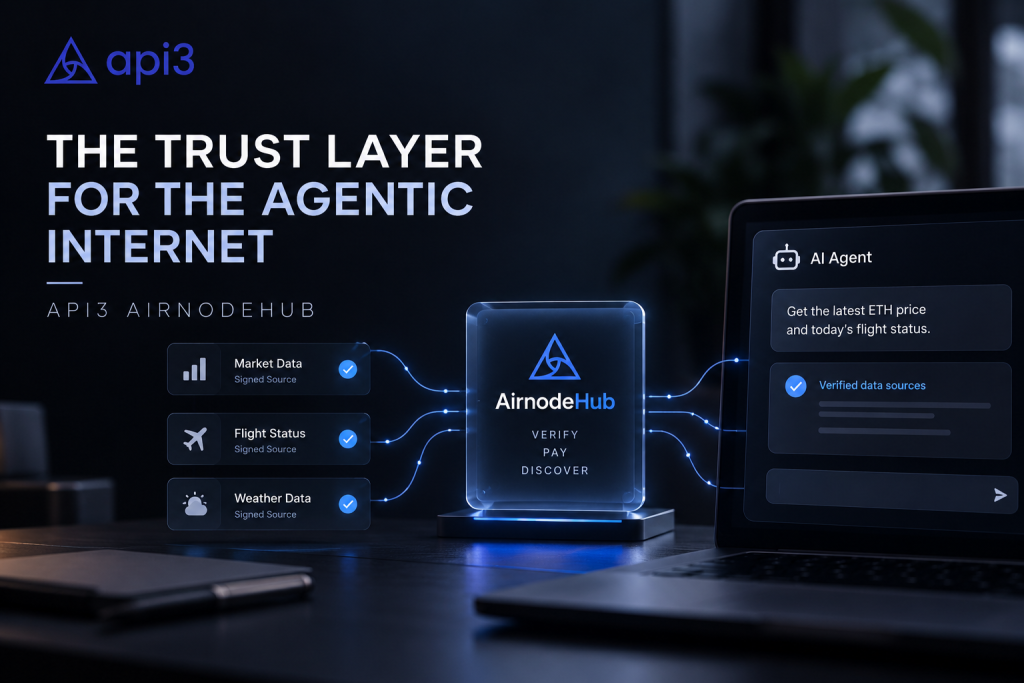
    That is the gap API3 is targeting with AirnodeHub, an early-access marketplace where AI agents discover, call, pay for and verify APIs without a human in the loop. The observation behind it is simple but easy to miss: almost everything being built for the agent economy is built for the consumer of data. Comparatively little is being built for the producer. AirnodeHub is a bet that the producer side is the one that matters.

    The problem becomes obvious the moment an agent assembles an answer from several places. It might pull a price from one service, a weather reading from another and a flight status from a third, combine them, and act on the result. Every step in that chain is a point where the origin of the information can quietly disappear. When the output of one call becomes the input to the next, a single unverified hop early on contaminates everything after it. For casual use this rarely matters. For an agent moving money or making commitments on someone’s behalf, it matters enormously.

    API3’s answer is not to check sources after the fact but to make each piece of data prove its own origin. The approach borrows from cryptography rather than reputation: a response is signed by the party that produced it, so any consumer can confirm who stood behind it using nothing more than a public key. A reputable intermediary signing is worth something; the original source signing is worth the most, because it attests to producing the data rather than merely passing it along. Crucially, these signatures compose — an agent can carry each one along a chain, so whoever consumes the final result can verify every underlying source.

    This is not new territory for the project. API3 coined the term first-party oracle to describe data providers who run their own infrastructure instead of routing information through third parties, and it has operated production oracle feeds on signed data for years. AirnodeHub generalizes that idea from blockchain price feeds to any API response, and repoints it from smart contracts to agents.

    What makes the timing notable is a shift in how data gets bought. Agents discover services by reading machine-readable descriptions, not marketing pages. They pay per request rather than per seat. They settle without a human clicking approve, and they chain calls relentlessly. Serving that buyer well is less about the data itself than about interface, payment and discovery — precisely the work most providers have never had reason to do. A marketplace that handles it on their behalf turns a hard, unglamorous problem into a distribution channel aimed at where their next customers actually are.

    There is a reason the rest of the field has avoided this side of the problem: building for the source is harder than building for the consumer. It means convincing hundreds of providers, one at a time, that a new channel is worth their attention — a relationship business rather than a purely technical one. But in the long run the authenticity of the data is what wins the consumer side, and there is no shortcut through better technology alone. API3’s framing for the result is deliberately broad: a data layer for the agentic internet.

    Whether AirnodeHub becomes that layer is an open question, and the project is upfront that the product is in early access. What the launch makes concrete is a thesis the industry has largely skipped — that the agent economy will eventually need provenance as a base primitive, not an afterthought, and that the way to deliver it is to empower the source rather than the middleman. The project’s broader work and the marketplace itself can be explored at api3.org and airnodehub.api3.org.

    About API3

    API3 is a decentralized oracle project that connects real-world data directly to blockchains and, increasingly, to AI agents through first-party, cryptographically signed data. It pioneered the first-party oracle model — in which data providers operate their own oracle nodes rather than relying on third-party intermediaries — and maintains more than 100 data feeds across dozens of networks. Through its Oracle Extractable Value (OEV) mechanism, API3 returns value generated by oracle updates to the applications that create it. Its latest initiative, AirnodeHub, extends the same source-signed data model to the emerging agent economy. API3 is governed by the API3 DAO. Learn more at api3.org and airnodehub.api3.org.

  • Carziqo Launches ER-SX Operations in Dallas, Introduces CARBON POINTS Rewards During Future Mobility Festival

    The October celebration connects all-electric autonomous mobility with cash-redeemable rewards for eligible ER-SX rental users.

    DALLAS, Texas, October 3rd, 2026, ZEX PR WIRE— Carziqo has announced the introduction of its ER-SX series autonomous ride-hailing vehicles in Dallas as part of the Carziqo Future Mobility Festival, pairing its latest mobility initiative with a CARBON POINTS promotion that allows eligible rental users to redeem platform points for cash.

    Held throughout October, the festival brings together the company’s electric mobility ambitions and customer appreciation activities. The Dallas announcement places the ER-SX series at the center of this year’s celebration, alongside benefits designed to make participation more accessible and rewarding.

    According to Carziqo, users who rent designated ER-SX series vehicles during the promotional period are eligible to receive CARBON POINTS under the corresponding rental offer. Eligible points can then be exchanged for cash in accordance with the platform’s published redemption terms.

    The initiative reflects the company’s approach to connecting the development of greener transportation with tangible customer benefits.

    Carziqo describes its autonomous ride-hailing fleet as fully electric. The ER-SX series follows that approach, producing zero tailpipe carbon dioxide emissions while driving. Overall environmental performance also depends on factors such as the electricity used for charging, vehicle manufacturing, and operational efficiency.

    The company has positioned electrification as a foundation for its mobility strategy, alongside intelligent fleet management and the development of more efficient transportation services. Its Dallas operations bring those priorities into the Future Mobility Festival while giving eligible users an additional way to participate through CARBON POINTS.

    The promotion also introduces the broader commercial concept behind environmental crediting: qualifying lower-carbon transportation activity can generate measurable value under specific programs.

    In applicable low-carbon fuel markets, electricity supplied for transportation may support the generation of tradable credits. Charging data, measured in kilowatt-hours, forms part of a calculation process governed by the relevant program’s eligibility, carbon-intensity, reporting, and verification requirements.

    Once properly established, eligible credits can be sold to market participants, including fuel suppliers that purchase credits to meet compliance obligations. Revenue from those transactions can support permitted activities and benefits, depending on the rules governing the program.

    Carziqo has identified this mechanism as a potential opportunity to connect electric fleet activity with additional customer value. Where its operations qualify, credit rights are established, and transactions are completed, the company aims to explore how permitted proceeds could support user benefits.

    For customers, CARBON POINTS provide a simpler point of participation. The points function as Carziqo platform reward units, with their cash redemption value determined by the applicable promotional terms. They are distinct from market-traded environmental credits and do not require users to arrange credit sales independently.

    Under the festival offer, the customer process centers on three steps: selecting an eligible ER-SX rental plan, receiving the corresponding CARBON POINTS allocation, and redeeming eligible points through the platform.

    The relevant offer sets out the point allocation, conversion rate, claim requirements, and validity period. These published conditions define the customer benefit.

    The Future Mobility Festival provides the setting for this initiative. Carziqo describes the annual October celebration as an opportunity to recognize customer support and share its direction for the years ahead.

    By combining the ER-SX introduction with CARBON POINTS, the company is bringing a vehicle-focused announcement and a customer reward activity into a single campaign. The approach gives the festival an immediate benefit for eligible participants while introducing the longer-term opportunities associated with electric mobility.

    Looking toward 2030, Carziqo has outlined priorities that include improving fleet energy efficiency, strengthening charging-data collection, developing clearer environmental measurement, and evaluating suitable crediting opportunities in eligible markets.

    These priorities reflect the role that operational information can play in the development of an electric mobility business. Reliable energy records can support fleet management and provide a foundation for assessing participation in applicable environmental programs.

    The Dallas announcement marks another step in Carziqo’s stated mobility plans. Through the ER-SX series and the Future Mobility Festival, the company is linking its all-electric transportation strategy with a customer initiative focused on clear participation requirements and cash-redeemable rewards.

  • Carziqo Brings A-DS Autonomous Delivery to San Francisco During Future Mobility Festival

    • The company reports rising delivery demand as it positions autonomous logistics as a response to growing operating costs and the need for more efficient urban services.

    SAN FRANCISCO, CA, Oct 03, 2026, ZEX PR WIRE — Carziqo says its A-DS autonomous delivery vehicles have begun operating in San Francisco, extending the company’s delivery business during the Carziqo Future Mobility Festival. The development comes as the company reports continued growth in delivery orders across its supported operations and sees increasing opportunities for autonomous technology in the movement of goods.

    The San Francisco operation brings a practical focus to the October celebration: how intelligent mobility can support the everyday needs of businesses and consumers. For Carziqo, autonomous delivery represents an opportunity to connect its vehicle technology with a service whose value depends on consistency, convenience and careful management of operating costs.

    The company’s recent announcements have emphasized rising A-DS order volumes and the importance of matching delivery demand with available fleet capacity. Carziqo says its priority is to translate that growth into better vehicle utilization and a more dependable service as the business develops.

    The economic backdrop gives that objective particular relevance. According to the U.S. Bureau of Labor Statistics, compensation costs for private industry workers rose 3.3 percent in the year ending June 2026, including a 3.1 percent increase in wages and salaries. Although these figures cover private industry broadly, they provide context for the cost pressures businesses face when planning labor-intensive services.

    For delivery operators, handling additional orders involves more than adding vehicles. It requires coordinating routes, staffing, vehicle availability and the time needed to complete each task. Higher demand creates a commercial opportunity, but the ability to serve that demand efficiently determines how much value the additional activity can generate.

    Carziqo’s approach centers on reducing the manual driving requirements of supported delivery journeys while maintaining human involvement in fleet supervision, maintenance, customer support and situations requiring direct intervention. The company describes this division of responsibilities as a way to organize delivery work more efficiently as volumes increase.

    That distinction is central to the business case for autonomous delivery. Automation can change how resources are allocated, but its usefulness depends on the performance of the wider service. A vehicle must be available when needed, assigned a suitable route and supported throughout its operating cycle.

    Carziqo describes the A-DS platform as combining automated driving with route planning, connected vehicle monitoring and centralized operational support. Its fleet systems are designed to bring together information about vehicle condition, delivery progress, charging requirements and maintenance needs, helping teams coordinate the vehicles as a network.

    For San Francisco, the significance of the deployment lies in applying that approach to local delivery needs. The commercial opportunity will depend on how effectively available capacity meets demand and how consistently the service performs within its operating scope. Those practical considerations give the expansion a business focus beyond the introduction of another autonomous vehicle model.

    Carziqo has previously described a phased approach to A-DS deployment, with attention to route suitability, operational stability and service consistency. Experience gathered from its delivery operations is intended to inform improvements in dispatching, maintenance planning and future deployment decisions.

    The Carziqo Future Mobility Festival places these developments within the company’s broader ambition to make intelligent transportation relevant to daily life. Held throughout October, the festival centers on greener mobility, connected services and the practical use of technology to improve how people and goods move through cities.

    Autonomous delivery gives that theme an everyday point of connection. Behind each delivery is a person waiting for an item or a business fulfilling a customer’s request. The value of the technology ultimately rests on whether it can help complete those tasks reliably and make the service easier to manage.

    The festival also provides an occasion to recognize the community supporting Carziqo’s development. In a separate A-DS announcement, the company introduced an additional Wednesday Performance Reward for eligible A-DS rental users, with amounts, claiming arrangements and eligibility governed by the terms published on its platform.

    As the company develops its delivery business, its stated priorities include closer coordination between demand and vehicle deployment, management of operating costs and continued improvement of the service experience.

    The San Francisco operation adds a new chapter to that effort during the Future Mobility Festival. With A-DS, Carziqo is positioning autonomous delivery as a practical part of its longer-term mobility ambitions—one whose progress will be measured through the everyday work of moving goods and serving customers.

    For company information and official updates, visit www.carziqo.com.

  • Timothy Caraboolad Publishes a Buyer’s Checklist for New-Build Condos in South Florida

    • Real estate developer Timothy Caraboolad is releasing a set of questions first-time buyers should ask before putting money down on a new-build apartment in South Florida.

    A market full of new buildings, and a lot of first-time buyers

    Florida, USA, Oct 03, 2026, ZEX PR WIRE — South Florida has no shortage of new construction. Buildings go up fast, sales offices open before the concrete cures, and renderings promise more than any buyer can verify in a single walkthrough.

    Timothy Caraboolad, a real estate developer and designer based in Palm Beach, Florida, has spent years on the other side of that process, building high-end custom homes through his firm Lad Design. He says the buyers who end up happiest are the ones who ask harder questions earlier, not the ones who fall for the best rendering.

    “A sales gallery is designed to sell you a feeling,” he says. “Your job as a buyer is to slow that down and ask what you’re actually getting for the price.”

    What to check before signing anything

    Caraboolad points first-time buyers toward a few areas that matter more than finishes.

    Construction quality behind the walls. Countertops and cabinetry are easy to judge. What is inside the walls is not. Caraboolad suggests asking who the general contractor is, how long they have built in the area, and whether the building uses concrete or wood-frame construction, since that affects sound, insurance, and long-term durability in a hurricane-prone region.

    HOA fees and what they actually cover. New buildings often advertise low fees at launch that rise once amenities open and reserves get funded. “Ask for the projected budget once the building is fully occupied, not just the introductory number,” Caraboolad says. He recommends buyers ask specifically what percentage of the fee goes into reserves, since that determines whether the building can pay for a roof or a seawall repair without a special assessment.

    Storm readiness. In South Florida, this is not optional. Buyers should ask about impact windows, generator backup for elevators and common areas, and flood elevation. Caraboolad says a building’s flood zone designation should be requested in writing, not estimated by a sales agent.

    Parking and storage, spelled out. Some buildings sell parking as a deeded asset. Others assign it and can reassign it later. Caraboolad says this distinction matters more than most buyers realize until after closing.

    Developer track record. A new building has no resale history to check. Caraboolad suggests buyers look at other projects the same developer has completed, not just renderings of the one being sold, and ask how those buildings have held up.

    Timing the purchase

    For pre-construction units, Caraboolad says the biggest risk is not price, it is timeline. Delays are common, and buyers should understand what happens to their deposit if the closing date slips.

    “Get the outside date for completion in writing,” he says. “And ask what your options are if that date passes.”

    He also encourages buyers to walk a finished unit in the same building, or a comparable one from the same developer, before relying on a model unit that may use upgraded finishes not included in the base price.

    Why this matters for first-time buyers specifically

    Caraboolad says first-time buyers face a particular disadvantage: they often do not know which questions are normal to ask, so they accept vague answers.

    “An experienced buyer will push back on a soft answer about HOA reserves or insurance history,” he says. “A first-time buyer might just assume that’s how it works. It isn’t. You’re allowed to ask for documentation before you commit.”

    His broader point is that a new building can be a strong investment in South Florida, but only when the buyer treats the sales process the same way a developer would: checking budgets, checking materials, and checking the people building it, before checking the view.

    About Timothy Caraboolad

    Timothy Caraboolad is an entrepreneur, real estate developer, and designer based in Palm Beach, Florida. He is the founder of Lad Design, a South Florida firm building high-end custom homes, and previously founded Arc Design, a luxury residential development and design firm in the Boston area. He holds a Bachelor’s Degree in International Business from Rollins College.

  • Brian Baldari on the Difference Between a Mentor and a Sponsor, and Why It Decides Promotions

    • ResilExec® Coaching founder Brian Baldari, Pharm.D., MBA, on why senior leaders who have plenty of advice and no advocacy stall at the same level for years.

    BRICK, N.J., Oct 03, 2026, ZEX PR WIRE — Most senior professionals have someone they go to for advice. Far fewer have someone who argues for them in a room they are not in. According to Brian Baldari, Pharm.D., MBA, founder of ResilExec® Coaching, that distinction accounts for a large share of stalled advancement among otherwise strong performers.

    Baldari spent 24 years inside pharmaceutical, healthcare, and enterprise leadership organizations. He held five successive Director-level roles, moved from Director to Vice President and Senior General Manager in 18 months, and led the commercial launch of 14 brands. He now works with Associate Directors, Directors, Senior Directors, Executive Directors, and Vice Presidents inside pharmaceutical, healthcare, and enterprise IT organizations.

    “A mentor talks to you. A sponsor talks about you,” Baldari says. “One of those changes your calendar. The other changes your title.”

    Advice Is Not Advocacy

    Mentorship is widely available and widely encouraged. Many organizations run formal programs for it. A mentor offers perspective, context, and guidance, and that guidance has real value early in a career when the primary gap is knowledge.

    Sponsorship operates differently. A sponsor spends their own credibility on someone else. They put a name forward on a succession slate, defend a candidate during calibration, and accept the consequences if the bet does not pay off. That is a materially different act, and it is not something an organization can mandate.

    “Leaders collect mentors because mentors are easy to ask for,” Baldari says. “Nobody feels awkward requesting advice. Asking someone to spend their reputation on you is a different conversation, and most people never have it.”

    Where the Gap Shows Up

    The gap becomes visible at the point where advancement decisions are made collectively. Calibration sessions and succession discussions involve people across multiple functions, many of whom have no direct experience of a given candidate’s work. In those rooms, a candidate is represented by whoever chooses to speak.

    “If nobody in that room can describe what you do at enterprise scale, you are not in the conversation, regardless of your review,” Baldari says. “The decision is not made on the strength of your record. It is made on the strength of the description someone else gives of it.”

    Baldari notes that this is where strong performers are most often surprised. Their performance ratings are high, their manager is supportive, and the outcome still does not change, because the people who influenced the decision were never engaged.

    Sponsorship as a Variable

    Sponsorship is one of five variables in Baldari’s Promotion Math™ framework, alongside Performance, Visibility, Narrative, and Timing. In his assessment, strong performers optimize the first variable and leave the remaining four unattended, then attribute the result to politics.

    “Performance gets you noticed. Positioning gets you promoted,” Baldari says. “Sponsorship is the variable people find hardest to work on, because it requires asking for something rather than producing something.”

    What Changes the Outcome

    Baldari advises leaders to identify the specific individuals who will participate in the decisions that affect them, then assess honestly whether those individuals could describe their contribution without prompting. In most cases the answer is no, and that is the actionable finding.

    From there the work is practical rather than social. It involves delivering value to those individuals rather than checking in with them, framing results at enterprise level rather than functional level, and showing up in forums where that work is visible to people beyond a direct reporting line.

    “You do not recruit a sponsor by asking them to be one,” Baldari says. “You give them something worth putting their name next to, and you make sure they understand what it was.”

    About Brian Baldari

    Brian Baldari, Pharm.D., MBA, based in Brick, New Jersey, is the founder of ResilExec® Coaching and Resilient Performance Group LLC. He spent 24 years inside pharmaceutical, healthcare, and enterprise leadership organizations, held five successive Director-level roles, and advanced from Director to Vice President and Senior General Manager in 18 months. He led the commercial launch of 14 brands across rare and chronic disease categories, led an organization of more than 250 people, and has mentored more than 50 leaders across three continents. Through ResilExec Coaching, he helps Associate Directors, Directors, Senior Directors, Executive Directors, and Vice Presidents accelerate career growth through personalized executive coaching, leadership development, and strategic career positioning.

    Media Contact

    Resilient Performance Group LLC

    https://resilexec.com