Author: Zex PRwire

  • How Georgian Mall Family Dental Turned Early Intervention Into a Family Practice Model

    • Georgian Mall Family Dental in Barrie, Ontario, built a growing practice around preventive care and patient trust since 2013.

    The Parking Lot Decision

    Barrie, Ontario, Jun 27, 2026, ZEX PR WIRE — A patient sat in the parking lot for 20 minutes before walking into Georgian Mall Family Dental. She had been to other clinics before. The experiences were bad enough that she almost drove away. But she came inside. After her appointment, she booked the rest of her family.

    That moment captures what happens when dental care shifts from reactive to proactive. The clinic, founded in 2013 and now holding over 1,300 reviews averaging 4.9 stars, has expanded three times in the same location by focusing on early intervention and patient comfort.

    Why Waiting for Pain Costs More

    Most people visit the dentist when something hurts. By that time, the problem is bigger, more stressful, and harder to manage.

    “We see it all the time. Patients wait until something hurts. By then, the problem is bigger, more stressful, and harder to manage. It doesn’t have to be that way,” explains the clinic team.

    The alternative is catching problems early. Small cavities are easier to treat than large ones. Early gum disease can be managed before it affects overall health. Preventive visits reduce the need for emergency appointments and complex treatments.

    “We focus on catching things early. If we can prevent a problem before it grows, that’s a better experience for everyone,” the team notes.

    Building Trust Through Transparency

    The clinic was founded by Dr. Rebecca Hulbert, a young mother of three boys who wanted to create a family-friendly environment where patients felt comfortable and informed. The practice grew through referrals and repeat visits from families who felt heard.

    Transparency with pricing and informed consent are core priorities. Patients receive step-by-step explanations of their appointments. Staff avoid rushing nervous patients. A kids zone helps children feel comfortable.

    “Creating a place where people love to come and feel at home. Money is never the ultimate goal. Patient happiness and feeling taken care of is,” the team emphasizes.

    The clinic is part of the LivBRITE Dental Group, which operates on the principle that confidence comes from good oral health. The message is simple: “More than a smile, it’s a state of mind that projects your confidence and inner power to everyone around you.”

    The Framework: Five Phases to Preventive Dental Care

    Anyone can adopt a preventive approach to oral health. Here’s how to shift from reactive to proactive:

    Phase 1: Schedule Regular Checkups Book dental visits every six months, even when nothing hurts. Early detection is easier and less expensive than waiting for symptoms.

    Phase 2: Ask Questions During Appointments Request explanations of what the dentist sees and why specific treatments are recommended. Informed decisions reduce anxiety and build trust.

    Phase 3: Focus on Daily Prevention Brush twice a day, floss daily, and use mouthwash if recommended. Small habits prevent big problems.

    Phase 4: Address Small Issues Immediately If a dentist identifies a minor cavity or early gum inflammation, treat it before it grows. Delaying small fixes leads to larger procedures.

    Phase 5: Track Your Oral Health Over Time Keep records of dental visits and treatments. Patterns over time help you and your dentist stay ahead of recurring issues.

    Quick Wins for Immediate Action

    • Book your next dental appointment before leaving the office.

    • Set phone reminders for brushing and flossing if you forget.

    • Ask your dentist to explain any unfamiliar terms during your visit.

    • Bring a list of questions to your next appointment.

    • Replace your toothbrush every three months.

    Red Flags That Signal Reactive Care

    • Only visiting the dentist when something hurts.

    • Skipping appointments because nothing seems wrong.

    • Delaying recommended treatments until symptoms worsen.

    • Feeling rushed or dismissed during dental visits.

    • Not understanding why a treatment is necessary.

    Apply This Framework This Week

    Preventive care works when it becomes routine. If you haven’t seen a dentist in the last six months, schedule an appointment this week. If you already have a visit coming up, write down three questions to ask. Small steps taken early prevent bigger problems later.

    The patient who almost drove away came back because the experience felt different. That shift happens when clinics and patients both commit to catching problems before they grow.

    About Georgian Mall Family Dental

    Georgian Mall Family Dental is a comprehensive family dental practice located inside Georgian Mall in Barrie, Ontario. Founded in 2013, the clinic focuses on preventive care, patient experience, and accessibility with extended hours seven days a week. The practice is part of the LivBRITE Dental Group and has expanded three times within the same location to serve families across Barrie and surrounding communities including Simcoe County, Springwater, Midhurst, Bradford, Innisfil, and beyond.


  • Manuel Rivera: Housing Stability Is the Foundation for Every Other Fight

    • Manuel Rivera, housing advocate and GMHC board leader from New York, explains why local action on affordable housing protects families in crisis.

    The Fight Starts Where People Live

    New York, USA, Jun 27, 2026, ZEX PR WIRE — Housing instability is not just about losing a roof. It is about losing health care appointments, job opportunities, and the ability to stay connected to school and community. For thousands of New York City families, the struggle to find and keep affordable housing threatens every other aspect of daily life.

    Manuel Rivera, Chairperson of the Consumer Advisory Board and Board of Directors at GMHC (Gay Men’s Health Crisis), has spent decades addressing this reality. Raised in public housing in New York City, he learned early that secure housing is the foundation for everything else.

    “Housing is the start,” Rivera says. “Without it, people can’t stabilize their health, their work, their families. Everything else breaks down.”

    Why Housing Affects Health, Jobs, and Safety

    Without stable housing, people miss medical appointments, lose access to consistent care, and face increased risk of chronic illness. Children miss school days. Workers lose jobs because they lack a stable address or a safe place to rest. LGBTQ individuals, especially those who are low income, face compounded barriers.

    Rivera points to the intersection of housing insecurity and other systems. “When you’re queer, low-income, and housing insecure, you’re not just fighting one system, you’re navigating all of them,” he says.

    This is not an abstract policy problem. It is a crisis affecting real people who are turned away, ignored, or priced out of safe housing.

    “We’re not talking about abstract policy,” Rivera explains. “We’re talking about people trying to find a safe place to live and being turned away, ignored, or priced out.”

    Community Solutions Start with Listening

    Rivera believes the best solutions come from the people who face the challenges. During his career addressing homelessness and expanding affordable housing in New York City, he prioritized community input over top-down mandates.

    “Ideas start with listening,” he says. “Growing up in public housing, I saw that the best solutions came from residents themselves.”

    He also served as Chairperson of the NYC Black and Latino LGBTQ Coalition, uniting organizations across the city to promote equity and inclusion. His work emphasized connecting issues that are often treated separately, from health equity to housing rights to LGBTQ justice.

    “There was too much siloing,” Rivera recalls. “You’d have one group fighting for health equity, another for housing rights, and a third for trans justice. But it’s the same people facing all of it. We needed to connect the dots.”

    Local Action List: 10 Steps to Take This Week

    Residents across New York City can take direct action to support affordable housing and community stability. Here are ten steps anyone can take this week:

    1. Attend a local community board meeting to voice support for affordable housing development in your neighborhood.

    2. Contact your city council member to ask what they are doing to protect tenants and expand affordable housing.

    3. Volunteer with a local tenant rights organization or housing advocacy group.

    4. Donate household items, furniture, or funds to organizations helping people transition out of homelessness.

    5. Learn your rights as a tenant and share that information with neighbors who may be facing housing issues.

    6. Support local ballot measures or policy initiatives that fund affordable housing or protect rent-stabilized units.

    7. Attend a tenant organizing workshop to understand how to advocate for better building conditions and fair treatment.

    8. Offer to mentor or support someone navigating housing applications, housing court, or shelter systems.

    9. Shop at or donate to businesses and nonprofits that hire and serve people experiencing homelessness.

    10. Share stories and resources on social media to raise awareness about housing insecurity and local solutions.

    How to Find Trustworthy Local Resources

    Start with established community organizations that have track records of service and accountability. In New York City, groups like the Urban Justice Center, Housing Works, and the Coalition for the Homeless provide direct services and advocacy. GMHC offers support for LGBTQ individuals and people living with HIV who face housing challenges.

    Community boards and tenant associations are also valuable sources of information. Many neighborhoods have tenant unions or organizing committees that can connect residents with legal aid, emergency assistance, and policy campaigns. Libraries often host know-your-rights workshops and maintain lists of local service providers.

    Look for organizations that center the voices of people directly affected by housing insecurity. Trustworthy groups prioritize transparency, community input, and solutions rooted in real experience.

    One Step Today

    Housing stability is not a distant policy goal. It is a local issue that demands local action. Whether you attend a community meeting, call your elected official, or volunteer your time, every action matters.

    Rivera’s message is clear: change starts with people who show up and stay in the fight.

    “Change doesn’t come from the top,” he says. “It comes from people who live the fight and stay in it.”

    Take one step today. Your community is counting on it.

    About Manuel Rivera

    Manuel Rivera is Chairperson of the Consumer Advisory Board and a member of the Board of Directors at GMHC (Gay Men’s Health Crisis) in New York, New York. He dedicated his professional life to addressing homelessness and expanding access to affordable housing in New York City. He served as Chairperson of the NYC Black and Latino LGBTQ Coalition, a citywide coalition uniting LGBTQ organizations to promote equity and inclusion. Raised in public housing in New York City, Rivera continues to advocate for tenant rights, LGBTQ inclusion, and community empowerment.

  • Sam Lagod: Why Discipline Beats Strategy in Real Estate Growth

    • Sam Lagod, an Atlanta real estate professional, shares the discipline framework that guided his career from leasing coordinator to managing student housing investments across the Southeast.

    The Turnaround No One Saw Coming

    Georgia, USA, Jun 27, 2026, ZEXPRWIRE  Marcus thought his problem was market timing. After two years bouncing between real estate gigs, he blamed slow seasons, bad leads, and competitors with bigger networks. Then a colleague asked him a simple question: “How many days this month did you actually do what you said you’d do?” Marcus couldn’t answer. Within six months of shifting his focus from strategy to daily discipline, he closed more deals than in the previous two years combined. The market hadn’t changed. His consistency had.

    Sam Lagod built his real estate career on a similar principle. After graduating from the College of Charleston in 2014 with a degree in Business and Hospitality, he entered residential real estate with Carolina One Real Estate, then moved into commercial property management with WRS Realty as a Leasing Manager. In 2019, he joined a real estate investment firm as an early employee, focused on student housing throughout the Southeast, where he managed operations across Georgia and South Carolina until 2025. His work included overseeing leasing teams, contractors, property management, acquisitions, and dispositions while guiding investors through all stages of the investment process.

    His approach wasn’t built on market predictions or aggressive expansion. It was built on showing up.

    The Problem with Real Estate Advice

    Most real estate professionals are told to focus on leads, leverage, and scale. Lagod took a different view. “A significant obstacle I’ve faced has been navigating periods of transition and uncertainty,” he explains. “I’ve learned to overcome these obstacles by staying disciplined, seeking advice from friends, family and colleagues and focusing on what I can control and consistent forward progress one day at a time.”

    That mindset shaped how he managed properties and teams. Instead of chasing every opportunity, he focused on relationships, execution, and incremental progress. Instead of scaling fast, he focused on doing the fundamentals well.

    “Trust, communication, and commitment.”

    Those three elements guided his work in student housing, where he coordinated renovations, tracked performance, and built systems that relied on consistency rather than shortcuts.

    Success Through Relationships, Not Just Transactions

    Lagod’s definition of success reflects his broader philosophy. “Success is building a life where I’m proud of the work I do, the people I surround myself with, the relationships I build, and the impact I leave on others,” he says. “I measure success by the progress I make and the relationships I build along the way.”

    That perspective influenced how he approached property management and investor relations. Rather than treating deals as isolated transactions, he treated them as part of longer relationships. He worked with contractors, leasing teams, and investors over multiple projects, building trust and improving performance over time.

    “Trust yourself and who you surround yourself with,” Lagod advises. That principle applied to hiring decisions, vendor relationships, and investor partnerships. It also applied to his personal life. Raised in Atlanta with his parents Lynn and Tim and his brother Jake, Lagod credits family as a foundational influence. “Family was and remains a huge aspect of my life,” he says.

    The Discipline Framework

    For Lagod, discipline isn’t about willpower. It’s about structure. He believes personal and professional success are connected. “Personal and professional success go hand in hand,” he says. “When I’m growing personally and maintaining strong relationships, it allows me to perform better professionally and approach challenges with clear perspective.”

    That integration shows up in his daily routine. He balances his real estate work with coaching the Marist High School Varsity Wrestling Program and volunteering with Project Open Hand. He surfs and spends time outdoors. He prioritizes relationships alongside work commitments.

    The result is a career built on steady execution rather than bursts of activity. Lagod didn’t rely on perfect timing or ideal conditions. He relied on doing what needed to be done, day after day, even during periods of uncertainty.

    Copy This Framework: The Five-Phase Discipline System

    Lagod’s approach can be broken into five practical phases anyone can follow:

    Phase 1: Define What You Control

    List the activities you can control every day, regardless of market conditions or external factors. Focus on inputs like calls made, properties visited, or relationships maintained, not outcomes like deals closed or revenue earned.

    Phase 2: Build a Daily Routine

    Create a schedule that includes your controllable activities. Commit to completing them before reacting to emails, opportunities, or distractions. Consistency matters more than intensity.

    Phase 3: Seek Outside Perspective

    Regularly check in with trusted colleagues, mentors, or family members. Ask them what they see in your performance and decisions. Use their feedback to adjust your approach without abandoning your core commitments.

    Phase 4: Measure Progress, Not Results

    Track whether you did what you said you’d do. Did you make the calls? Did you follow up? Did you complete the reviews? Results will follow consistent execution, but only if you stay focused on the daily actions.

    Phase 5: Integrate Personal and Professional Growth

    Invest time in relationships, health, and activities outside work. When personal habits are strong, professional performance improves. When personal life suffers, work suffers too. Treat them as connected, not competing.

    Quick Wins You Can Start This Week

    • Write down three activities you can control every day and commit to completing them for seven days straight.

    • Identify one person whose advice you trust and schedule a 15-minute check-in to review your current focus.

    • Block one hour each morning for your highest-priority controllable activity before checking messages or meetings.

    • Track your daily completion rate in a simple notebook or spreadsheet. Aim for 80 percent consistency, not perfection.

    • Schedule one non-work activity that supports your energy and relationships, and treat it as non-negotiable.

    Red Flags That Signal You’re Off Track

    • You spend more time planning than executing.

    • You blame market conditions, timing, or competition for lack of progress.

    • You can’t name three people you’ve built deeper relationships with in the past six months.

    • Your daily activities change based on mood, news, or external pressure rather than a consistent plan.

    • You feel busy but can’t identify tangible progress when someone asks what you’ve accomplished.

    Apply the Framework This Week

    Discipline isn’t dramatic. It’s the decision to do what matters, even when it’s not exciting. Lagod’s career shows that steady execution, strong relationships, and daily progress beat elaborate strategies and perfect timing. Whether you’re managing properties, building a portfolio, or starting a real estate career, the framework is the same: focus on what you control, stay consistent, and measure progress over time.

    This week, choose one phase from the framework and put it into practice. Define your controllable activities. Build your routine. Seek outside perspective. Track your progress. Integrate your personal and professional growth. Start small, stay consistent, and watch the results follow.

    About Sam Lagod

    Sam Lagod is an Atlanta real estate professional with experience in real estate investment operations, property management, and student housing across the Southeast. In 2019, he joined a real estate investment firm as an early employee, where he managed leasing teams, property operations, acquisitions, and dispositions until 2025. He holds a Bachelor of Arts in Business and Hospitality from the College of Charleston and serves as a volunteer coach for the Marist High School Varsity Wrestling Program and volunteers with Project Open Hand. He is based in Atlanta, Georgia.

  • Michael Sealy on Why Knowing the Full Business Is the Real Competitive Advantage in Commercial Real Estate

    Dallas-based commercial real estate executive Michael Sealy, Director of Corporate Strategy at Sealy & Company, explains how cross-functional experience shapes better strategic decisions in a complex market.

    A Career Built Across Every Department

    Dallas, TX, 26th June 2026, ZEX PR WIRE, Most careers in commercial real estate follow a vertical path. A leasing broker becomes a senior broker. An investment analyst becomes a fund manager. Specialization is treated as the route to expertise. Michael Sealy, Director of Corporate Strategy at Sealy & Company in Dallas, Texas, took a different path.

    Over more than two decades at Sealy & Company, Michael Sealy has worked in construction management, ground-up development, investment analysis, and capital markets before moving into his current strategic role. That horizontal movement was deliberate. He started his career as a leasing broker at Colliers International, gaining deal-level experience before joining the family-connected firm in late 2000 and beginning what would become a systematic education in every dimension of a full-service real estate platform.

    Why Breadth Produces Better Strategy

    In commercial real estate, strategy is only as strong as the operational understanding behind it. Decisions about which assets to pursue, how to structure capital, when to develop versus acquire, and how to position a firm within a changing market require more than financial modeling. They require an understanding of how buildings get built, how capital flows, and how each department’s decisions ripple across the organization.

    Michael Sealy’s career arc was designed to develop exactly that kind of understanding. By the time he assumed oversight of the firm’s capital markets functions, he was not approaching financing decisions in isolation. He understood the construction and development context within which those financing decisions would have to perform.

    The Strategic Value of Operational History

    The transition from execution to strategy is one of the most consequential shifts in any real estate executive’s career. The risk, for many, is that it becomes a move away from operational reality rather than above it. Michawl Sealy’s multi-department career has positioned him to lead the firm’s corporate strategy function with a grounding that is difficult to replicate through analysis alone.

    His current focus includes evaluating strategic opportunities, assessing capital alignment, and supporting enterprise-wide planning, work that draws on two decades of firsthand exposure to how those plans are actually executed at the operational level.

    Community as a Parallel Commitment

    Outside his work at Sealy & Company, Michael Sealy is active in the Dallas community. As a member of the Salesmanship Club of Dallas, he volunteers with the Momentous Institute and the Byron Nelson Golf Tournament. He is also committed to wildlife conservation, managing land specifically to support wildlife and waterfowl habitats.

    These commitments reflect the same long-term thinking that characterizes his professional work. Both require patience, sustained investment, and a willingness to do work whose benefits may not materialize immediately.

    About Michael Sealy

    Michael Sealy is the Director of Corporate Strategy at Sealy & Company, a full-service commercial real estate firm based in Dallas, Texas. He has worked in commercial real estate for over two decades, with experience across construction, development, capital markets, and strategic planning. He can be found at michaelsealydallas.com.

  • Dataline Launches Data Launch Partner Program to Power the Next Generation of AI Trading and Onchain Agents

    British Virgin Islands, BVI, June 2026, ZEX PR WIREDataline, the data infrastructure layer for AI agents operating across crypto and financial markets, recently announced the launch of its Data Launch Partner Program, opening access to an initial cohort of AI systems, trading agents, and data providers building on its unified intelligence layer.  


    As AI agents increasingly move from chat-based interfaces to autonomous decision-making systems, the need for structured, cross-market, and verifiable financial data has become a foundational bottleneck. Dataline closes this gap by unifying distributed market data into a schema-based layer, with each response carrying an AI-generated confidence score so the agent can judge for itself whether to act on it.  

    A Unified Data Layer for Agent Economies

    Dataline connects real-time data across major centralised exchanges, decentralised protocols, and prediction markets, including Binance, Coinbase, OKX, Hyperliquid, dYdX, Polymarket, and Kalshi, into a single structured response format.  

    Each query is processed through a cross-venue normalisation system that aggregates pricing, funding rates, liquidity conditions, and event-based signals into confidence-scored outputs with source-level traceability and freshness indicators. 

    This allows AI agents to operate on consistent, verified inputs rather than fragmented or venue-specific APIs.  

    From Data Access to Decision Infrastructure

    The evolution of AI agents has shifted the industry focus away from blind execution and toward interpretation.  

    Dataline’s system is designed to solve this by providing the following:  

    • Cross-venue data normalization across trading and prediction markets

    • Confidence-scored outputs with divergence detection between sources

    • Structured responses optimized for planner–executor–verifier agent loops

    • Real-time aggregation of market signals and event data

    Already Powering Live Agent Systems

    Dataline is already deployed in production environments, supporting over 19.4 million on-chain transactions across the Base, BNB Chain, Sui, and the TON ecosystem.  

    Agent systems built on top of Dataline — including ChatPilot, GhostDriver, and FlowAgent — are actively using its structured data layer for live trading, signal processing, and autonomous execution workflows.

    Launch Partners Across AI and Execution Layers

    The initial Data Launch cohort includes partnerships with AI agent frameworks and execution infrastructure providers such as Sentient, Kite AI, B3, Fraction AI, and Sahara AI.  

    These integrations reflect a growing ecosystem where AI agents not only interpret financial data but also execute transactions across programmable settlement layers in real time.  

    Exclusive Offer for Base Builders

    To support the growing community of builders on Base, Dataline is offering six months of free data feeds to qualifying Base projects. Teams building on Base can claim the offer by reaching out to @datalineai on X and introducing their project.  

    Accelerating the Shift Toward Agent-Native Financial Infrastructure

    As AI systems become embedded in financial decision-making, industry infrastructure is shifting from API-centric models toward schema-based intelligence layers capable of unifying siloed markets.  

    As part of this transition, Dataline enables agents to operate across fragmented environments through a unified execution layer, without requiring venue-specific logic or manual reconciliation.  

    Become a Dataline Launch Partner

    Dataline is expanding its Data Launch Partner cohort. Projects interested in integrating Dataline’s data layer or joining the program can reach out to @datalineai on X to start the conversation.  

  • Dataline Launches Data Launch Partner Program to Power the Next Generation of AI Trading and Onchain Agents

    British Virgin Islands, BVI, June 2026, ZEX PR WIREDataline, the data infrastructure layer for AI agents operating across crypto and financial markets, recently announced the launch of its Data Launch Partner Program, opening access to an initial cohort of AI systems, trading agents, and data providers building on its unified intelligence layer.  


    As AI agents increasingly move from chat-based interfaces to autonomous decision-making systems, the need for structured, cross-market, and verifiable financial data has become a foundational bottleneck. Dataline closes this gap by unifying distributed market data into a schema-based layer, with each response carrying an AI-generated confidence score so the agent can judge for itself whether to act on it.  

    A Unified Data Layer for Agent Economies

    Dataline connects real-time data across major centralised exchanges, decentralised protocols, and prediction markets, including Binance, Coinbase, OKX, Hyperliquid, dYdX, Polymarket, and Kalshi, into a single structured response format.  

    Each query is processed through a cross-venue normalisation system that aggregates pricing, funding rates, liquidity conditions, and event-based signals into confidence-scored outputs with source-level traceability and freshness indicators. 

    This allows AI agents to operate on consistent, verified inputs rather than fragmented or venue-specific APIs.  

    From Data Access to Decision Infrastructure

    The evolution of AI agents has shifted the industry focus away from blind execution and toward interpretation.  

    Dataline’s system is designed to solve this by providing the following:  

    • Cross-venue data normalization across trading and prediction markets

    • Confidence-scored outputs with divergence detection between sources

    • Structured responses optimized for planner–executor–verifier agent loops

    • Real-time aggregation of market signals and event data

    Already Powering Live Agent Systems

    Dataline is already deployed in production environments, supporting over 19.4 million on-chain transactions across the Base, BNB Chain, Sui, and the TON ecosystem.  

    Agent systems built on top of Dataline — including ChatPilot, GhostDriver, and FlowAgent — are actively using its structured data layer for live trading, signal processing, and autonomous execution workflows.

    Launch Partners Across AI and Execution Layers

    The initial Data Launch cohort includes partnerships with AI agent frameworks and execution infrastructure providers such as Sentient, Kite AI, B3, Fraction AI, and Sahara AI.  

    These integrations reflect a growing ecosystem where AI agents not only interpret financial data but also execute transactions across programmable settlement layers in real time.  

    Exclusive Offer for Base Builders

    To support the growing community of builders on Base, Dataline is offering six months of free data feeds to qualifying Base projects. Teams building on Base can claim the offer by reaching out to @datalineai on X and introducing their project.  

    Accelerating the Shift Toward Agent-Native Financial Infrastructure

    As AI systems become embedded in financial decision-making, industry infrastructure is shifting from API-centric models toward schema-based intelligence layers capable of unifying siloed markets.  

    As part of this transition, Dataline enables agents to operate across fragmented environments through a unified execution layer, without requiring venue-specific logic or manual reconciliation.  

    Become a Dataline Launch Partner

    Dataline is expanding its Data Launch Partner cohort. Projects interested in integrating Dataline’s data layer or joining the program can reach out to @datalineai on X to start the conversation.  

  • The Countdown Begins: Get Ready for a New World of Blockchain

    • The future is approaching faster than ever, and a new chapter in blockchain innovation is about to begin.

    Alberta, Canada, Jun 24, 2026, ZEX PR WIRE — Today, we are excited to announce that the countdown has officially started for the launch of CORAL COIN (CORL), a next-generation blockchain ecosystem built to empower users, businesses, and communities through secure, transparent, and utility-driven digital solutions.

    On 27 June 2026, Coral Blockchain will take a significant step forward as CORAL COIN officially goes live, opening the door to a new world of decentralized technology and digital finance.

    Why Coral?

    Blockchain technology has transformed industries worldwide, but challenges remain. Many projects focus on hype rather than utility. Others struggle with transparency, scalability, security, or real-world adoption.

    Coral Blockchain was created with a different vision.

    Our mission is to build an ecosystem that combines innovation with practical value, creating opportunities for users and organizations to participate in the digital economy with confidence.

    At the heart of this ecosystem is CORAL COIN (CORL) — a digital asset designed to support transactions, ecosystem participation, future decentralized applications, staking opportunities, and long-term blockchain growth.

    A New World of Blockchain

    The next generation of blockchain is not just about digital currencies.

    It is about creating systems that are secure, transparent, efficient, and accessible to everyone.

    Coral Blockchain is being developed to support this vision by focusing on:

    • Security and reliability
    • Transparent blockchain data
    • Smart contract functionality
    • Community-driven innovation
    • Real-world utility
    • Scalable blockchain infrastructure

    As technology continues to evolve, Coral aims to become a platform where innovation meets trust.

    Digitally Powered. Physically Secured.

    These four words represent the foundation of the Coral ecosystem.

    In today’s digital economy, security is not optional—it is essential.

    Every blockchain transaction, wallet interaction, and smart contract operation should be protected by robust technology and transparent verification mechanisms.

    Coral Blockchain is committed to creating an environment where users can participate confidently, knowing that transparency and security remain core priorities.

    Our ecosystem is being built with long-term sustainability in mind, ensuring that growth never comes at the expense of trust.

    Building for the Future

    The blockchain industry is entering a new era.

    Decentralized finance, digital assets, tokenization, and Web3 technologies are transforming the way people interact with money, data, and ownership.

    Coral Blockchain is preparing for this future by developing an ecosystem capable of supporting emerging technologies and expanding opportunities for adoption.

    As blockchain moves from experimentation to mainstream use, projects must provide genuine value and meaningful utility.

    That is exactly what Coral intends to deliver.

    Community at the Core

    Behind every successful blockchain project is a strong community.

    Coral Blockchain believes that innovation thrives when people come together to build, contribute, and grow.

    Developers, investors, entrepreneurs, and blockchain enthusiasts will all play an important role in shaping the future of the Coral ecosystem.

    The launch of CORAL COIN is not simply the introduction of a digital asset—it is the beginning of a movement focused on innovation, transparency, and long-term value creation.

    The Countdown Has Begun

    The excitement is building.

    The vision is clear.

    The future is near.

    As we prepare for the official launch on 27 June 2026, we invite everyone to join us on this journey and become part of the Coral community.

    The countdown has begun.

    Get ready for a new world of blockchain.

    Get ready for innovation.

    Get ready for transparency.

    Get ready for the future.

    CORAL COIN (CORL)

    Digitally Powered. Physically Secured.

    • Official Launch: 27 June 2026
    • The future is decentralized.
    • The future is CORAL.
  • Kevin D. Oden & Associates: New Federal Model Risk Guidance (SR 26-2) Leaves Generative and Agentic AI Outside Scope, Shifting the Burden to Institutions

    San Francisco, CA, 24th June 2026, ZEX PR WIRE — Kevin D. Oden & Associates (KDOA), a model risk management and quantitative advisory firm, today shared its perspective on SR 26-2, the revised interagency guidance on model risk management issued jointly by the Federal Reserve, the Office of the Comptroller of the Currency, and the FDIC on April 17, 2026.

    The revised guidance (SR 26-2, OCC Bulletin 2026-13, and FDIC FIL-15-2026) supersedes the 2011 guidance widely known as SR 11-7, which had governed how banking organizations identify, validate, monitor, and govern quantitative models for fifteen years. The update moves toward a more flexible, principles-based approach that is tailored to an institution’s model risk profile and the size and complexity of its operations. It is expected to be most relevant to banking organizations with more than $30 billion in total assets, though smaller institutions with significant model-risk exposure may also fall within its expectations.

    KDOA’s central observation is what the guidance leaves out. SR 26-2 expressly places generative AI and agentic AI models outside its scope, describing them as novel and rapidly evolving. The revised principles apply to traditional statistical and quantitative models. For institutions already deploying AI-driven tools across credit, fraud, BSA/AML, and customer-facing functions, this means there is no regulatory floor specific to those systems. The responsibility to define proportionate governance and controls sits with the institution.

     “The agencies modernized the baseline and were deliberate about not extending it to generative and agentic AI,” said Kevin Oden, Managing Partner of Kevin D. Oden & Associates. “That is a reasonable call given how fast the technology is moving, but it does not reduce the risk these systems carry. It relocates the burden. Boards and model risk teams now have to build credible governance for AI without a prescriptive standard to point to, while also re-grounding their traditional model programs in the revised guidance.”

    KDOA notes three practical implications for institutions reassessing their programs against SR 26-2:

    1. Re-baselining is not optional. Policies, validation standards, and inventory taxonomies written against SR 11-7 reference a superseded standard. Programs should be re-mapped to the revised principles, with particular attention to how materiality and a risk-based, tailored approach are documented.
    2. The AI gap is now an institutional decision. Because generative and agentic AI sit outside the guidance, institutions must decide, document, and defend how those systems are governed under their own risk frameworks. Examiners can still act on unsafe or unsound practices regardless of scope. Separate AI-specific guidance is widely anticipated.
    3. Proportionality cuts both ways. A principles-based standard gives institutions room to right-size their programs, but it also removes the cover of a checklist. The reasoning behind each control choice has to hold up.

     A final point on scope: the exclusion is narrower than it first appears. Only generative and agentic AI fall outside SR 26-2. Traditional statistical and quantitative models remain fully in scope, as do non-generative, non-agentic AI and machine learning models. For most institutions, that means the bulk of their AI/ML footprint, including the conventional machine learning used in credit, fraud, and BSA/AML, is still governed by the revised guidance and has to be re-mapped to it. The open question sits only with the newest generative and agentic systems, which is exactly where the institution, not the regulator, now sets the standard.

    KDOA’s validation and governance teams, whose members have held senior model risk roles at institutions including the Federal Reserve, Fannie Mae, Wells Fargo, Bank of America, Lloyds Banking Group, and Varo Bank, are advising clients on re-baselining their programs to the revised guidance.

    The firm’s technology platform, Model IQ, supports this work by managing the full model lifecycle in one system, from registration and risk tiering through validation, monitoring, and board reporting. Its program-assessment tooling is being updated to evaluate institutions against the revised guidance, helping teams identify gaps and track remediation as they transition off the 2011 standard.


    About Kevin D. Oden & Associates

    Kevin D. Oden & Associates provides quantitative analysis, model risk management, and risk advisory services to the financial industry and beyond. The firm’s team includes more than ten PhDs and senior quantitative analysts with experience across credit, market, BSA/AML, fraud, CECL, stress testing, and AI/ML models. KDOA is SOC 2 Type II certified and an NMSDC-certified Minority Business Enterprise. Its Model IQ platform was designed by practicing model risk managers for the teams that run MRM programs day to day.

    For more Information, You can Visit: https://kdoden.com

  • 47% of HNWIs Now Manage Active Lives Across 3 or More Countries

    A new report by Perfect.Live, based on request data from 1,000+ high-net-worth clients across 127 countries, finds that multi-location living has become the operational norm — and that managing it is now the primary driver of lifestyle delegation.

    Perfect.Live has published its first annual report on HNWI lifestyle delegation, covering internal request data aggregated across 2025-2026.

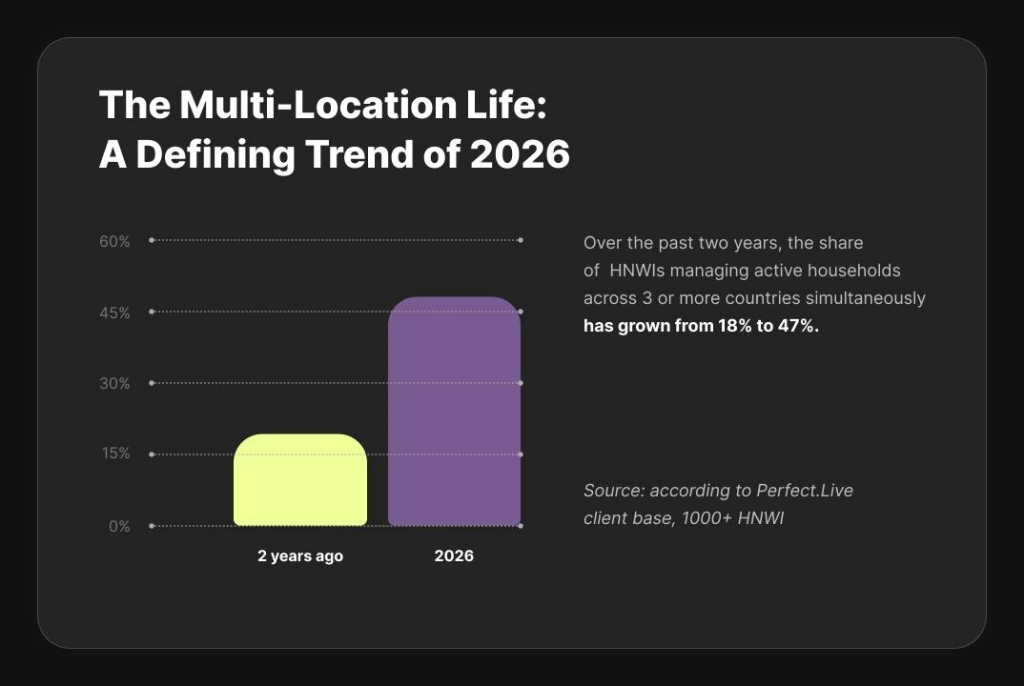
    The core finding: the primary residence is no longer one place. Nearly half of wealthy individuals now run active households in 3 or more countries simultaneously — staff, suppliers, and logistics operating in parallel across jurisdictions. 

    A record 142,000 millionaires relocated internationally in 2025, the highest figure ever recorded, and the share of Perfect.Live clients with households in 3 or more countries has grown from 18% to 47% in 2 years. That operational complexity is what drives delegation.

    When those clients outsource, 34% of all requests fall under Mobility & Speed — private transfers, jet brokerage, airport fast-track —  because time is the scarce resource. Travel planning accounts for another 27%, household and personal support for 18%. Across every category, the pattern is consistent: clients stay involved at the level of decisions and outcomes, and delegate everything in between.

    Trip patterns are shifting too: visits are getting shorter and more frequent, with clients preferring 2- or 3-day stops across several cities over single-destination stays. On the household side, wealthy families are moving away from large in-house teams toward a lean core structure supported by external partners for the recurring operational layer.

    The fastest-growing segment is corporate business travel for senior executives, with GMV now exceeding $500,000 per month, as corporations increasingly formalise concierge support as part of senior talent strategy.

    Request patterns vary by region. Eurozone clients skew toward cultural itineraries and private dining access. US clients show the highest request velocity, driven by jets, fast-track, and last-minute logistics. ME clients generate the highest average ticket per event. Asian clients show a high share of complex multi-country itineraries combining business and education-related logistics. Spend ranges from episodic delegators under $10,000 per month to HNWI clients running continuous request flow above $50,000.

    About Perfect.Live

    Perfect.Live is a 24/7 lifestyle management platform serving 1,000+ high-net-worth individuals and corporate partners across 127 countries, operating directly with private clients and as embedded infrastructure for private banks, family offices, and wealth management firms.

  • Jerome Dubrulle Is Ready for Home-Buying Season – And So Is the Detroit Michigan Market

    Detroit, MI, 24th June 2026, ZEX PR WIRE, Home-buying season in Detroit Michigan is here, and the window moves fast. Jerome Dubrulle, a Detroit Michigan-area real estate professional with deep local market knowledge, is actively working with buyers, sellers, and investors navigating one of the most competitive stretches of the year.

    April through August is peak season in Metro Detroit. There’s more inventory, showings are picking up, and families trying to close before September are getting into bidding wars with investors and relocators who’ve been watching the same listings.

    Spring (April through June) brings the widest selection of homes on the market, but also the sharpest competition. Multiple-offer situations are the norm, not the exception. Buyers who come in unprepared leave empty-handed.

    In July and August, sellers whose homes sat through spring without a deal start adjusting their prices. Demand is still there, but the market settles down enough that a prepared buyer can find value if they’ve done their homework and know where to look.

    What Jerome Brings to the Table

    Jerome is a local Michigander who leverages his market experience to benefit his clients. He understands neighborhood-level pricing, knows the difference between a listing that’s priced to move and one that’s been sitting for a reason, and helps clients figure out exactly which moment they’re operating in.

    He walks every buyer through a detailed Buyer Guide from day one, covering luxury homes, investment properties, rental listings, and everything in between. Sellers get the same attention: pricing strategy, timing, and presentation are all factored in from the start.

    From MLS coordination and home inspections to title searches and closing-day logistics, Jerome handles the details so clients can stay focused on the decision that matters.

    “Whether someone is buying their first home or adding to an investment portfolio, the goal is the same,” Dubrulle said. “Make a confident, informed decision. Not a rushed one.”

    Get in Touch

    Anyone looking to buy or sell in the Metro Detroit area this season can reach Jerome Dubrulle directly at 248-701-3526, by email at realestate@jeromedulbrulle.com, or through his website.

    About Jerome Dubrulle

    Jerome Dubrulle is a Detroit-area real estate professional serving buyers, sellers, and investors across the Detroit Michigan metro area. He specializes in residential, luxury, and investment properties, offering comprehensive market analysis, buyer and seller guidance, and hands-on support from initial consultation through closing.