Category: Finance News Network

  • Zamanat Targets GCC’s $250 Billion SME Financing Gap With Up to $100 Million Tokenized Private Credit Fund

    Dubai, UAE, September 10th, 2026, Chainwire

    Zamanat Fund CEIC Limited is the company’s first live proof point for regulated fund tokenization on ZIGChain focused on GCC private credit.

    Zamanat today announced its sponsorship of Zamanat Fund CEIC Limited (the “Fund”), a DIFC-domiciled tokenized private credit fund with a target size of up to USD 100 million. The Fund targets the GCC’s estimated $250 billion SME financing gap, with only 11 percent of SMEs across the region having access to credit.

    Closing a $250 billion structural gap in GCC SME credit

    Across the GCC, SMEs are central to economic growth yet remain significantly underserved by traditional financing. In the UAE, SMEs generate more than half of GDP and employ the majority of the private-sector workforce, yet receive less than 10 percent of total bank lending.

    The Fund will invest in private credit across the region, directing capital towards strong homegrown companies whose financing needs are not fully met through traditional lending channels. The strategy supports national ambitions to expand SME participation, private-sector growth and access to alternative financing, including priorities set out under Saudi Arabia’s Vision 2030 and the UAE Centennial 2071.

    “Strong businesses across the GCC still struggle to access growth capital despite sound fundamentals. Zamanat sponsored the Fund to create a credible route between those businesses and institutional capital. With a target size of up to USD 100 million and interests issued as Investment Tokens, it is our first live proof point for bringing GCC private credit into a regulated digital structure for Professional Clients,” said Umair Tariq, Founder and CEO of Zamanat.

    Bringing GCC private credit into digital markets

    Tokenization expands the infrastructure around traditionally hard-to-access private-market assets without changing the underlying investment or credit profile.

    The Fund combines a regional private credit strategy, a DIFC fund structure, institutional administration and digital issuance on ZIGChain. It provides a first live demonstration of how regional private credit can be brought into a DFSA-regulated tokenized structure for Professional Clients.

    The Fund is a DFSA-regulated closed-ended fund registered as an Exempt Fund and classified as a Credit Fund. It is managed by Truleum Venture Partners Limited and administered by Apex Group. Fund interests will be issued as ZM1 Investment Tokens on ZIGChain within a regulated, whitelisted environment.

    As sponsor, Zamanat brings its regional private credit, investment structuring and institutional partnership expertise to the Fund’s development. Truleum retains responsibility for all regulated fund-management activities.

    The ZM1 Investment Token structure provides a blockchain-native ownership and settlement layer within the Fund’s regulated framework. It also allows qualifying investors who meet the DFSA Professional Client criteria to participate alongside institutional investors.

    Zamanat is backed by Disrupt.com, a MENA-based, operator-led AI-native venture builder and lead investor in the business.

    Building the global market for Digital Shariah Assets

    Global Islamic finance assets are projected to reach $9.7 trillion by 2029, yet demand for digital and Shariah-aligned assets is growing faster than the institutional infrastructure connecting them with global capital.

    Zamanat continues to build the global market for Digital Shariah Assets. Its wider operating model combines investment structuring, Shariah expertise, regulated partner routes and digital distribution to bring real-world assets to market through traditional and digital channels.

    The DIFC-domiciled Fund evidences the regulated fund-tokenization, digital ownership and partner-orchestration capability within that wider build. Zamanat is progressing a separate pipeline of Digital Shariah Assets across private credit, receivables, real estate and other asset classes.

    Institutional partnerships

    Apex Group acts as Fund Administrator, providing institutional fund administration and controls from the outset.

    “Zamanat is supporting the creation of a new category in Digital Assets. Bringing institutional structure and digital distribution together within a DFSA-regulated framework sets the standard for how this market should be built, and this fund shows the model working at institutional scale. We are proud to support the infrastructure behind it, and we look forward to partnering further on the projects Zamanat already has in motion,” said Peter Hughes, Founder & CEO, Apex Group.

    The global market for Digital Shariah Assets does not yet exist as an institutional category. Zamanat is building it.

    Notes to Editors

    Sources

    LSEG and ICD, 2025 Islamic Finance Development Indicator Report, 14 October 2025 (global Islamic finance assets projected to reach $9.7 trillion by 2029); World Bank, Competition in the GCC SME Lending Markets: An Initial Assessment (estimated $250 billion GCC SME credit gap; 11 percent of SMEs with access to credit); Kearney, GCC Retail Banking Radar 2024.

    Investor notice

    This communication as related to Zamanat Fund CEIC Limited is approved by Truleum Venture Partners Limited in the DIFC (DFSA License Number: F008013).

    This release is for information only. It is not an offer, invitation or recommendation to subscribe for interests in Zamanat Fund CEIC Limited or acquire ZM1 Investment Tokens. Any participation will be made only through the Fund Manager, final offering documents and applicable Professional Client eligibility requirements. For avoidance of doubt, this communication is intended for and directed only to investors who meet the requirements to be considered Professional Clients as specified under the Dubai Financial Services Authority Conduct of Business Rulebook, Rule 2.3.3. The Fund is an ‘Exempt Fund’. Accordingly, the ZM1 Investment Tokens are available only to Professional Clients.

    This release and the information contained herein does not constitute, and is not intended to constitute, a public offer of securities in any other jurisdiction and accordingly should not be construed as such. The ZM1 Investment Tokens are only available to a limited number of investors from the DIFC. The ZM1 Investment Tokens have not been approved by or licensed or registered with any other relevant licensing authority or governmental agency. No transaction will be concluded in onshore UAE outside the DIFC.

    The Fund is not an Islamic Fund and is not marketed as Shariah-compliant. References to Shariah in this release relate to Zamanat’s broader platform and market ambition and not to the Fund.

    About Zamanat

    Zamanat is building the global market for Digital Shariah Assets. The company connects asset originators with global capital through investment structuring, Shariah expertise, regulated partner routes, tokenization and distribution across traditional and digital channels.

    Zamanat also sponsors and develops institutional investment products through appropriately licensed partners. Each product follows its own legal and regulatory framework and, where presented as Shariah-aligned, its own product-specific Shariah review and governance process. Website: www.zamanathq.com

    Contact

    Global Head of PR & Communications
    Katarzyna Kosior
    disrupt.com
    info@zamanathq.com

  • ENTRRO Launches a New Customer Acquisition Network Built Around the World’s Oldest and Most Powerful Form of Marketing: Human Recommendation

    In a world increasingly dominated by AI, algorithms and digital advertising, ENTRRO makes real-world recommendations measurable, trackable and rewarding, creating value for businesses, promoters and customers.

    United States, 10th Sep 2026 — As artificial intelligence transforms how businesses communicate, advertise and compete for attention, ENTRRO is taking a different approach: putting people back at the center of customer acquisition.

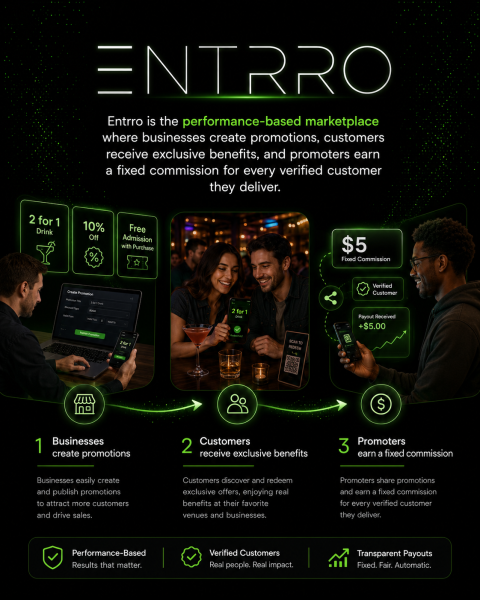
    Officially launched on September 1, 2026, following a year of development and real-world testing with partners, ENTRRO is a performance-based promotion network designed to turn everyday human recommendations into measurable customer acquisition.

    The idea is simple.

    People recommend restaurants, bars, clubs, events, experiences and local businesses every day. They tell friends, guests and clients where to eat, where to go, what to try and what is worth experiencing.

    Until now, much of that influence has been invisible and difficult to measure.

    ENTRRO digitalizes it, tracks it and rewards it.

    Human Influence, Now Trackable

    Businesses spend enormous amounts of money competing for attention through social media advertising, search ads, radio, billboards, influencers and other marketing channels.

    At the same time, consumers are surrounded by advertisements, sponsored content, notifications and promotional messages all competing for the same few seconds of attention.

    ENTRRO approaches the problem from the opposite direction.

    Instead of paying for attention, businesses can pay for customers.

    A business creates an offer and determines its rules, limits and promoter payout. A promoter shares that offer with someone they believe will genuinely enjoy the business. The customer receives the digital promotion, visits the participating venue and redeems it.

    The transaction is verified and tracked, and when the required conditions are satisfied, the promoter earns a commission.

    The journey can be summarized in four words:

    Share- Scan – Show – Earn

    Rather than asking businesses to purchase exposure and hope it eventually produces revenue, ENTRRO is designed around measurable real-world outcomes.

    Three Participants. One Ecosystem.

    ENTRRO was built around a simple principle: a sustainable network works best when everyone involved receives value.

    The customer wins by discovering businesses, experiences and promotions through people they meet, know or trust while receiving an incentive to try something new.

    The promoter wins by turning something they already do naturally—recommending places and experiences—into an opportunity to earn money. Recommendations, redemptions and earnings can be tracked transparently.

    The business wins by gaining a customer acquisition channel tied to measurable activity rather than simply purchasing impressions, clicks or potential awareness.

    That alignment is what makes ENTRRO different.

    The company isn’t trying to replace human interaction with another algorithm. It is using technology to make human interaction more valuable.

    Why Human Recommendation Matters in the Age of AI

    Artificial intelligence is making it easier and less expensive than ever to generate advertisements, images, videos, emails and promotional content at enormous scale.

    As the volume of digital content grows, authentic human recommendations may become even more valuable.

    A recommendation from a bartender, hotel employee, rideshare driver, concierge, hospitality professional, local personality, friend or someone who genuinely knows a city can carry context and credibility that mass advertising often struggles to reproduce.

    Human recommendation has existed for thousands of years. What has been missing is the infrastructure to attribute it, verify it and reward it at scale in a digital world.

    That is the problem ENTRRO was created to address.

    From Marketing Expense to Customer Acquisition

    Traditional advertising can generate awareness, but connecting that exposure directly to paying customers can be difficult.

    ENTRRO introduces a different model.

    Businesses establish the offer, qualifying conditions, campaign limits and promoter compensation in advance. Promotions are shared digitally and verified when customers arrive and redeem them.

    This creates a transparent connection between:

    Recommendation – Customer – Redemption – Revenue – Reward

    The potential extends far beyond conventional influencer marketing.

    You don’t need millions of followers to influence someone’s decision. A hotel employee recommending a restaurant, a rideshare driver suggesting a nightclub, a bartender recommending a late-night venue, or a local resident telling visitors where to go can all influence purchasing decisions.

    These interactions already happen every day in cities around the world.

    ENTRRO’s vision is to build the infrastructure connecting those recommendations to measurable business results.

    Local Connections. Real Rewards.

    ENTRRO began its rollout in New Orleans, where businesses and promoters are joining the network, and the company has begun expanding its presence into Las Vegas and Miami.

    The ambition is much larger: a global network where anyone capable of making a meaningful recommendation can potentially participate in the customer acquisition economy and businesses of all sizes can create promotion programs around measurable results.

    In an increasingly automated world, ENTRRO is making a bet on something fundamentally human:

    People trust people.

    Technology shouldn’t eliminate that connection.

    It should make the connection measurable, scalable and rewarding.

    ENTRRO, The Smart Promotion Network

    Share. Scan. Show. Earn.

    Local Connections. Real Rewards.

    Website: https://entrro.com
    Facebook: https://www.facebook.com/search/top?q=entrro.business
    Instagram: https://www.instagram.com/entrro.business

    Media Contact

    Mark Calhoun
    Sales Director
    ENTRRO
    Press C Media Relations
    Email: hello@entrro.com

    Media Contact

    Organization: Entrro

    Contact Person: Mark Calhoun

    Website: https://entrro.com

    Email: Send Email

    Contact Number: +15046156955

    Country: United States

    Release id: 48968

    The post ENTRRO Launches a New Customer Acquisition Network Built Around the World’s Oldest and Most Powerful Form of Marketing: Human Recommendation appeared first on King Newswire. This content is provided by a third-party source.. King Newswire makes no warranties or representations in connection with it. King Newswire is a press release distribution agency and does not endorse or verify the claims made in this release. If you have any complaints or copyright concerns related to this article, please contact the company listed in the ‘Media Contact’ section

    file

  • Alessio Vinassa Unveils an Emerging Technology Investment Approach Shaped by Financial Challenges

    Dubai, United Arab Emirates, September 10th, 2026, Chainwire

    Tech entrepreneur and angel investor Alessio Vinassa today announced the expansion of his investment framework focusing on the convergence of artificial intelligence and cybersecurity, applying strategic risk-mitigation model lessons derived from managing high-pressure financial turnarounds to emerging enterprise technologies. Before he began investing across artificial intelligence, cybersecurity, Web3 and innovative finance, he faced a financial collapse that changed how he understood risk.

    Alessio reached a point where approximately €180,000 was due while only about €2,200 remained in his bank account. The situation left him facing the possibility of bankruptcy and forced him to confront the consequences of growth without sufficient protection, diversification or structural discipline.

    The experience became more than a difficult chapter in his entrepreneurial career. It influenced how he would later evaluate businesses, support founders and approach emerging technology.

    Today, Alessio has more than fifteen years of operating and investment experience and has backed more than 40 ventures across cybersecurity, artificial intelligence, Web3 and innovative finance. His current work reflects a strategic reality that businesses can no longer afford to ignore artificial intelligence and cybersecurity are becoming increasingly intertwined.

    Artificial intelligence is changing how companies interpret information, automate work and make decisions. Each capability can also introduce another form of dependence. Systems require access to data. Automated tools may influence customer interactions, financial activity and internal operations. The more authority companies give these technologies, the more important security, transparency and accountability become.

    For Alessio, this is where innovation must meet discipline.

    “AI should amplify executive judgment, not replace it,” he says.

    Technology can increase speed and capability, but leaders remain responsible for determining how that capability should be used, which risks are acceptable and where human oversight must remain.

    Cybersecurity provides part of the foundation for that trust. As artificial intelligence becomes embedded in important business processes, security extends beyond protecting networks from external threats. Companies must also understand who can access information, how automated actions are monitored and what happens when a system produces an unexpected result.

    Businesses that address these questions early may be better positioned to earn the confidence of customers, investors and commercial partners. Those that treat security as an addition after adoption risk allowing operational exposure to grow alongside their success.

    Alessio’s technology and investment perspective was shaped by learning what can happen when momentum is mistaken for stability. His financial collapse revealed that creating value and protecting it require different capabilities. A company may appear successful while becoming increasingly dependent on favourable conditions, concentrated decisions or systems that have not developed at the same rate as its growth.

    The same lesson applies to emerging technology. A product can attract attention and investment before proving that it can operate securely, respond to failure or sustain customer trust.

    Alessio evaluates opportunity through more than technical novelty. His approach considers whether a technology addresses a meaningful problem, whether customers can adopt it consistently and whether the company has the governance required to support expansion. In his published investment commentary, he has identified cybersecurity, artificial intelligence governance, identity solutions and enterprise automation as areas where technology is addressing essential infrastructure needs.

    The leadership teams behind these products are equally important. Alessio has spoken about the value of founders who can identify where their businesses are exposed, explain how their systems will respond under pressure and recognise which evidence would require them to change direction.

    “Good governance makes companies faster, not slower,” Alessio says.

    Governance is sometimes treated as a restriction on innovation. Alessio views it as the structure that allows innovation to scale responsibly. Clear decision rights, reliable reporting and defined accountability enable companies to move without depending on one person to resolve every issue.

    This perspective has particular relevance as businesses adopt artificial intelligence at increasing speed. Competitive pressure can encourage companies to introduce tools before they fully understand the information those tools access or the decisions they influence.

    Alessio does not argue that innovation should slow by default. His position is that speed becomes commercially valuable only when the systems supporting it can be trusted. The objective is not to eliminate every possible risk. It is to understand exposure before customers, employees and operations become dependent on the technology.

    His progression from financial collapse to investing across emerging technology also informs his broader work on leadership. The lesson was not simply that an entrepreneur can recover after losing money. Recovery became meaningful because it changed the structures and decisions that followed.

    Alessio is developing these ideas further in his book, No One Is Coming: The Mental Operating System for Leaders Under Pressure. The book examines how founders, executives and operators make consequential decisions when certainty is unavailable and responsibility cannot be transferred to someone else.

    As artificial intelligence and cybersecurity continue to converge, that responsibility will extend beyond technology teams. Investors will need to examine the security behind innovation. Boards will need to understand the systems on which their organisations depend. Founders will need to build trust as deliberately as they build capability.

    The €180,000 turning point gave Alessio’s investment philosophy a personal foundation. It taught him that unmanaged exposure can remain hidden while confidence is high and growth is still visible. His work today applies that lesson to a new technological era: innovation creates lasting value only when the structures protecting it are built to endure.

    About Alessio Vinassa

    Alessio Vinassa is an entrepreneur, angel investor, technology builder and author with more than fifteen years of experience across cybersecurity, artificial intelligence, Web3, innovative finance and business leadership. He has backed more than 40 ventures and works with founders and executives on investment, strategy, organisational development and leadership under pressure. He operates between the UAE and Europe.

    Contact

    Alessio Vinassa
    info@alessiovinassa.io

  • Jeremy Packman: Before Adding Another School Program, Fix the System You Already Have

    • California education leader Jeremy Packman says schools should examine implementation, ownership, and existing workflows before assuming another program will solve an old problem.

    SANTA ROSA, Calif., Sep 10, 2026, ZEX PR WIRE — When a school faces a persistent problem, the response can be predictable: find a new program.

    A new behavior framework is introduced. A new intervention is launched. Staff attend professional development training. New procedures are added to calendars and meetings. For a while, the initiative receives attention. Then daily demands take over, implementation becomes uneven, lacking fidelity, and another solution eventually takes its place.

    After 25 years working in public education, Jeremy Packman believes school leaders should challenge that cycle.

    “Before adding something new, I want to know why what we already have isn’t working,” Packman said. “Is the program actually the problem, or did we never create the structure needed to implement it consistently?”

    For Packman, the distinction matters. Schools can have strong ideas on paper and still struggle to turn them into everyday practice.

    New Programs Cannot Fix Unclear Systems

    Packman has worked as a teacher, assistant principal, principal, and Administrator on Special Assignment. Across those roles, he has seen how school improvement efforts can become harder to sustain when responsibilities are unclear.

    A program may require a true cycle of inquiry, with teachers to document interventions, administrators to review progress, specialists to provide support, and teams to meet regularly. If nobody knows exactly who owns each step, or if each participant isn’t following the program with fidelity, the program can quickly become another item competing for attention.

    “One of the first things I look for is ownership,” Packman said. “If five people are involved but nobody can tell me who is responsible for the next step, that’s where I expect the process to break.”

    He encourages leaders to map existing workflows before purchasing a new product or introducing another initiative. Who starts the process? Who follows up? Where is progress recorded? How often is it reviewed? What happens when something is missed?

    Those questions are basic by design.

    “You can have an impressive program and still have a weak process underneath it,” he said. “Adding another layer doesn’t repair the foundation.”

    Initiative Overload Has an Operational Cost

    New initiatives also compete with existing responsibilities. “I remember taking over a principal position, and in my first week I was directed to apply three new initiatives before I even walked in the door”. This level of change was overwhelming for the staff and led to major concerns with my leadership approach

    Teachers still have lessons to prepare. Administrators still have student and staff issues to address. Support teams still have meetings, interventions, and follow-ups to manage.

    Every addition asks people to divide their attention further.

    Packman believes leaders should therefore ask what will be removed when something new is introduced, and why.

    “If you’re asking staff to start doing three new things on Monday, what are you telling them they can stop doing?” he said. “If the answer is nothing, you’re not really prioritizing. You’re just adding. Instead, a good administrative approach would be to see how any new initiative can be built into what teachers are already doing. This requires adding teaching voice to the decision process”

    Packman’s preference is to simplify first.

    “I’d rather find the point where the process breaks than throw out the entire process,” Packman said. “Sometimes the fix is a clearer handoff, a shared tracker, or a meeting that actually ends with someone owning the next action.”

    This reflects a broader principle in his leadership approach: implementation deserves as much attention as planning.

    An initiative does not become part of a school’s culture because it appears in a presentation. It becomes part of the culture when people understand it, use it consistently, and know what to do when it stops working.

    School Leaders Should Ask Better Questions Before Saying Yes

    Packman suggests that leaders pressure-test new initiatives before introducing them.

    What specific problem is this supposed to solve? Is there evidence that the existing approach has failed, or has it simply been implemented inconsistently? What type of data is being used as evidence, and Who will own the new work? How will staff know whether it is working? What existing responsibility can be removed to make room for it?

    There is another question that can be harder for leaders to ask: Do we need something new at all?

    Schools operate in an environment where improvement is often associated with addition. A new initiative can feel like visible action. Fixing an existing workflow can appear less ambitious.

    Packman argues that the less exciting option may sometimes produce the better result.

    “There’s nothing flashy about getting the same basic process right every week,” he said. “But consistency is what makes a system dependable.”

    Better Implementation Starts With Listening

    Packman’s approach does not mean schools should resist change. His career has required him to lead through significant change, including school closures and reopening during COVID-19.

    Instead, he argues for more disciplined change.

    He has described active listening as central to his leadership style. That becomes especially important before asking educators to adopt something new.

    Teachers and support staff often know where an existing process is failing because they work inside it every day. That said, they may still be very resistant to the change. Their experience can reveal unnecessary steps, conflicting expectations, duplicated work, and responsibilities that were never clearly assigned.

    “You have to meet people where they are,” Packman said. “If you’re changing a system, understand what people are already doing before you tell them what they need to do next.”

    That does not mean every concern should stop an initiative. It means implementation should reflect the environment in which the initiative must survive.

    About Jeremy Packman

    Jeremy Packman is a California-based Administrator on Special Assignment with 25 years of experience in public education, including 14 years in school leadership. His background includes classroom teaching and administrative leadership, with experience in student services, MTSS, restorative practices, special education systems, and education law. His work focuses on building practical systems that create clearer expectations, stronger follow-through, and better support for students, families, and educators. Learn more at JeremyPackman.com.

  • Crown Care NEMT Launches Nationwide Private Pay Medical Transportation with Two-Hour Booking Confirmation

    Crown Care NEMT has launched private pay non-emergency medical transportation across all 50 states, with online booking, two-hour confirmation, and wheelchair, stretcher and long-distance interstate service available without Medicaid or insurance authorization.

    FL, FL, United States, 10th Sep 2026, Grand Newswire – Crown Care NEMT today announced the nationwide availability of its private pay non-emergency medical transportation service, now operating across all 50 states with an online booking system that returns confirmed vehicle and driver details within two business hours.

    The service operates entirely outside the Medicaid and insurance billing model. Patients and families book directly, receive a quote before the ride is confirmed, and are not required to obtain prior authorization or work through a transportation broker. Bookings are submitted through a three-step online form or by phone, and a coordinator responds with vehicle assignment, driver name, license plate and a direct dispatcher line.

    Crown Care NEMT Launches Nationwide Private Pay Medical Transportation with Two-Hour Booking Confirmation

    Non-emergency medical transportation covers scheduled trips that do not require an ambulance: dialysis appointments, chemotherapy sessions, hospital discharges, outpatient procedures, specialist follow-ups and long-distance transfers between medical facilities. The private pay segment of this market serves patients who do not qualify for Medicaid transportation benefits, patients whose plans do not cover the trip type they need, and families coordinating care for a relative in another state.

    “Families arranging medical transportation are usually doing it during an already difficult week,” said CEO Mario Lee of Crown Care NEMT. “The two-hour confirmation standard exists because a patient with a dialysis appointment on Thursday cannot wait until Wednesday night to learn whether a vehicle is coming. Removing the authorization step is what makes that timeline possible.”

    Crown Care NEMT operates four vehicle categories: ambulatory sedans and SUVs for patients who can transfer independently, wheelchair-accessible vans with hydraulic lifts and securement systems, stretcher transport for patients who must remain recumbent, and long-distance interstate service for transfers to specialty medical centers. All service is door-to-door, with drivers assisting patients between the residence entrance and the vehicle.

    The company reports that long-distance interstate transport represents a growing portion of its bookings, driven by patients traveling to nationally ranked specialty centers including facilities in Rochester, Minnesota; Cleveland, Ohio; Houston, Texas; and Baltimore, Maryland. These trips typically fall outside standard Medicaid transportation coverage, which is generally limited to in-state travel to the nearest qualified provider.

    Alongside statewide coverage, Crown Care NEMT has published city-level service information for metropolitan areas including Chicago, Minneapolis, Indianapolis and Detroit, listing local hospital systems and the vehicle types available in each market.

    Service is available 24 hours a day, seven days a week. Same-day rides are frequently available in major metropolitan areas. Patients receive a firm quote before any ride is confirmed, and booking information is not shared with brokers or third parties.

    Booking and coverage details are available at crowncarenemt.com. Reservations can also be made by phone at +1 518 666 6222.

    About Crown Care NEMT
    Crown Care NEMT is a private pay non-emergency medical transportation provider operating in all 50 states. The company provides ambulatory, wheelchair-accessible, stretcher and long-distance interstate medical transport on a direct-pay basis, without Medicaid or insurance billing. More information is available at https://crowncarenemt.com.

    Media Contact

    Organization: Crown Care NEMT

    Contact
    Person:
    Mario Lee

    Website:

    https://crowncarenemt.com

    Email:

    info@crowncarenemt.com

    City: FL

    State: FL

    Country:United States

    The post Crown Care NEMT Launches Nationwide Private Pay Medical Transportation with Two-Hour Booking Confirmation
    appeared first on Grand Newswire.
    It is provided by a third-party content provider. Grand Newswire makes no
    warranties or representations in connection with it.

  • AI Labs Integrates Google’s Gemini into AIV Chatbot to Launch Next-Generation Investment Analytics Platform

    SINGAPORE – 10/09/2026 – (SeaPRwire) – Singapore-based AI Labs, a subsidiary of Web3 education pioneer Academic Labs, today announced that it has integrated Google’s Gemini AI into its flagship AIV Chatbot.

    The upgrade positions AIV as an advanced, structured investment analytics tool designed to simplify research across cryptocurrencies like Bitcoin and Ether, as well as tech giants including Nvidia and SpaceX. AIV allows users to ask simple questions about assets such as Bitcoin and Ether, as well as technology companies such as Nvidia and SpaceX. It then organizes responses around market outlook, technical analysis, fundamentals and risk, presenting the results in a format resembling a concise research note rather than simply generating “buy” or “sell” signals.

    The approach is intended to give users a more structured way of thinking about investment decisions.

    AIV is able to break an investment portfolio down into different sources of risk and return, distinguish between established assets and higher-growth exposures, and examine how seemingly different investments may become correlated during periods of market stress.

    For technology equities, the same framework can be used to distinguish between areas such as AI infrastructure, cloud computing and consumer platforms, while setting out the main upside and downside cases.

    The analytics platform is also designed to go beyond identifying potential returns. AIV can frame an investment thesis in terms of the assumptions on which it depends and highlight the conditions that would challenge those assumptions. Key price levels, changes in fundamentals or other “invalidation” scenarios can therefore provide investors with a clearer indication of when an investment view should be reconsidered.

    Google’s Gemini is central to the platform’s potential. Google’s AI models can work across text, images, video, audio and code, while connecting with current information and interacting with external tools.

    Applied to AIV, these capabilities will allow the Chatbot to analyze earnings releases, retrieve market data, examine charts and tokenomics documents, calculate portfolio exposures, and explain the results in a conversational format that is easy to understand.

    Over time, as the technology matures, Gemini could enable investors to upload financial documents or charts for analysis, compare risks across assets, and identify developments that challenge an existing investment thesis. This would move the Chatbot closer to becoming an interactive investment research assistant.

    “Investors are surrounded by a wealth of information, but information on its own does not create clarity,” said Ryan Chi, CEO and founder. “AIV is being built to help users connect the signals that actually matter.”

    Kingston Kwek, an advisor to AIV, said the key objective is to make sophisticated investment analytics traditionally associated with professional investors more accessible to a broader audience by tapping Gemini’s extensive analytical capabilities, especially since Gemini has achieved global adoption with hundreds of millions of users worldwide.

    If AIV can pair Gemini’s ability to summarize and organize information with transparent sources, clear risk controls and plain-language explanations, it could become a powerful research tool for investors navigating the growing overlap between crypto, artificial intelligence and technology equities.

    Media Contact

    Company: AI Labs

    Contact: Media Team

    Email: ryan@academic-labs.org

    Website: https://ai-labs.live/

  • Strata Maker Launches a Pons Volume Bot to Get Pons Launchpad Tokens Noticed

    Strata Maker has launched a Pons volume bot built to solve the first problem every new launch runs into: a token that nobody can see. The service routes real buy and sell orders into a Pons token’s own liquidity pool on Robinhood Chain, lifting the pair on the screeners and charts so that ordinary traders browsing the launchpad actually notice it. It is available now at www.stratamaker.com.

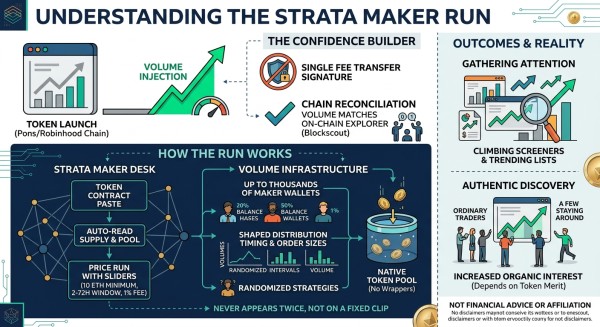
    Tokens minted on the Pons launchpad often sit with a flat chart in their first hours, and a flat chart reads as dead to anyone who lands on the pair. Strata Maker is aimed squarely at that window. Rather than posting numbers to a dashboard, it places genuine swaps into the token’s live pool on Robinhood Chain, so the activity shows up on-chain and in the aggregators where discovery actually happens.

    What the tool does not ask for is as much the point as what it does. Running a campaign involves a single signed transfer to cover the fee, and nothing else. There is no token approval, no spending allowance, and no contract call against the user’s token, which is the specific reason the tool cannot touch a creator’s supply. Users connect a standard EVM wallet such as MetaMask, Coinbase Wallet, Trust or Rainbow, sign once, and the run begins.

    The volume itself is carried by a rotating fleet of funded maker wallets, up to several thousand in a single run. Each wallet touches the pair only a handful of times before it retires for good, so an address that appears in one campaign never shows up in another. Combined with timing drawn from a shaped distribution and order sizes that never repeat, the result is a tape that reads like genuine trading rather than a bot firing on a fixed interval. Because the record of how the volume arrived is the part anyone reviewing a pair actually looks at, that realism is treated as a core feature, not a finishing touch.

    Every fill lands in the token’s own pool from the first order to the last, with no wrapper, no mirror and no stand-in venue. When a run closes, Strata Maker reconciles the delivered volume against Blockscout, the chain’s own explorer, so the figure it reports and the figure a user can count on-chain are the same. If a run ever lands short of the target that was paid for, the difference is returned to the paying wallet automatically, without a support ticket.

    Setup is deliberately minimal. There is no account to create and no dashboard tree to learn. A user pastes a token contract, and Strata Maker reads the name, symbol, supply and pool address straight off the chain rather than depending on a third-party index. The engine confirms the token was minted on Pons, prices the run live as the user moves the sliders, and takes a single transfer when the configuration is set. The pricing is a flat one percent of the volume routed, paid once before anything starts, with a minimum run of 10 ETH and windows that range from two hours to three days.

    The service is scoped to a single launchpad on purpose. Because the engine only has to understand Pons, its venue resolution and pacing are tuned to how Pons tokens behave rather than generalised across chains, and it declines any token that was not minted on Pons instead of handling it poorly. It is a purpose-built piece of volume infrastructure, not a catch-all tool wearing a Pons label.

    Strata Maker is also plain about the boundary of what routed volume can do. It moves a pair up the screeners, the trending lists and the charts people scan, which is exactly the attention a fresh Pons launch lacks. It does not manufacture buyers, and the company states as much on its own site. The honest use of the tool is to get a real launch seen, on top of a token that gives people a reason to stay once they arrive. Strata Maker notes that it is an independent tool, not affiliated with or endorsed by Pons, Ponsfamily or Robinhood Markets, and that nothing it publishes is financial advice.

    Strata Maker is available now at www.stratamaker.com, where a run is priced in front of the user before any transfer is made.

    Media Contact

    Organization: Strata Maker

    Contact Person: Clementine Lehner

    Website: https://www.stratamaker.com/

    Email: Send Email

    Country: United States

    Release id: 48951

    The post Strata Maker Launches a Pons Volume Bot to Get Pons Launchpad Tokens Noticed appeared first on King Newswire. This content is provided by a third-party source.. King Newswire makes no warranties or representations in connection with it. King Newswire is a press release distribution agency and does not endorse or verify the claims made in this release. If you have any complaints or copyright concerns related to this article, please contact the company listed in the ‘Media Contact’ section

    file

  • RavenDB Launches Quill to Bring Production AI Agents to Enterprise SQL Systems, No Migration Required

    Hadera, Israel, September 8th, 2026, TechnologyWire

    The new context layer connects to existing SQL databases and builds a governed, model-agnostic foundation for AI agents running on live operational data, in weeks rather than years.

    RavenDB, a NoSQL document database used by more than 12,000 customers, today announced the launch of its new product, Quill, a context layer for SQL databases that makes them ready for production AI agents without migrating the system of record or architecting a custom AI stack. 

    With AI becoming a board-level mandate, CTOs and VPs of engineering are under pressure to ship AI capabilities fast. But for organizations whose mission-critical data sits in legacy SQL systems, built years before embeddings or agents existed, AI can’t access their data. Modernizing or replacing the systems is expensive, risky, and time-consuming. By the time the system is updated, nobody remembers what the project was supposed to achieve or how ROI was measured.

    Recently, a Gartner survey of infrastructure and operations leaders found that one in five AI initiatives fail, and only 28% report a positive ROI, which is linked to how well the technology is integrated, governed, and aligned with operational needs, not to the sophistication of the model. As AI becomes the industry standard, organizations have been left without a clear path to deliver, until now. 

    “Anyone can stand up an AI demo in an afternoon, but getting that demo into production with data pipelines, semantic search, security, governance, all the plumbing a small proof of concept doesn’t need until it has to run at scale, is the hard part,” said Oren Eini, founder and CEO of RavenDB. “Quill exists because we’d rather hand teams that plumbing already assembled than watch them rebuild the same project after project. You get access to the live data you need, decide the scope on day one, and change it as you go, instead of building everything from scratch.” 

    Quill connects directly to an organization’s existing SQL database and puts a context layer on top of it, making it possible to launch production-ready agents in weeks rather than the 18 to 24 months of a typical in-house build. The source system stays exactly where it is and remains authoritative, and the full AI stack, search, retrieval, and agents that can answer questions, are included. Agents built on Quill support web chat, WhatsApp, Telegram, Slack, and Discord out of the box.

    “With Quill, the plumbing was already there, so we spent our time building the actual feature,” said Hagay Albo, CEO at Albos Technologies and Holdings, an early adopter of Quill. 

    By default, Quill is governed, sitting between the AI and the source system, and it is built on the assumption that the model itself cannot be trusted with unrestricted access, so organizations decide exactly what an agent can and cannot see, independent of the source database’s own permissions. In a healthcare setting, for example, an agent can answer a patient’s question about an upcoming appointment, while prescription data is never part of the dataset it can query. What is usually a custom security project becomes a configuration choice. Quill is also model-agnostic, so teams can use any AI model, switch providers, or run entirely on their own hardware. 

    Quill is now available for organizations running PostgreSQL, SQL Server, or MySQL, with more databases to be supported in the future, and can be deployed in the cloud or on-premises to meet data-residency or regulatory requirements. 

    To start using Quill today, visit: https://ravendb.net/quill

    About RavenDB:

    RavenDB is a hybrid NoSQL document database built for modern application development. Used by more than 12,000 customers across 50 industries, RavenDB helps teams move faster with seamless data management across cloud, on-prem, and edge environments. With full-text search, automatic indexes, and an easy-to-use studio for monitoring and administration, RavenDB is the database developers love and enterprises trust.

    Learn more at www.ravendb.net

    Contact

    Shahni Ben-Haim
    SBH Media Relations
    shahni@sbhmedia.com

  • Global Multi-Asset Broker FP Markets Secures UAE CMA Category 5 Licence

    Limassol, Cyprus, September 9th, 2026, FinanceWire

    Global multi-asset Forex and CFD broker FP Markets has been granted a Category 5 Licence by the UAE’s Capital Market Authority (CMA), formerly the Securities and Commodities Authority (SCA), adding to the Australian-founded broker’s global regulatory footprint and marking a strategic step into the UAE market. 

    The licence, held by group entity FP Markets MENA Securities L.L.C. S.O.C., permits the broker to carry out marketing, promotional, and client introduction activities in Dubai and across the Emirates. In recent years, the UAE has drawn growing numbers of brokers, fintechs, and financial services providers looking to operate on more solid regulatory ground as they build out their regional client base. 

    John Lewis, FP Markets Chief Marketing Officer, stated: ‘Securing a CMA licence is part of FP Markets’ longer-term approach to regulation. Over the past 20 years, each licence we’ve added has built toward the multi-regulated presence we operate today, and the UAE is a natural next step in that. For our clients and partners, this means added security, transparency, and quality of service.’   

    The licence also underpins a more direct regulatory relationship within the UAE market, on top of FP Markets’ existing multi-jurisdictional oversight. FP Markets holds licences across multiple leading jurisdictions including: the Australian Securities and Investments Commission (ASIC), the Financial Services Authority (FSA) in Seychelles, the Financial Sector Conduct Authority (FSCA) of South Africa, and the Capital Markets Authority (CMA) of Kenya.

    FP Markets will continue to expand its regulatory coverage across markets, in conjunction with ongoing investment in its trading infrastructure, technology, and support functions, ensuring that the pace of regulatory growth is matched by the award-winning quality of service the broker offers to clients and partners alike. 

    About FP Markets

    FP Markets is a global, multi-regulated, award-winning broker established in Sydney, Australia in 2005. The broker offers 10,000+ CFD instruments across seven asset classes, available on industry-leading platforms including MetaTrader 4/5, TradingView, and cTrader. 

    FP Markets’ regulatory presence includes the Australian Securities and Investments Commission (ASIC), the Financial Services Authority (FSA) in Seychelles, the Financial Sector Conduct Authority (FSCA) of South Africa, and the Capital Markets Authority (CMA) of Kenya.

    For more information, users can visit www.fpmarkets.com

    Contact

    CMO
    John Lewis
    FP Markets
    j.lewis@fpmarkets.com

  • Spyder Moving and Storage launches a 30-day challenge for stress-free relocations

    Mississippi, USA, Sep 09, 2026, ZEX PR WIRE — Most people wait too long to start packing. Spyder Moving and Storage, based in Oxford, Mississippi, says the biggest source of moving day stress is not the move itself. It is the four weeks before it.

    Vladyslav Ladygin, owner of Spyder Moving and Storage, built the company around the idea that a move goes smoothly when the plan is broken into small pieces instead of one big weekend scramble. The 30-day challenge is the company’s attempt to put that thinking into a format anyone can follow, whether they hire movers or not.

    “A move feels overwhelming when it’s one giant task,” Ladygin said. “It stops feeling that way once you break it into thirty small ones.”

    What the challenge covers

    The plan runs in four blocks, each covering about a week:

    Days 1 to 7: Sort and decide. Go room by room and separate items into keep, donate, and toss. Spyder Moving and Storage recommends starting with closets and garages, since those tend to hold the most items nobody has touched in a year.

    Days 8 to 14: Gather supplies and set a budget. This includes boxes, tape, and padding, along with a firm number for what the move should cost. The company suggests getting a written estimate early so there are no surprises later.

    Days 15 to 21: Pack the rooms used least. Guest rooms, storage areas, and seasonal items go first. Kitchens and bedrooms wait until closer to moving day, since those stay in use the longest.

    Days 22 to 30: Confirm logistics and pack the essentials. This is the week to confirm the moving date, arrange parking or elevator access, and pack a separate bag with the things needed for the first night in the new place.

    Built from the company’s own jobs

    Spyder Moving and Storage says the plan reflects patterns the company sees on actual moves, not a generic template. Every step in the plan maps to a problem the company has run into on jobs: families who packed the kitchen too early and had nowhere to cook, or households that waited until the last week to start and ran out of boxes.

    The company plans to publish the full day-by-day checklist through its channels so households can follow along without needing to hire a mover first. Ladygin said the goal is for the plan to work whether Spyder handles the move or a family does it themselves.

    “We built this company to make moving less stressful,” Ladygin said. “That doesn’t have to depend on whether someone books us.”

    A plan for local families too

    Spyder Moving and Storage works with households across Oxford and the surrounding area, and the company says the same 30-day approach applies to local moves as well as longer ones. A move across town still benefits from the same early sorting and early packing, even if the truck ride is short.

    The company also supports several local and regional causes, including Move for Hunger, pet shelters, and the Denver Children’s Foundation, and treats the 30-day plan as part of the same idea: give people a clear, usable resource rather than a vague promise.

    How to follow along

    Spyder Moving and Storage will share the checklist in stages over the next month, timed to match the four blocks of the plan. Households that want to start now can begin with the sort-and-decide phase, since that step works no matter when moving day falls.

    The company said it built the plan to be simple enough to start today and specific enough to actually follow through day 30.

    To read more, visit the website here.

    About Spyder Moving and Storage

    Spyder Moving and Storage is a moving and storage company based in Oxford, Mississippi. It was founded and is owned by Vladyslav Ladygin, a graduate of William Carey University in Hattiesburg, Mississippi. The company serves local and long-distance moves and supports several community and charitable organizations, including Move for Hunger and the Denver Children’s Foundation.